Preview AR preview Buy Hand Made Painting Switch to Digital Image Send
Details Guide Add to favorites Download Similars X-Ray Diaporama Q&A Stats

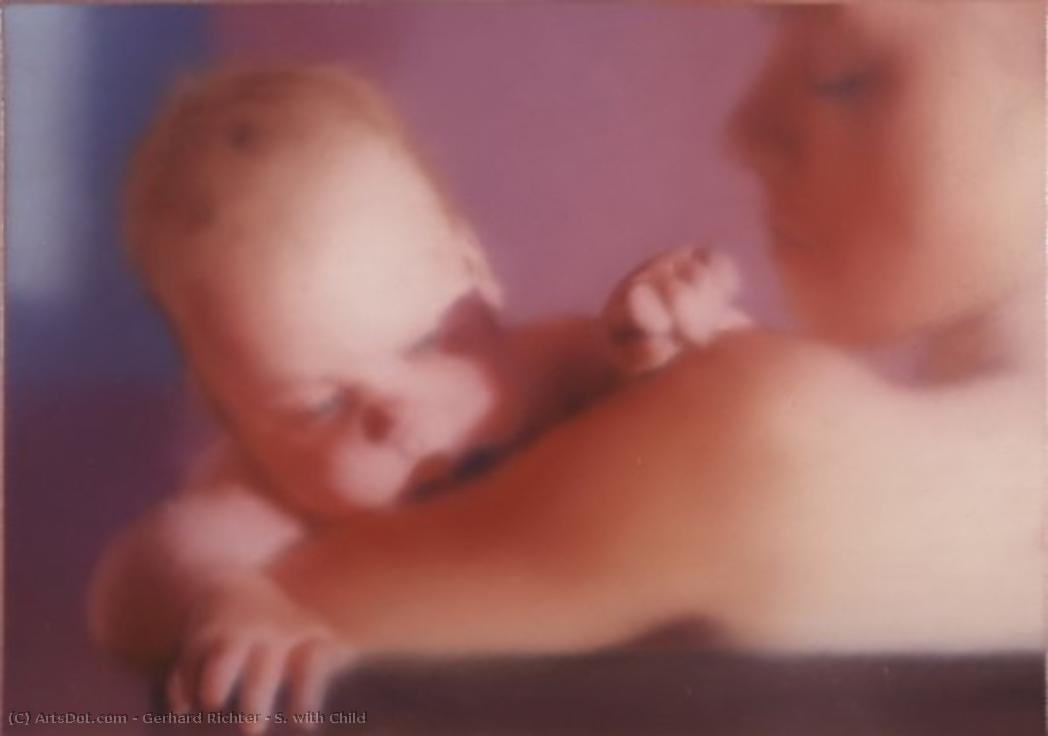
S. with Child

Gerhard Richter’s "S. with Child" (1995) is a poignant photographic study of a newborn, rendered in warm tones & subtle realism. Explore this intimate work by a renowned artist.

Explore Gerhard Richter's art (b. 1932): abstract & photorealistic paintings, 'Capitalist Realism', color charts & more. A leading German artist influencing contemporary art.

The artwork displayed on this page is protected by copyright law, which means we cannot legally create or sell an identical reproduction. This protection is enforced under international agreements such as the Berne Convention and by national laws, including those outlined by the U.S. Copyright Law - Title 17.

This method fully complies with copyright regulations because it does not involve copying or duplicating the protected artwork. Instead, it is a creative reinterpretation - a new painting that is influenced by the original but not identical to it.

Giclée / Art Print

Museum-quality giclée or canvas print with fast production and flexible finish options. ( Buy Hand Made Painting Switch to Digital Image)

Corner sample of the P118B picture frame: moulded polystyrene, 5 cm wide and 3 cm thick
P118B $10
Corner sample of the P118H picture frame: moulded polystyrene, 5 cm wide and 3 cm thick
P118H $10
Corner sample of the P118W picture frame: moulded polystyrene, 5 cm wide and 3 cm thick
P118W $10
Corner sample of the P438Z picture frame: moulded polystyrene, 5.5 cm wide and 3.5 cm thick
P438Z $10
Corner sample of the P508JH picture frame: moulded polystyrene, 7 cm wide and 3.5 cm thick
P508JH $12
Corner sample of the P508YH picture frame: moulded polystyrene, 7 cm wide and 3.5 cm thick
P508YH $12
Corner sample of the P805H picture frame: moulded polystyrene, 5 cm wide and 3.5 cm thick
P805H $10
Corner sample of the P805Z picture frame: moulded polystyrene, 5 cm wide and 3.5 cm thick
P805Z $10
Corner sample of the P919BZ picture frame: moulded polystyrene, 7 cm wide and 3.5 cm thick
P919BZ $10
Corner sample of the P919G picture frame: moulded polystyrene, 7 cm wide and 3.5 cm thick
P919G $10
Corner sample of the P919XJ picture frame: moulded polystyrene, 7 cm wide and 3.5 cm thick
P919XJ $10
Corner sample of the P959ZH picture frame: moulded polystyrene, 5 cm wide and 3 cm thick
P959ZH $10
Corner sample of the P968JZ picture frame: moulded polystyrene, 6 cm wide and 4 cm thick
P968JZ $12
Corner sample of the W106C picture frame: solid wood, 5 cm wide and 3 cm thick
W106C $8
Corner sample of the W218G picture frame: solid wood, 5 cm wide and 3 cm thick
W218G $10
Corner sample of the W218JH picture frame: solid wood, 5 cm wide and 3 cm thick
W218JH $8
Corner sample of the W218Y picture frame: solid wood, 5 cm wide and 3 cm thick
W218Y $10
Corner sample of the W307PJ picture frame: solid wood, 6 cm wide and 3 cm thick
W307PJ $10
Corner sample of the W316G picture frame: solid wood, 6 cm wide and 3 cm thick
W316G $10
Corner sample of the W316PJ picture frame: solid wood, 6 cm wide and 3 cm thick
W316PJ $8
Corner sample of the W316Y picture frame: solid wood, 6 cm wide and 3 cm thick
W316Y $10
Corner sample of the W398PJ picture frame: solid wood, 5 cm wide and 3 cm thick
W398PJ $8
Corner sample of the W4111J picture frame: solid wood, 6.5 cm wide and 3.5 cm thick
W4111J $10
Corner sample of the W500HY picture frame: solid wood, 7 cm wide and 5 cm thick
W500HY $15
Corner sample of the W500JH picture frame: solid wood, 7 cm wide and 5 cm thick
W500JH $15
Corner sample of the W692G picture frame: solid wood, 8 cm wide and 4 cm thick
W692G $12
Corner sample of the W849H picture frame: solid wood, 5 cm wide and 3 cm thick
W849H $8
Corner sample of the W940BG picture frame: solid wood, 7.5 cm wide and 4.5 cm thick
W940BG $15
Corner sample of the W953PJ picture frame: solid wood, 6 cm wide and 3.5 cm thick
W953PJ $8

Standard
custom
CM
INCH

Pick from our preset sizes that match the artwork's original proportions.

width
height

Type the width and the height you need, to fit your frame or your wall. A print can only be cut, never made bigger than the picture, so a size with a different shape loses a part of the image. We send you a digital mockup to approve before we print anything. The picture shown on this page does not show the real cut — only the mockup does.

Worldwide Delivery () in 2 weeks instead of standard 4/5 weeks. (29 October)

Free Worldwide Express Shipping
High-Quality Linen Canvas
Full Shipping Insurance
Customs Tax Refund Guarantee
True Color Matching Guarantee
100-Day Return Policy (Defects Only)
100% Money-Back Guarantee
Bulk Discount Offer

Total Price

$ 69

S. with Child

Giclée / Art Print

Reproduction Size

-

Total Price

$ 69

Quick Facts

  • style: realism, romanticism
  • dimensions: 36 x 51 cm
  • subject: newborn baby
  • title: S. with Child

Art Quiz

There is only one correct answer for each question.

Question 1:
In what year was Gerhard Richter's 'S. with Child' created?
Question 2:
The photograph is characterized by a dominant color palette of which tones?
Question 3:
What photographic technique might have been used to achieve the warm hues in 'S. with Child'?
Question 4:
The description notes a particular quality of the depth of field. What is it?
Question 5:
Which artistic style elements are present in 'S. with Child' alongside realism?

A Tender Moment: Exploring Gerhard Richter’s ‘S. with Child’

This intimate photograph by renowned German artist Gerhard Richter, created in 1995, offers a poignant glimpse into the universal themes of new life and maternal connection. Titled ‘S. with Child’, the work transcends simple portraiture, becoming an evocative meditation on vulnerability, innocence, and the enduring power of beginnings.

Subject & Composition

The image centers on a newborn infant lying supine, its face gently illuminated. Richter’s masterful composition focuses intently on the baby's features and form, employing a shallow depth of field that softly blurs the background—drawing all attention to the subject. This deliberate choice creates an immediate sense of closeness and intimacy, as if we are sharing a private moment with mother and child. The framing is tight, emphasizing the smallness and fragility inherent in new life.

Style & Technique

While seemingly straightforward in its realism, ‘S. with Child’ embodies Richter's complex artistic approach. Known for his explorations of photography’s relationship to reality, he often manipulates images to question their objectivity. Here, the photograph possesses a subtle, almost faded quality—a characteristic achieved through techniques like selenium toning—that lends it a nostalgic and dreamlike atmosphere. The warm color palette – dominated by pinks, reds, and oranges – further enhances this emotional resonance. Though photographic in nature, the image’s soft focus and tonal qualities imbue it with a painterly sensibility.

Historical Context & Artistic Lineage

Richter emerged as a significant figure in post-war German art, grappling with themes of memory, history, and representation. His early work was influenced by artists like Picasso and Jean Arp, but he quickly developed his unique style, often blurring the lines between abstraction and figuration. ‘S. with Child’ represents a departure into more personal territory, yet still reflects Richter's broader interest in exploring the subjective nature of perception. The 1990s saw Richter increasingly engage with portraiture, utilizing found photographs as source material—a practice that continued to challenge conventional notions of authorship and originality.

Symbolism & Emotional Impact

The symbolism within ‘S. with Child’ is both universal and deeply personal. The newborn represents potential, hope, and the cyclical nature of life. The soft lighting and warm tones evoke feelings of tenderness, protection, and unconditional love. The image doesn't simply depict a baby; it embodies the profound emotional weight associated with parenthood. It’s a quiet, contemplative work that invites viewers to reflect on their own experiences of family, connection, and the fleeting beauty of infancy.

For Collectors & Interior Design

‘S. with Child’ is a compelling piece for collectors seeking works that blend technical mastery with emotional depth. Its muted palette and intimate subject matter make it exceptionally versatile for interior design. The photograph would be particularly striking in:
  • A nursery or children's room, adding a touch of sophisticated warmth.
  • A living space, creating a focal point that invites contemplation.
  • A bedroom, fostering a sense of peace and tranquility.
Its size (36 x 51 cm) makes it suitable for both smaller spaces and as part of a larger gallery wall. A high-quality reproduction of this work will undoubtedly bring a touch of artistic elegance and emotional resonance to any environment.

Questions & Answers

What level of contrast does "S. with Child" by Gerhard Richter show?

The contrast level of "S. with Child" by Gerhard Richter is gentle.

What placement suits the format of "S. with Child" by Gerhard Richter?

The landscape format of "S. with Child" by Gerhard Richter is recommended for a bedroom. Format and space together guide the placement of a reproduction.

Is "S. with Child" by Gerhard Richter a painting, a drawing or a print?

In the catalog, "S. with Child" by Gerhard Richter is filed as wall art. The category helps find similar works.


Artist Biography

A Life Shaped by Division: The Early Years and Artistic Formation of Gerhard Richter

Gerhard Richter’s story is inextricably linked to the fractured history of 20th-century Germany. Born in Dresden in 1932, his childhood unfolded under the shadow of a rising National Socialist regime. This formative period, marked by displacement – his family moved several times during the war years – instilled within him a profound sense of uncertainty and a questioning spirit that would permeate his artistic practice for decades to come. The idyllic landscapes of his early upbringing in Reichenau and Waltersdorf were soon disrupted by conflict, leaving an indelible mark on his psyche. His father, though not a fervent supporter of the Nazi party, navigated the complexities of life under authoritarian rule as a schoolteacher, while his mother fostered a love for literature and music within the family. This duality – a pragmatic acceptance of circumstance alongside a yearning for cultural expression – became a defining characteristic of Richter’s own artistic approach. He began formal training at the Dresden Academy of Fine Arts in 1951, initially immersed in the tradition of socialist realism demanded by the East German state. However, even within this constrained environment, a desire for artistic freedom simmered beneath the surface, fueled by a growing dissatisfaction with ideological constraints and a longing to explore more expansive creative possibilities.

Escaping Constraints: Düsseldorf and the Exploration of Style

The year 1961 proved pivotal. Richter, along with his wife Marianne Eufinger, made the daring decision to flee East Germany, seeking refuge in the burgeoning art scene of Düsseldorf. This move marked a radical shift in his artistic trajectory. The West German landscape offered a liberating environment where experimentation and innovation were not only permitted but actively encouraged. In Düsseldorf, he encountered a vibrant community of artists grappling with questions of identity, representation, and the legacy of history. He quickly began to dismantle the rigid stylistic conventions of socialist realism, embarking on a period of intense exploration that would define his early mature work. This era saw him oscillate between seemingly disparate approaches – from photorealism, meticulously recreating photographic images with astonishing precision, to abstract compositions characterized by bold colors and dynamic brushstrokes. His collaboration with Sigmar Polke led to the coining of the term ‘Capitalist Realism,’ a deliberately ambiguous label that reflected their shared skepticism towards established artistic norms and their appropriation of imagery from advertising and mass media. This period wasn’t about finding *a* style, but rather questioning the very notion of stylistic coherence, embracing contradiction as a fundamental principle.

Blurring Boundaries: Photorealism, Abstraction, and the Power of Chance

Richter's artistic vocabulary expanded throughout the 1960s and beyond, encompassing a remarkable range of techniques and themes. His photorealistic paintings, often based on family photographs or newspaper images, are not merely copies of reality but rather investigations into the nature of perception and representation. By meticulously rendering these images with an almost clinical detachment, he forces viewers to confront the inherent ambiguity of photographic truth. Simultaneously, Richter delved deeper into abstraction, creating canvases layered with vibrant colors and gestural marks. These abstract works are often created using a unique technique involving squeegees – tools typically used for cleaning windows – which he drags across the surface of the canvas, manipulating the paint in unpredictable ways. This embrace of chance and spontaneity is central to his artistic philosophy, allowing him to relinquish control and invite unexpected outcomes. His ‘Color Charts,’ systematic arrangements of colored squares, further challenge traditional notions of artistic expression, questioning the very definition of painting itself. These works are not about individual aesthetic preferences but rather about exploring the inherent properties of color and its organizational possibilities.

Legacy and Influence: A Master of Contemporary Art

Gerhard Richter’s impact on contemporary art is undeniable. His willingness to challenge conventions, his relentless experimentation with technique, and his profound engagement with historical and political themes have established him as one of the most important artists of our time. He has consistently resisted easy categorization, defying attempts to pigeonhole his work into a single stylistic framework. This refusal to be defined, coupled with his technical virtuosity and intellectual rigor, has earned him widespread critical acclaim and commercial success – his paintings regularly fetch record prices at auction. Beyond the market value, however, lies a deeper significance. Richter’s art speaks to the complexities of modern existence, grappling with issues of memory, identity, and the search for meaning in a fragmented world. He doesn't offer answers but rather poses questions, prompting viewers to confront their own preconceptions and engage in critical dialogue. His influence can be seen in the work of countless artists who have followed in his footsteps, drawn to his innovative techniques and his unwavering commitment to artistic exploration. Richter’s legacy is not simply about creating beautiful objects; it's about expanding the possibilities of painting itself. He remains a vital force in contemporary art, continuing to inspire and provoke audiences with his challenging and deeply resonant work.
Gerhard Richter

Gerhard Richter

1932 - , Germany

Quick Facts

  • Full Name: Gerhard Richter
  • Nationality: German
  • Notable Artworks:
    • Zwei-Mann-Bob
    • Untitled (106)
    • Wand (Wall)
    • Fuji
    • Abstraktes Bild
    • Betty
  • Place Of Birth: Dresden, Germany
  • Date Of Birth: 1932
Explore artworks organized by themes, styles, and characteristics.