FREE ART CONSULTATION

x
Buy print Buy printBuy Image Buy Image SendSend
DetailsDetails Add to favorites Add to favorites DownloadDownload SimilarsSimilars X-RayX-Ray DiaporamaDiaporama

Concert on a Balcony

Experience Gerard van Honthorst's "Concert on a Balcony" – a dramatic Baroque masterpiece brimming with light, music, and intrigue. A captivating portrait of musicians and a baby, showcasing his signature tenebrism.

Explore the dramatic Baroque paintings of Gerard van Honthorst, Dutch master of *tenebrism* and captivating light effects. Discover his portraits & biblical scenes!

Hand Made Oil Reproduction

Hand-painted oil on canvas in your size and frame, made to order by our artists.

P118B $10
P118H $10
P118W $10
P438Z $10
P508JH $12
P508YH $12
P805H $10
P805Z $10
P919BZ $10
P919G $10
P919XJ $10
P959ZH $10
P968JZ $12
W106C $8
W218G $10
W218JH $8
W218Y $10
W307PJ $10
W316G $10
W316PJ $8
W316Y $10
W398PJ $8
W4111J $10
W500HY $15
W500JH $15
W692G $12
W849H $8
W940BG $15
W953PJ $8

Standard
custom
CM
INCH

Pick from our preset sizes that match the artwork's original proportions.

width
height

You may enter your own dimensions to fit a specific frame or space. If your selected size does not match the original image's proportions, we will either crop the artwork or extend the painting with additional hand-painted elements. A digital mockup will be sent for your approval before production begins.
Please note that the on-screen preview does not reflect the actual cropping or extension. Only the mockup will accurately show the final composition.
While custom sizes are available, we recommend selecting a dimension from the predefined list to preserve the original proportions.

Examples of what can be changed: Replace face with customer photo; Add pet (e.g., replace cat with dog); Include hidden message in background; Change background landscape or elements.
After order, WahooArt.com team will email client for instructions and provide a mockup preview

Worldwide Delivery () in 3/4 weeks instead of standard 5 weeks. (2 July). No compromise on quality.

why_choose_icon
Free Worldwide Express Shipping
why_choose_icon
High-Quality Linen Canvas
why_choose_icon
Full Shipping Insurance
why_choose_icon
Customs Tax Refund Guarantee
why_choose_icon
True Color Matching Guarantee
why_choose_icon
60-Day Return Policy (Defects Only)
why_choose_icon
100% Money-Back Guarantee
why_choose_icon
Bulk Discount Offer

Total Price

-

reproduction

Concert on a Balcony

Reproduction Medium

Reproduction Size

-

Total Price

-

Quick Facts

  • Movement: Dutch Golden Age
  • Artistic style: Baroque
  • Title: Concert on a Balcony
  • Year: 1624
  • Artist: Gerard van Honthorst
  • Influences: Caravaggio
  • Medium: Oil on canvas

Art Quiz

There is only one correct answer for each question.

Question 1:
What artistic movement is most closely associated with Gerard van Honthorst’s use of dramatic lighting and shadow?
Question 2:
The painting ‘Concert on a Balcony’ depicts a group of musicians. What element contributes most to the scene's overall atmosphere of camaraderie?
Question 3:
Gerard van Honthorst’s style is often described as ‘Gherardo delle Notti’. What does this nickname refer to?
Question 4:
According to the provided research, what artistic influence is most prominently attributed to Gerard van Honthorst’s work?
Question 5:
What is the approximate size of ‘Concert on a Balcony’?

Artwork Description

The Scene Unfolds: A Glimpse into 17th Century Life

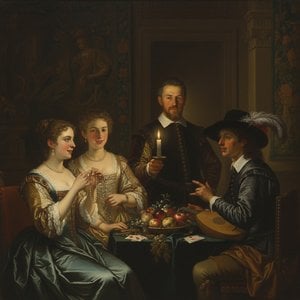
Gerard van Honthorst’s “Concert on a Balcony,” painted in 1624, isn't merely a depiction of musicians; it’s a carefully constructed tableau vivant – a stage for observing human interaction and the subtle drama of everyday life. The painting transports us to a richly furnished interior, likely a wealthy household’s salon or perhaps a private entertainment space. The setting itself is crucial: a balcony overlooking a darkened street, suggesting an evening gathering, a moment of respite from the bustling city below. Notice how Honthorst masterfully uses light – not as a simple illumination, but as a powerful tool to shape our perception and draw attention to key elements within the scene. The warm glow emanating from candles casts long shadows, creating depth and intimacy while simultaneously highlighting the faces and instruments of the performers.

  • The Musicians: A woman with a guitar, a violinist, and two singers – each rendered with remarkable detail, capturing their expressions and gestures.
  • The Child: The presence of a young child, likely being held by one of the performers, adds an element of innocence and vulnerability to the scene, subtly contrasting with the more worldly activities unfolding around him.
  • The Book: A book resting on the stage – a detail that hints at the possibility of a theatrical performance or perhaps a musical rehearsal, grounding the scene in a specific context.

Masterful Technique: Caravaggism and the Art of *Tenebrismo*

Honthorst’s style is deeply rooted in the innovations of Caravaggio, a movement known as *Caravaggism*. This Italian painter revolutionized art by employing what's called *tenebrismo*, a dramatic technique characterized by stark contrasts between light and dark. In “Concert on a Balcony,” this is immediately apparent. The foreground is bathed in a warm, almost theatrical light, while the background fades into deep shadow. This creates a powerful sense of depth and draws our eye to the central figures – the musicians engaged in their performance. Honthorst’s brushwork is loose and expressive, contributing to the painting's dynamic energy. He doesn’t meticulously render every detail; instead, he focuses on capturing the essence of the scene through color, light, and movement.

Color Palette:** The dominant colors are rich browns, reds, and golds, reflecting the opulence of the setting and the performers' attire. The use of deep blues and blacks in the background creates a sense of mystery and distance.

Symbolism and Interpretation: More Than Just a Musical Gathering

Beyond its surface depiction of musicians playing music, “Concert on a Balcony” invites us to contemplate broader themes. The scene suggests a celebration of community, artistry, and the pleasures of social interaction. The balcony itself can be interpreted as a threshold – a space between private intimacy and public performance. It’s a place where individuals come together to share their talents and create moments of beauty. Some art historians have suggested that the painting also reflects the anxieties of the time, with the darkness representing uncertainty and the light symbolizing hope and prosperity. The inclusion of the child adds another layer of meaning, perhaps hinting at the future generation of artists and musicians.

A Timeless Appeal: Reproduction and Interior Design

Gerard van Honthorst’s “Concert on a Balcony” remains a captivating work of art due to its masterful composition, dramatic lighting, and evocative atmosphere. Reproductions offer an accessible way to bring this scene into your home or office, adding a touch of elegance and sophistication. When selecting a reproduction, consider the quality of the print and the framing – a rich, dark frame will best complement the painting’s chiaroscuro effect. This artwork is not just a visual representation; it's an invitation to step back in time and experience the vibrant energy of 17th-century life. Its timeless appeal makes it a perfect addition to any art collection or a striking focal point for interior design.

Related Artworks


Artist Biography

A Master of Light and Shadow: The Life and Art of Gerard van Honthorst

Gerard van Honthorst emerged from Utrecht in 1592, a pivotal figure poised to illuminate the Dutch Golden Age with his dramatic artistry. Initially guided by his father, a decorative painter, young Gerard’s talent blossomed under the tutelage of Abraham Bloemaert, establishing a solid foundation in draftsmanship and composition. However, it was a transformative journey to Rome that irrevocably altered the course of his artistic development. There, amidst the fervent energy of the Italian Baroque, he encountered the groundbreaking work of Caravaggio – an encounter that would define his signature style and earn him the evocative nickname “Gherardo delle Notti,” or Gerard of the Nights. The dramatic use of tenebrism, a technique employing stark contrasts between light and dark, became Honthorst’s hallmark, imbuing his canvases with a palpable sense of drama and emotional intensity. He wasn't merely imitating Caravaggio; he was translating the Italian master’s innovations into a distinctly Dutch sensibility, focusing on intimate scenes illuminated by artificial light sources – candles, lamps, and fires – creating an atmosphere both realistic and deeply theatrical. This mastery over light wasn’t simply technical skill; it was a means of revealing character, of drawing the viewer into the emotional core of each scene.

From Roman Acclaim to Dutch Mastery

Honthorst's time in Rome was marked by considerable success and patronage. He found favor amongst the city’s elite, including Vincenzo Giustiniani, for whom he created the powerful “Christ Before the High Priest,” a work that exemplifies his masterful command of light and shadow. This painting, now residing in London’s National Gallery, showcases not only his technical skill but also his ability to convey profound psychological depth within his figures. He further solidified his reputation by working for Cosimo II de' Medici, Grand Duke of Tuscany, demonstrating an adaptability and versatility that would serve him well throughout his career. Upon returning to Utrecht around 1620, Honthorst quickly established himself as a leading portrait painter in the Dutch Republic. His ability to capture not just physical likeness but also the character and social standing of his sitters made him highly sought after by wealthy merchants, nobles, and even royalty. He became president of the Guild of St. Luke in Utrecht in 1623, a testament to his growing influence within the artistic community. This period saw a flourishing of commissions, allowing Honthorst to refine his style and establish a distinctive voice within Dutch painting.

A Courtly Artist: Commissions and Collaborations

The reach of Honthorst’s talent extended beyond the Netherlands. His work attracted the attention of Sir Dudley Carleton, who enthusiastically recommended him to prominent English aristocrats like the Earl of Arundel and Lord Dorchester. This led to commissions from Queen Elizabeth of Bohemia, sister of Charles I, who employed him as both a painter and drawing master for her children. These royal connections culminated in significant works such as the allegorical depiction of Charles and Henrietta Maria as Diana and Apollo, now housed at Hampton Court Palace. Honthorst’s willingness to collaborate with other artists also speaks to his open-mindedness and artistic generosity. He famously hosted Peter Paul Rubens during a visit to Utrecht, even painting him in a playful scene depicting Diogenes searching for an honest man – a testament to the mutual respect between these two Baroque giants. While some collaborative works, like “The Taking of Christ,” were initially attributed solely to Honthorst, modern scholarship has revealed the contributions of other artists, highlighting the complex dynamics of artistic production during this period. These collaborations weren’t simply about sharing workload; they were intellectual exchanges that enriched the artistic landscape.

Legacy and the Utrecht Caravaggisti

Gerard van Honthorst’s influence resonated far beyond his lifetime. He was a key figure in the *Utrecht Caravaggisti* movement – a group of Dutch painters who embraced Caravaggio's dramatic realism and tenebrism. Alongside artists like Hendrick ter Brugghen and Dirck van Baburen, he helped to establish a distinctly Dutch interpretation of Italian Baroque style. His emphasis on genre scenes illuminated by artificial light, his masterful portraits, and his ability to convey emotional depth through skillful use of chiaroscuro left an indelible mark on the development of Dutch Golden Age painting. Even his brother, Willem van Honthorst, followed in his footsteps, though often with works initially misattributed to Gerard due to stylistic similarities.
  • Honthorst’s paintings continue to captivate audiences today.
  • His dramatic beauty and psychological insight are enduring qualities.
  • He cemented his place as a pivotal figure in art history.
Van Honthorst's ability to seamlessly blend Italian influences with Dutch sensibilities ensured his lasting legacy, inspiring generations of artists who followed. He died in Utrecht in 1656, leaving behind a body of work that continues to illuminate the artistic landscape and remind us of the power of light and shadow to reveal the human condition.
Gerard van Honthorst

Gerard van Honthorst

1590 - 1656 , Netherlands

Quick Facts

  • Artistic Movement Or Style: Baroque, Caravaggism
  • Artists Or Movements Influenced By This Artist: ['Utrecht Caravaggisti']
  • Artists Who Influenced This Artist: ['Caravaggio']
  • Date Of Birth: 1590
  • Date Of Death: 1656
  • Full Name: Gerard van Honthorst
  • Nationality: Dutch
  • Notable Artworks:
    • Christ in the Garden
    • Supper Party
    • Diana and Apollo
  • Place Of Birth: Utrecht, Netherlands
Explore artworks organized by themes, styles, and characteristics.