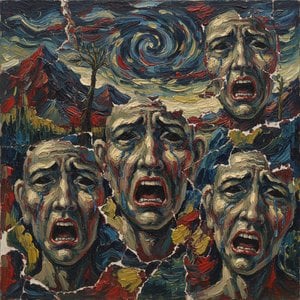
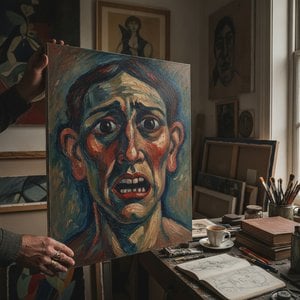
Pierrot (1910) by Georges Rouault, hand-painted oil painting reproduction by a master artist
Preview AR preview Switch to Print Switch to Digital Image Send
Details Guide Add to favorites Download Similars X-Ray Diaporama Q&A Presentation Stats

Pierrot Hand-painted oil painting reproduction

Explore Georges Rouault’s ‘Pierrot,’ a raw Expressionist portrait brimming with emotion & distorted forms. Thick impasto & symbolic flame capture an intense inner state. Discover this captivating 1910 masterpiece.

Discover Georges Rouault (1871-1958), a French Expressionist painter renowned for his emotive religious scenes, bold colors & depictions of marginalized figures. Explore his unique stained-glass inspired style.

The artwork displayed on this page is protected by copyright law, which means we cannot legally create or sell an identical reproduction. This protection is enforced under international agreements such as the Berne Convention and by national laws, including those outlined by the U.S. Copyright Law - Title 17.

As a respectful and legal alternative, we offer custom, hand-painted artworks inspired by the original. Our skilled and professional artists carefully study the original's style, mood, and artistic essence to create a new, unique piece that evokes the same feeling - while remaining an original creation in its own right.

This method fully complies with copyright regulations because it does not involve copying or duplicating the protected artwork. Instead, it is a creative reinterpretation - a new painting that is influenced by the original but not identical to it.

Hand Made Oil Reproduction

Hand-painted oil on canvas in your size and frame, made to order by our artists. ( Switch to Print Switch to Digital Image)

Corner sample of the P118B picture frame: moulded polystyrene, 5 cm wide and 3 cm thick
P118B $10
Corner sample of the P118H picture frame: moulded polystyrene, 5 cm wide and 3 cm thick
P118H $10
Corner sample of the P118W picture frame: moulded polystyrene, 5 cm wide and 3 cm thick
P118W $10
Corner sample of the P438Z picture frame: moulded polystyrene, 5.5 cm wide and 3.5 cm thick
P438Z $10
Corner sample of the P508JH picture frame: moulded polystyrene, 7 cm wide and 3.5 cm thick
P508JH $12
Corner sample of the P508YH picture frame: moulded polystyrene, 7 cm wide and 3.5 cm thick
P508YH $12
Corner sample of the P805H picture frame: moulded polystyrene, 5 cm wide and 3.5 cm thick
P805H $10
Corner sample of the P805Z picture frame: moulded polystyrene, 5 cm wide and 3.5 cm thick
P805Z $10
Corner sample of the P919BZ picture frame: moulded polystyrene, 7 cm wide and 3.5 cm thick
P919BZ $10
Corner sample of the P919G picture frame: moulded polystyrene, 7 cm wide and 3.5 cm thick
P919G $10
Corner sample of the P919XJ picture frame: moulded polystyrene, 7 cm wide and 3.5 cm thick
P919XJ $10
Corner sample of the P959ZH picture frame: moulded polystyrene, 5 cm wide and 3 cm thick
P959ZH $10
Corner sample of the P968JZ picture frame: moulded polystyrene, 6 cm wide and 4 cm thick
P968JZ $12
Corner sample of the W106C picture frame: solid wood, 5 cm wide and 3 cm thick
W106C $8
Corner sample of the W218G picture frame: solid wood, 5 cm wide and 3 cm thick
W218G $10
Corner sample of the W218JH picture frame: solid wood, 5 cm wide and 3 cm thick
W218JH $8
Corner sample of the W218Y picture frame: solid wood, 5 cm wide and 3 cm thick
W218Y $10
Corner sample of the W307PJ picture frame: solid wood, 6 cm wide and 3 cm thick
W307PJ $10
Corner sample of the W316G picture frame: solid wood, 6 cm wide and 3 cm thick
W316G $10
Corner sample of the W316PJ picture frame: solid wood, 6 cm wide and 3 cm thick
W316PJ $8
Corner sample of the W316Y picture frame: solid wood, 6 cm wide and 3 cm thick
W316Y $10
Corner sample of the W398PJ picture frame: solid wood, 5 cm wide and 3 cm thick
W398PJ $8
Corner sample of the W4111J picture frame: solid wood, 6.5 cm wide and 3.5 cm thick
W4111J $10
Corner sample of the W500HY picture frame: solid wood, 7 cm wide and 5 cm thick
W500HY $15
Corner sample of the W500JH picture frame: solid wood, 7 cm wide and 5 cm thick
W500JH $15
Corner sample of the W692G picture frame: solid wood, 8 cm wide and 4 cm thick
W692G $12
Corner sample of the W849H picture frame: solid wood, 5 cm wide and 3 cm thick
W849H $8
Corner sample of the W940BG picture frame: solid wood, 7.5 cm wide and 4.5 cm thick
W940BG $15
Corner sample of the W953PJ picture frame: solid wood, 6 cm wide and 3.5 cm thick
W953PJ $8

Standard
custom
CM
INCH

Pick from our preset sizes that match the artwork's original proportions.

width
height

Type the width and the height you need, to fit your frame or your wall. This is hand-painted, so for a size with a different shape the artist can paint a bit more around the picture, or cut a bit — you choose. We send you a digital mockup to approve before the painting starts. The picture shown on this page does not show the real result — only the mockup does.

Examples of what can be changed: Replace face with customer photo; Add pet (e.g., replace cat with dog); Include hidden message in background; Change background landscape or elements.
After order, WahooArt.com team will email client for instructions and provide a mockup preview

Worldwide Delivery () in 3/4 weeks instead of standard 5 weeks. (11 November). No compromise on quality.

Free Worldwide Express Shipping
High-Quality Linen Canvas
Full Shipping Insurance
Customs Tax Refund Guarantee
True Color Matching Guarantee
100-Day Return Policy (Defects Only)
100% Money-Back Guarantee
Bulk Discount Offer

Total Price

$ 272

Pierrot

Reproduction Medium

Reproduction Size

-

Total Price

$ 272

Quick Facts

  • Title: Pierrot
  • Influences:
    • Medieval Artistry
    • Van Gogh
  • Subject or Theme: Portrait, Inner State
  • Year: 1910
  • Movement: Expressionism
  • Medium: Oil & Pastel on Paper

Art Quiz

There is only one correct answer for each question.

Question 1:
What artistic movement is most closely associated with Georges Rouault’s ‘Pierrot’?
Question 2:
The dark blue-violet background in ‘Pierrot’ is primarily intended to:
Question 3:
The use of thick, impasto brushstrokes in ‘Pierrot’ contributes to which characteristic?
Question 4:
The red flame-like element above the woman's head in ‘Pierrot’ most likely symbolizes:"
Question 5:
Georges Rouault's apprenticeship as a glass painter influenced his style by primarily focusing on:"

Identification of Pierrot by Georges Rouault

Pierrot is a work by the French artist Georges Rouault, executed in 1910. Born in Paris, France, in 1871, Rouault remained connected to his home city until his death in Paris, France, in 1958. This piece emerged during a period when the artist was establishing his presence in the Parisian art scene, having previously studied under Gustave Moreau at the École des Beaux-Arts.

The work belongs to a broader thematic interest in the figures of the circus and the marginalized. Rouault frequently utilized clowns and performers to explore the human condition, often employing a rough painterly style characterized by heavy black contouring. This technique, reminiscent of the stained glass for which he trained as an apprentice, defines the structural boundaries of his subjects.

Other notable works from this period of the artist's development include:

  • The Way to Calvary (1891)
  • Arlequin (1939)
  • Vieux faubourg (1950)
  • Nu (1925)

The Composition and Visual Elements

Executed as a drawing, this work utilizes oil and pastel on paper to define its subject. The medium allows for a specific interplay of texture and color, characteristic of the artist's technical approach. The application of material emphasizes a rough, painterly quality that prioritizes expressive form over precise anatomical accuracy.

The composition relies on heavy black contouring to frame luminous color fields. This technique, reminiscent of the stained glass work from the artist's early apprenticeship, creates a sense of weight and structural clarity. The interplay between the dark outlines and the internal light suggests a tension between the figure and its immediate space. Such formal qualities reflect a transition toward the emotional intensity of Expressionism, using distorted lines to convey internal states rather than mere physical likeness.

Provenance and Collection History

The ownership history of this work traces a path from Paris to the United States. It was previously held in the collection of André Lhôte in Paris. The piece later moved to the collection of Theodore Schempp in New York, New York.

In 1938, the work was part of a gift from Joseph Pulitzer, Jr. of St. Louis, Missouri. Following this transfer, it was eventually given to the Fogg Art Museum in 1976.

Current Location and Museum Access

The work is held by the Harvard Art Museums. It is part of the Fogg Museum collection, specifically within the Modern and Contemporary Art division. This piece was acquired through the Gift of Mr. and Mrs. Joseph Pulitzer, Jr.

Visitors seeking to view this drawing may find it within the museum's permanent holdings. While availability for public display can change, the object remains a significant part of the institution's modern collections. The museum provides access to its various departments through scheduled gallery rotations.

Questions & Answers

Is "Pierrot" free of copyright?

The copyright answer for "Pierrot" by Georges Rouault: the work is still protected by copyright. This determines whether reproductions of the image may be freely made.

Where can I see a preview of "Pierrot"?

A preview of "Pierrot" by Georges Rouault is available on the artwork's Preview page.

Where is the portrait format of "Pierrot" recommended to be displayed?

With its portrait shape, a reproduction of "Pierrot" is suggested for a living room.


Artist Biography

A Life Forged in Parisian Shadows

Georges Rouault, born in Paris in 1871 amidst the turmoil of the Commune, lived a life deeply etched by hardship and spiritual seeking. His earliest years were spent literally in the shadows – his family sought refuge in a cellar during the city’s bombardment, an event that would resonate throughout his artistic vision. This humble beginning, coupled with a devoutly Catholic upbringing fostered by his mother, instilled within him a profound empathy for the marginalized and suffering, themes that would become central to his oeuvre. He wasn't destined for formal academic privilege; instead, he embarked on an apprenticeship as a glass painter at fourteen, a craft that profoundly shaped his aesthetic sensibilities. The vibrant hues and bold outlines inherent in stained glass became foundational to his mature style – a characteristic use of dark contours framing luminous color fields, reminiscent of medieval artistry. This early immersion wasn’t merely technical; it was spiritual, imbuing him with an appreciation for the narrative power of light and image. He simultaneously pursued formal training at the École des Beaux-Arts, where he became a devoted pupil of Gustave Moreau, whose Symbolist leanings further nurtured Rouault's inclination towards emotionally charged subject matter.

From Fauvism’s Embrace to Expressionist Depths

Rouault’s artistic journey wasn’t one of immediate recognition or easy categorization. While initially influenced by the Symbolists, he found himself drawn into the orbit of the burgeoning Fauvist movement in the early 20th century. He befriended artists like Henri Matisse and Albert Marquet, participating in exhibitions alongside them, yet his temperament always steered him toward a more somber and introspective path than the purely aesthetic explorations of his contemporaries. The vibrant colors of Fauvism served as a springboard, but Rouault quickly transcended its limitations, infusing his canvases with an emotional intensity that foreshadowed Expressionism. He began to focus on subjects often overlooked or deemed unworthy of artistic attention: prostitutes, clowns, judges, and prisoners. These weren’t merely depictions of societal outcasts; they were poignant allegories for the human condition – explorations of sin, redemption, and the inherent dignity within suffering. His characterizations, often grotesque yet deeply empathetic, resonated with a growing sense of unease and alienation in modern society, influencing a generation of Expressionist painters who sought to convey inner turmoil through distorted forms and jarring colors.

A Moral Compass in Canvas and Print

The First World War proved to be a pivotal moment for Rouault, solidifying his commitment to religious faith and deepening the moral weight of his art. He largely withdrew from public exhibitions during this period, dedicating himself to intensely personal projects like the *Miserere* series – a monumental cycle of etchings depicting scenes of human suffering inspired by the Psalms. These works, created over more than a decade, are arguably his most powerful and enduring achievement. The plates themselves were reworked repeatedly, reflecting Rouault’s relentless pursuit of emotional truth and spiritual understanding. He wasn't interested in mere representation; he sought to capture the raw essence of human experience – the anguish, the despair, but also the glimmer of hope that persists even in the darkest corners of existence. Beyond *Miserere*, his paintings continued to explore similar themes, often featuring figures isolated and burdened by their circumstances, yet imbued with a quiet dignity. His depictions of clowns, for example, weren’t simply comedic; they were tragic figures embodying the absurdity and loneliness of life.

Legacy of Passion and Spiritual Resonance

Georges Rouault's artistic legacy extends far beyond his technical innovations or stylistic affiliations. He was a profoundly spiritual artist who used his craft as a means of moral inquiry and empathetic connection. His work challenged conventional notions of beauty, embracing ugliness and suffering as integral aspects of the human experience. He rejected the purely decorative in favor of art that confronted viewers with uncomfortable truths about themselves and their society. In later life, he received commissions for religious works, including designs for Sergei Diaghilev’s ballet *The Prodigal Son*, further cementing his reputation as a uniquely devout artist. A curious and perhaps tragic footnote to his career is the fact that, late in life, Rouault destroyed approximately 300 of his paintings – an act driven by self-criticism and a relentless pursuit of artistic perfection. This dramatic gesture underscores the intensity of his creative process and his unwavering commitment to expressing his inner vision. Rouault died in Paris in 1958, leaving behind a body of work that continues to resonate with audiences today—a testament to the enduring power of art born from compassion, faith, and an unflinching gaze upon the complexities of the human heart. His paintings are not merely images; they are windows into the soul.
Georges Rouault

Georges Rouault

1871 - 1958 , France

Quick Facts

  • Full Name: Georges Henri Rouault
  • Nationality: French
  • Date Of Birth: 1871
  • Date Of Death: 1958
  • Place Of Birth: Paris, France
  • Notable Artworks:
    • The Way to Calvary
    • End of Autumn 1
    • The Minx
    • Pere Ubu Singer
  • Artistic Movement Or Style: Expressionism, Fauvism
  • Artists Who Influenced This Artist:
    • Gustave Moreau
    • Vincent van Gogh
  • Artists Or Movements Influenced By This Artist: ['Expressionist painters']
Explore artworks organized by themes, styles, and characteristics.