Museum-quality giclée or canvas print with fast production and flexible finish options. ( Buy Hand Made Painting Switch to Digital Image)





























Pick from our preset sizes that match the artwork's original proportions.

Type the width and the height you need, to fit your frame or your wall. A print can only be cut, never made bigger than the picture, so a size with a different shape loses a part of the image. We send you a digital mockup to approve before we print anything. The picture shown on this page does not show the real cut — only the mockup does.
Worldwide Delivery () in 2 weeks instead of standard 4/5 weeks. (10 November)
Man Dining
Reproduction Size
Georges Pierre Seurat (1859-1891) stands as a monumental figure in the artistic landscape of late 19th century France, irrevocably altering perceptions of painting through his pioneering exploration of Pointillism. More than just a technique—though undeniably revolutionary—Pointillism represented a profound intellectual commitment to scientific principles and an unwavering dedication to capturing optical reality. Seurat’s brief but impactful career wasn't merely about applying pigment; it was about fundamentally reshaping how artists understood the relationship between perception and representation.
Seurat’s intellectual framework was inseparable from his artistic practice. He meticulously studied the work of Henri Poincaré, a mathematician who championed the idea that color perception is not simply how objects appear but rather how they are interpreted by the eye—a concept central to Pointillism's theoretical underpinning. This dedication to scientific rigor distinguishes Seurat’s approach from many of his contemporaries and underscores his conviction that art could benefit from incorporating insights into sensory experience.
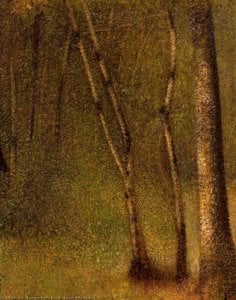
“Man Dining” exemplifies Seurat’s early experiments with Pointillism, demonstrating a willingness to challenge established artistic conventions. While he would later refine the technique—particularly in monumental canvases like ‘A Sunday on La Grande Jatte’—this smaller study remains a testament to his foundational understanding of optical mixing and his unwavering commitment to capturing the essence of visual perception. It stands as an enduring symbol of Seurat's transformative contribution to modern art.
The artwork’s subdued palette and textured surface lend themselves beautifully to interior design projects seeking a calming, contemplative aesthetic. Consider incorporating reproductions in spaces where tranquility is valued—perhaps alongside complementary shades of grey or earthy tones—to evoke the same sense of quiet observation that characterizes Seurat's masterpiece.
A preview of "Man Dining" by Georges Seurat is available on the artwork's Preview page.
The recommended use of a print of "Man Dining" is accent.
Georges Seurat appears under the alternate names Georges Pierre Seurat, Georges-Pierre Seurat.

To understand the trajectory of modern painting, one must look at the brief, intense existence of Georges Seurat. Born in Paris, France, on December 2, 1859, he was the son of Ernestine Faivre and Antoine Chrysostome Seurat, a man who had transitioned from a legal official to a property speculator in Champagne. This background provided the stability necessary for his rapid, disciplined ascent within the Parisian art scene. He did not merely paint; he engineered a new way of seeing that challenged the spontaneous impulses of his predecessors.
His career was a sprint, not a marathon. He died in Paris, France, on March 29, 1891, at the age of 31. This premature end left a body of work that feels concentrated and deliberate, lacking the sprawling, loose evolution seen in many of his contemporaries. Even his final, unfinished efforts, such as The Circus, reveal a mind preoccupied with the structural mechanics of light and social order. He replaced the fleeting glance with a calculated, permanent precision.
The impact of his short life is measured by the sheer density of his technical innovations. He moved art away from the emotional spontaneity of the moment and toward a systematic, almost mathematical application of color. His presence in the history of the nineteenth century remains defined by this refusal to rely on intuition alone. He sought a logic in the canvas that remains visible in every dot of pigment he left behind.
The trajectory of Georges Seurat began in Paris, where his family moved to Boulevard de Magenta shortly after his birth. His upbringing was shaped by a stable environment provided by his father, Antoine Chrysostome Seurat, a former legal official turned property speculator. This background allowed the young artist access to the formal education necessary to challenge the established norms of the late 19th century. He did not rely on mere intuition; his development was built on a foundation of rigorous, systematic training.
His formal education started at the École Municipale de Sculpture et Dessin, where he studied under the sculptor Justin Lequien. This early exposure to sculpture likely contributed to the structural, almost frieze-like quality seen in his later compositions. By 1878, he had moved into the upper echelons of French art education, enrolling at the prestigious École des Beaux-Arts. During his tenure there, he studied under Henri Lehmann, a period that instilled in him the traditional techniques and compositional discipline he would eventually deconstruct through scientific analysis.
Seurat replaced the spontaneous, intuitive brushwork of his predecessors with a calculated, systematic approach to light. He developed Pointillism, a method defined by the application of small, distinct dots of pure color onto a canvas. This was not a decorative choice but a functional one. By utilizing Divisionism, he separated local color into individual dots, relying on the viewer’s eye to achieve optical blending. This process, which he termed chromoluminarism, treated color as a science rather than a mere feeling. He sought to reconstruct the physics of sight through the precise placement of pigment.
His precision extended to his preparatory work. He frequently used conté crayon on paper with a rough surface to map out his compositions. This disciplined method ensured that every dot in his final large-scale works was part of a larger, mathematically orchestrated structure. The resulting surfaces possess a rhythmic, vibrating quality that stems from the tension between individual points of color and the unified image they form on the retina. His work remains a study in how technical rigor can dictate visual perception.
Seurat’s vision relied on a rigid, mathematical approach to light. He rejected the spontaneous, emotional brushwork of his predecessors in favor of a systematic reconstruction of sight. This method turned the canvas into a site of optical calculation rather than mere observation. His work sought to capture the essential, unchanging structure of a scene through the precise application of color theory. He did not simply paint a landscape; he engineered a visual experience based on how the human eye processes light and pigment.
His large-scale compositions demonstrate this commitment to order. A Sunday Afternoon on the Island of La Grande Jatte (1884-1886) uses a monumental scale to present a scene of Parisian leisure through a dense mosaic of dots. This work functions as a manifesto for Neo-Impressionism, replacing fluid movement with a sense of permanent, sculptural stillness. Similarly, Bathers at Asnières (1884) shows his early ability to reconcile classical, frieze-like figure types with the modern, industrial reality of the Seine. These paintings prove that his interest lay in the intersection of scientific precision and contemporary life.
Even his final, unfinished efforts reveal a preoccupation with the tension between movement and structure. The Circus (1890–91) utilizes a Neo-Impressionist style to depict the energy of a public spectacle, yet it remains anchored by his characteristic control of form. In Young Woman Powdering Herself (1889-1890), he applied his technique to a single subject, exploring the artifice of human vanity through a highly constructed setting. His output was a constant effort to find a logic in light that the fleeting glance of Impressionism could not provide.
Seurat’s impact on the trajectory of modern art is measurable through the radical shifts his methods forced upon subsequent movements. By replacing the intuitive brushwork of his predecessors with a systematic, scientific approach to color and light, he expanded the boundaries of what a painting could achieve. This intellectual rigor moved art away from mere representation and toward a structured analysis of perception. His insistence on the optical blending of pigment changed the fundamental mechanics of how a viewer interacts with a canvas.
The ripples of his technical innovations reached far beyond the Neo-Impressionist circle. The Fauvists adopted his emphasis on bold, non-naturalistic color, while the Cubists drew from his ability to deconstruct forms into geometric components. Even the Abstract Expressionists, focused on the raw energy of the gesture, owe a debt to the way he liberated color from the constraints of traditional mixing. He proved that art could be both a rigorous intellectual pursuit and a method for capturing the essence of modern life.

1859 - 1891 , France

Explore the scientific brilliance of Seurat and Signac. Discover how Pointillism revolutionized color through optical mixing and light, offering a profound look into the Neo-Impressionist movement for true art connoisseurs and collectors.

Explore the vibrant evolution of Post-Impressionism. From Seurat's revolutionary Pointillism to the emotional depth of masters, discover how this movement redefined modern art history through color, structure, and unparalleled creative expression.
 Preview
 Send
Send Share
Share
 Details
 Guide
Guide

 Download
 Similars
 X-Ray
X-Ray Diaporama
 Q&A
Q&A
 Stats
Stats
 Read More









 Glass option is only available in size under 110 CM