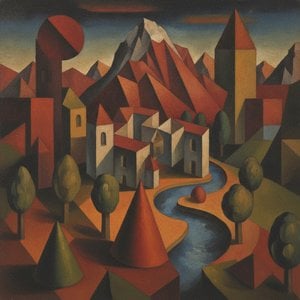
The Metallic Plow (1962) by Georges Braque, hand-painted oil painting reproduction by a master artist
Preview AR preview Switch to Print Switch to Digital Image Send

Details Guide Add to favorites Download Similars X-Ray Diaporama Q&A Presentation Stats

The Metallic Plow Hand-painted oil painting reproduction

Georges Braque's 'The Metallic Plow' (1962) captures rural life with bold Expressionist strokes and geometric abstraction, reflecting his pivotal role in Cubism’s evolution. Explore this iconic landscape painting.

Cubism pioneer Georges Braque co-founded the movement with Picasso. Explore his revolutionary works and innovative collages today.

The artwork displayed on this page is protected by copyright law, which means we cannot legally create or sell an identical reproduction. This protection is enforced under international agreements such as the Berne Convention and by national laws, including those outlined by the U.S. Copyright Law - Title 17.

As a respectful and legal alternative, we offer custom, hand-painted artworks inspired by the original. Our skilled and professional artists carefully study the original's style, mood, and artistic essence to create a new, unique piece that evokes the same feeling - while remaining an original creation in its own right.

This method fully complies with copyright regulations because it does not involve copying or duplicating the protected artwork. Instead, it is a creative reinterpretation - a new painting that is influenced by the original but not identical to it.

Hand Made Oil Reproduction

Hand-painted oil on canvas in your size and frame, made to order by our artists. ( Switch to Print Switch to Digital Image)

Corner sample of the P118B picture frame: moulded polystyrene, 5 cm wide and 3 cm thick
P118B $10
Corner sample of the P118H picture frame: moulded polystyrene, 5 cm wide and 3 cm thick
P118H $10
Corner sample of the P118W picture frame: moulded polystyrene, 5 cm wide and 3 cm thick
P118W $10
Corner sample of the P438Z picture frame: moulded polystyrene, 5.5 cm wide and 3.5 cm thick
P438Z $10
Corner sample of the P508JH picture frame: moulded polystyrene, 7 cm wide and 3.5 cm thick
P508JH $12
Corner sample of the P508YH picture frame: moulded polystyrene, 7 cm wide and 3.5 cm thick
P508YH $12
Corner sample of the P805H picture frame: moulded polystyrene, 5 cm wide and 3.5 cm thick
P805H $10
Corner sample of the P805Z picture frame: moulded polystyrene, 5 cm wide and 3.5 cm thick
P805Z $10
Corner sample of the P919BZ picture frame: moulded polystyrene, 7 cm wide and 3.5 cm thick
P919BZ $10
Corner sample of the P919G picture frame: moulded polystyrene, 7 cm wide and 3.5 cm thick
P919G $10
Corner sample of the P919XJ picture frame: moulded polystyrene, 7 cm wide and 3.5 cm thick
P919XJ $10
Corner sample of the P959ZH picture frame: moulded polystyrene, 5 cm wide and 3 cm thick
P959ZH $10
Corner sample of the P968JZ picture frame: moulded polystyrene, 6 cm wide and 4 cm thick
P968JZ $12
Corner sample of the W106C picture frame: solid wood, 5 cm wide and 3 cm thick
W106C $8
Corner sample of the W218G picture frame: solid wood, 5 cm wide and 3 cm thick
W218G $10
Corner sample of the W218JH picture frame: solid wood, 5 cm wide and 3 cm thick
W218JH $8
Corner sample of the W218Y picture frame: solid wood, 5 cm wide and 3 cm thick
W218Y $10
Corner sample of the W307PJ picture frame: solid wood, 6 cm wide and 3 cm thick
W307PJ $10
Corner sample of the W316G picture frame: solid wood, 6 cm wide and 3 cm thick
W316G $10
Corner sample of the W316PJ picture frame: solid wood, 6 cm wide and 3 cm thick
W316PJ $8
Corner sample of the W316Y picture frame: solid wood, 6 cm wide and 3 cm thick
W316Y $10
Corner sample of the W398PJ picture frame: solid wood, 5 cm wide and 3 cm thick
W398PJ $8
Corner sample of the W4111J picture frame: solid wood, 6.5 cm wide and 3.5 cm thick
W4111J $10
Corner sample of the W500HY picture frame: solid wood, 7 cm wide and 5 cm thick
W500HY $15
Corner sample of the W500JH picture frame: solid wood, 7 cm wide and 5 cm thick
W500JH $15
Corner sample of the W692G picture frame: solid wood, 8 cm wide and 4 cm thick
W692G $12
Corner sample of the W849H picture frame: solid wood, 5 cm wide and 3 cm thick
W849H $8
Corner sample of the W940BG picture frame: solid wood, 7.5 cm wide and 4.5 cm thick
W940BG $15
Corner sample of the W953PJ picture frame: solid wood, 6 cm wide and 3.5 cm thick
W953PJ $8

Standard
custom
CM
INCH

Pick from our preset sizes that match the artwork's original proportions.

width
height

Type the width and the height you need, to fit your frame or your wall. This is hand-painted, so for a size with a different shape the artist can paint a bit more around the picture, or cut a bit — you choose. We send you a digital mockup to approve before the painting starts. The picture shown on this page does not show the real result — only the mockup does.

Examples of what can be changed: Replace face with customer photo; Add pet (e.g., replace cat with dog); Include hidden message in background; Change background landscape or elements.
After order, WahooArt.com team will email client for instructions and provide a mockup preview

Worldwide Delivery () in 3/4 weeks instead of standard 5 weeks. (9 November). No compromise on quality.

Free Worldwide Express Shipping
High-Quality Linen Canvas
Full Shipping Insurance
Customs Tax Refund Guarantee
True Color Matching Guarantee
100-Day Return Policy (Defects Only)
100% Money-Back Guarantee
Bulk Discount Offer

Total Price

$ 272

The Metallic Plow

Reproduction Medium

Reproduction Size

-

Total Price

$ 272

Quick Facts

  • Location: Private Collection
  • Artistic style: Landscape
  • Medium: Oil on canvas
  • Notable elements: Geometric abstraction
  • Subject or theme: Rural life/Agriculture

Art Quiz

There is only one correct answer for each question.

Question 1:
What is the primary subject depicted in ‘The Metallic Plow’?
Question 2:
The painting ‘The Metallic Plow’ was created in which year?
Question 3:
Which artistic movement is most closely associated with Georges Braque’s style in ‘The Metallic Plow’?
Question 4:
Based on the image description, what is a prominent feature of the scene in ‘The Metallic Plow’?
Question 5:
Georges Braque is best known for his pioneering work in which art movement?

A Moment Frozen in Time: Georges Braque’s “The Metallic Plow”

Georges Braque's "The Metallic Plow," painted in 1962, isn’t merely a depiction of agricultural labor; it’s a carefully constructed meditation on the intersection of tradition and modernity. This evocative work, rendered in a style that leans heavily into Expressionism while retaining traces of Cubist influence, captures a fleeting moment within the vast expanse of the French countryside. The painting immediately draws the eye to its central subject: a plow, powerfully rendered with bold, geometric forms—a testament to Braque’s enduring fascination with deconstructing and rebuilding visual reality. It's a scene imbued with a quiet intensity, suggesting not just the physical act of plowing but also the deeper connection between humanity and the land.

The Metallic Plow by Georges Braque

Echoes of Cubism and the Dawn of Expressionism

To fully appreciate “The Metallic Plow,” it’s crucial to understand Braque's pivotal role in the development of both Cubism and Expressionism. Following his early training as a house painter, Braque’s artistic journey led him through the vibrant circles of Paris, where he encountered and collaborated with artists like Pablo Picasso. During the period from 1908 to 1912, Braque and Picasso pioneered Cubism—a revolutionary approach that shattered traditional perspective by presenting objects from multiple viewpoints simultaneously. “The Metallic Plow,” however, moves beyond the strictly analytical concerns of early Cubism. While retaining a geometric sensibility, it embraces a looser, more emotive brushstroke, aligning with the tenets of Expressionism. This shift reflects a broader artistic trend of the time—a desire to convey subjective experience and emotional resonance rather than simply replicating objective reality.

The painting’s palette – dominated by earthy ochres, yellows, grays, and whites – reinforces this sense of groundedness and rustic authenticity. These muted tones evoke the textures of soil, sky, and weathered wood, creating a visual harmony that anchors the scene in its rural setting. Notice how Braque utilizes contrasting colors—the vibrant red and brown of the plow itself—to draw our attention to this central element, highlighting its importance within the composition.

Symbolism and the Rhythm of Rural Life

Beyond its formal qualities, “The Metallic Plow” is rich in symbolic meaning. The plow itself represents not just agricultural labor but also a fundamental human drive—the effort required to shape our environment and secure sustenance. The scattered birds overhead add another layer of interpretation, suggesting freedom, aspiration, or perhaps the fleeting beauty that can be found amidst hard work. Braque’s deliberate use of fragmented forms and dynamic brushstrokes conveys a sense of movement and energy, mirroring the rhythm of rural life—the cyclical patterns of planting, harvesting, and renewal.

The presence of a solitary figure on the left side of the painting further enriches the scene. While somewhat obscured, this individual embodies the human element within the landscape, suggesting a connection between the farmer and his work, between labor and reward. It’s a subtle yet powerful reminder that “The Metallic Plow” is not simply an abstract study of form but also a poignant portrayal of human experience.

A Legacy of Innovation: Reproductions for Today

Reproductions of "The Metallic Plow" offer a remarkable opportunity to bring this seminal work into your home or office. WahooArt.com meticulously recreates Braque’s masterful technique, capturing the painting's nuanced colors and dynamic composition with exceptional fidelity. Whether you are an art enthusiast, a collector seeking to expand your collection, or simply someone drawn to the beauty of rural landscapes, this reproduction provides a tangible connection to one of the 20th century’s most influential artists. Experience the power and poetry of “The Metallic Plow” – a timeless testament to Braque's artistic vision.

Questions & Answers

Where can I find statistics about "The Metallic Plow" by Georges Braque?

Statistics about "The Metallic Plow" by Georges Braque are on the artwork's Stats page: monthly visits of the artwork, visits of the artist's works, and country and language breakdowns of recent visitors.

Which artist and which style stand behind "The Metallic Plow"?

"The Metallic Plow" was created by Georges Braque in the Expressionist Landscape style. Artist and movement identify the work's tradition.

What does "The Metallic Plow" by Georges Braque depict, and in what mood?

"The Metallic Plow" by Georges Braque combines plow, oxen, field, rural, birds, agriculture, landscape with an earthy atmosphere.


Artist Biography

Early Life, Family and Training

Georges Braque was born in Argenteuil, France, in 1882. His early years were spent in Le Havre, France, within a household defined by the practicalities of decoration and color. Growing up in a family of house painters and decorators, he was immersed in the tactile realities of his trade from a young age. This upbringing provided a foundation of technical craftsmanship that would later inform his approach to the canvas.

Before pursuing the fine arts, he followed the established path of his kin by apprenticing as a house painter and decorator. This period of manual labor instilled in him a specific understanding of materials and the physical properties of surfaces. Such practical training offered a grounded perspective on how pigments interact with different textures, a sensibility that would eventually distinguish his later experiments with materiality.

The transition from trade to formal study took him to Paris in 1902. It was there that he continued his studies at the Académie Humbert, seeking to refine his innate inclinations through academic discipline. This period of formal instruction provided the necessary structure for his developing vision, bridging the gap between the manual application of paint and the intellectual pursuit of composition.

The Fauvist Period and Cézanne's Influence

The early years of Braque's career were shaped by the lingering shadows of Impressionism and Post-Impressionism. His initial explorations sought to capture the fleeting qualities of light and atmosphere, yet a deeper structural hunger began to emerge. By 1905, he turned toward the principles of Fauvism, embracing a more intense and non-naturalistic use of color to convey emotion. This period was marked by a departure from mere observation, as he began to prioritize the expressive power of the palette over the literal depiction of his subjects.

This newfound coloristic freedom found a necessary anchor in the work of Paul Cézanne. Braque found himself drawn to the way Cézanne utilized firm structures and a deliberate approach to color to organize the visual field. It was this intersection of Fauvist color and Cézannian geometry that would define his transition into a more radical mode of seeing. He sought to reconcile the emotional intensity of his colors with a sense of architectural permanence.

The results of this synthesis are visible in his 1908 work, Houses at L'Estaque. In this piece, the landscape is no longer a collection of soft impressions but a series of colorful, tilted planes and geometric shapes. The influence of Cézanne is unmistakable here, as the terrain is reduced to its essential volumes. He began to dismantle the traditional perspective of the landscape, replacing it with a fragmented, structured reality that prioritized the underlying form of the world.

The Development of Cubism

Between 1907 and 1914, Paris became the site of a profound visual restructuring through the collaboration of Georges Braque and Pablo Picasso. This partnership moved beyond the emotional intensity of Fauvism toward a more cerebral investigation of form. They developed Analytical Cubism, a method that dissected objects into fragmented geometric shapes. Rather than attempting to replicate the illusion of three-dimensional space, they sought to represent the totality of an object by presenting multiple viewpoints simultaneously. This approach stripped away traditional perspective, replacing it with a complex arrangement of planes and lines.

By about 1912, the movement underwent a significant transition into Synthetic Cubism. This phase moved away from the dissection of forms and toward the construction of new images through the assembly of diverse elements. Braque was a primary innovator in this shift, having created the first papier collé by attaching wallpaper to a drawing. This act of gluing physical materials onto the surface challenged the boundaries of the canvas, asserting the painting as an autonomous object rather than a window into another world. His work during this period focused on the relationship between representation and the tangible reality of the materials used.

Technique and Artistic Innovation

Braque’s approach to the canvas was defined by a restless curiosity regarding the physical properties of his materials. He moved beyond the traditional boundaries of oil painting by introducing elements that challenged the illusion of depth. By incorporating real-world materials such as newspaper clippings, wallpaper, and fabric, he disrupted the singular perspective of the picture plane. This experimentation led to the development of papier collé, a method of pasting paper that allowed him to integrate the textures of everyday life directly into his compositions. He sought to bridge the gap between the painted image and the tangible object.

His technical repertoire was marked by a tactile, almost sculptural sensibility. He frequently blended pigments with sand to alter the surface texture, creating a grit that caught the light in unexpected ways. To further manipulate the viewer's perception of space and materiality, he experimented with copying the visual patterns of wood grain and marble. This was not merely a decorative choice but a way to explore how different surfaces interact with light and form. He also utilized stenciled letters on his works, a technique that added a layer of graphic dimension and helped anchor the composition within a modern, legible reality.

  • Fruit Dish and Glass (1912)
  • Violin and Pipe (1912)
  • Clarinet and Bottle of Rum on the Mantlepiece (1912)

War and Stylistic Evolution

The outbreak of World War I in 1914 brought a sudden, violent interruption to the intellectual rigor of the Cubist movement. Braque was called up for military service, a period that would fundamentally alter both his physical well-being and his creative temperament. In 1915, he sustained a serious head wound in the trenches, an injury that resulted in temporary blindness and required a trepanation to recover his sight. This brush with darkness forced a shift in his perception. The rigid, analytical structures that had defined his earlier years began to soften, replaced by a more personal and lyrical approach to his subjects.

Upon his return from the war, the strict geometric constraints of his previous collaboration with Picasso were no longer his sole concern. His style evolved to incorporate elements of classical composition, seeking a sense of balance and harmony that felt more grounded in the physical world. He moved away from the purely intellectual dissection of form, embracing a more nuanced and contemplative way of seeing. His work became less about the fragmentation of space and more about the quiet, serene atmosphere of the objects themselves.

  • Still Life with Playing Cards (1919)

Key Works and Notable Pieces

The trajectory of Braque's career is marked by specific compositions that signal his shifts in thought and technique. In 1908, Houses at L'Estaque emerged, utilizing colorful, tilted planes and geometric shapes that reflected a departure from traditional perspective. This period of experimentation continued into 1910 with Violin and Palette, a work that utilized paper and mixed media to study how color interacts with form. By 1911, his focus moved toward the dissection of space in Man with a Guitar, a piece that exemplifies the analytical approach he developed alongside his contemporaries.

As his methods evolved, the introduction of new materials changed the texture of his canvases. The 1912 work Fruit Dish and Glass demonstrated the transition into a style where recognizable subject matter was reincorporated through the use of collage. Even after the disruptions of war, his output maintained a connection to his earlier investigations. The Musician, created in 1918, reflects a period of personal transition, while his much later 1955 painting, Two Birds, shows a continued interest in the fundamental properties of his chosen subjects.

Legacy and Enduring Impact

By the time of his death on August 31, 1963, Georges Braque had fundamentally altered the understanding of how we perceive and represent the world. As a co-founder of the Cubism movement, he helped dismantle the long-held reliance on traditional perspective, replacing it with a fragmented, multi-dimensional reality. His work moved beyond mere imitation of nature, seeking instead to capture the essence of objects through a rigorous study of form and space. This shift forced a permanent change in the visual language of the twentieth century.

His influence on subsequent generations of artists remains immeasurable. By introducing papier collé and integrating everyday materials into his compositions, he bridged the gap between the canvas and the tangible world. This innovation challenged the boundaries of what a painting could be, paving the way for future explorations into texture and materiality. Even as his style evolved toward more lyrical and serene themes in his later years, the structural integrity of his Cubist foundations remained a constant presence in his output.

  • Houses at L'Estaque
  • Man with a Guitar
  • Fruit Dish and Glass
  • Violin and Pipe
Georges Braque

Georges Braque

1882 - 1963 , France

Quick Facts

  • Artistic Movement Or Style:
    • Fauvism
    • Cubism
    • Analytical Cubism
    • Synthetic Cubism
  • Artists Or Movements Influenced By This Artist: ['Modern art']
  • Artists Who Influenced This Artist:
    • Henri Matisse
    • André Derain
    • Paul Cézanne
  • Full Name: Georges Braque
  • Nationality: French
  • Notable Artworks:
    • Houses at L'Estaque
    • The Patience
    • Violin and Palette
    • Mandola
  • Place Of Birth: Argenteuil, France
  • Date Of Birth: 1882
  • Date Of Death: 1963
Explore artworks organized by themes, styles, and characteristics.