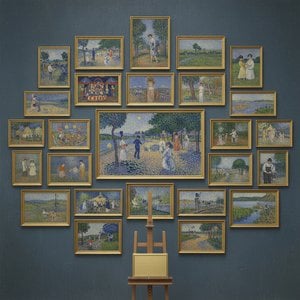
A Life Shaped by Light and Form
Born in Jönköping in 1855, Georg Wilhelm Pauli began his life in a Sweden that was rapidly changing. His path was set early through the Royal Academy of Arts in Stockholm, where he studied during the 1870s and 1880s. He was a man of deep curiosity, a trait that led him away from the familiar streets of his home toward the studios of France and Italy. These travels were not merely sightseeing trips; they were essential encounters with new ways of seeing. In the light of Paris and the classical shadows of Italy, he absorbed the techniques of the era, moving from the precise observations of naturalism toward a more profound interest in the human psyche and the spiritual weight of imagery.
His personal life was deeply intertwined with his creative one. He married Hanna Hirsch, a fellow painter who understood the demands of a life dedicated to art. Together, they shared a passion for experimentation, eventually moving to a manor house and studio called Villa Pauli in Storängen, Nacka. This space was more than a home; it was a sanctuary for their shared devotion to their craft. Their partnership reflected a broader movement in Swedish art, where artists sought to push past the boundaries of simple representation to find something more meaningful beneath the surface of the visible world.
The Scale of Vision
Pauli was a painter of immense scale. He had a particular talent for transforming large, empty walls into narratives that commanded attention. His work was not confined to small canvases; he was a master of the mural, taking on massive public commissions that changed the character of the buildings they inhabited. His hands touched the walls of the Gothenburg Museum, the New Stockholm Opera House, and the Royal Institute of Technology in Stockholm. These works often drew from mythology and classical traditions, using large figures to tell stories that felt both ancient and immediate.
His approach to these large-scale works was often controversial. In his hometown of Jönköping, he created murals in a Cubist style that sparked intense debate among those accustomed to more traditional forms. He was a member of the Opponenterna, a group of artists who stood against the conservative teaching methods of the Academy. This rebellious streak was a defining feature of his career. He was never content to simply repeat what had come before; he wanted to find a new language for the modern age.
Evolution of Style and Thought
The way Pauli saw the world shifted as he aged. In the early 1900s, he encountered the geometric experiments of Cubism in Paris. For a time, his work embraced these fractured, abstract shapes, reflecting a desire to break down the world into its essential components. Yet, he eventually returned to a more personal aesthetic. He favored a palette of deep colors and compositions that leaned back toward the classical and the mythological. He remained interested in the tension between the physical and the idea, a theme seen in works like Mens sana in corpore sano, where the strength of the human body is placed in conversation with the intellect.
Beyond his paintings, Pauli was a man of letters. He was a prolific author, writing books on art and history, including works on Ernst Josephson. His life was a continuous attempt to bridge the gap between the seen and the understood. When he died in 1935 in Stockholm County, he left behind a legacy that was etched into the very architecture of Sweden. His paintings remain in the Nationalmuseum in Stockholm, preserved as part of the country's visual history.


 Preview
 Send
Send Share
Share
 Details
 Guide
Guide

 Download
 Similars
 X-Ray
X-Ray Diaporama
 Q&A
Q&A
 Stats
Stats

 Read More
 Switch to Print





































 Glass option is only available in size under 110 CM