

The artwork displayed on this page is protected by copyright law, which means we cannot legally create or sell an identical reproduction. This protection is enforced under international agreements such as the Berne Convention and by national laws, including those outlined by the U.S. Copyright Law - Title 17.
This method fully complies with copyright regulations because it does not involve copying or duplicating the protected artwork. Instead, it is a creative reinterpretation - a new painting that is influenced by the original but not identical to it.
Museum-quality giclée or canvas print with fast production and flexible finish options. ( Buy Hand Made Painting Switch to Digital Image)
Pick from our preset sizes that match the artwork's original proportions.

Type the width and the height you need, to fit your frame or your wall. A print can only be cut, never made bigger than the picture, so a size with a different shape loses a part of the image. We send you a digital mockup to approve before we print anything. The picture shown on this page does not show the real cut — only the mockup does.
Worldwide Delivery () in 2 weeks instead of standard 4/5 weeks. (23 October)
Cave
Reproduction Size
In the landscape of contemporary art, few works possess the quiet, subversive power of Gavin Turk’s “Cave.” Created in 1995, this piece does not rely on grand gestures or overwhelming scale to command attention; instead, it operates through a profound sense of absence and the deliberate manipulation of institutional memory. At first glance, one might perceive only a minimalist installation—a stark, empty studio space punctuated by a singular, familiar blue plaque. Yet, beneath this deceptive simplicity lies a masterful critique of how we assign value to creativity. The work serves as a hauntingly beautiful meditation on what remains when the artist departs, leaving behind only the echoes of their presence and the cold, official markers of recognition.
The piece emerged from a moment of profound institutional friction. Following his unsuccessful application for an MA at the Royal College of Art, Turk responded not with a traditional exhibition of skill, but with a conceptual provocation that would define his career within the Young British Artists (YBA) movement. By presenting a vacant space adorned with an English Heritage-style plaque—stating simply that the sculptor had worked there between 1989 and 1991—Turk effectively hijacked the language of historical commemoration to mock the very institutions that sought to gatekeep his success. It is a work born of rejection, transformed into a triumphant statement on the power of self-definition.
To encounter “Cave” is to enter a labyrinth of symbolism where the boundaries between reality and artifice begin to dissolve. The blue plaque, an iconic symbol of London’s architectural heritage, typically denotes greatness and historical permanence. In Turk’s hands, however, this symbol becomes a tool of institutional critique. It represents the "official" version of history—a curated narrative bestowed upon those who meet certain predetermined standards. By presenting this plaque in a vacuum, Turk invites the viewer to question whether such accolades signify genuine artistic merit or merely serve as social stamps of approval within the art market.
The technical execution of the work further deepens this exploration of the "copy" versus the "original." The plaque itself is a vacform plastic reproduction, a material choice that deliberately underscores the artwork’s connection to mass production and reproducibility. There is no attempt at preciousness here; instead, there is a conscious embrace of the synthetic. This mirrors the broader themes of Turk’s practice: the deconstruction of the "genius" myth and the interrogation of authorship. For the collector or enthusiast, the piece offers a sophisticated intellectual layer, challenging us to consider how much of our perception of "truth" is merely a well-placed imitation.
For interior designers and collectors of contemporary conceptual art, a high-quality reproduction of “Cave” offers more than mere decoration; it provides a conversational centerpiece that anchors a space with intellectual weight. The stark contrast of the blue and white plaque against a dark, minimalist background allows it to integrate seamlessly into modern, avant-garde, or even industrial-chic environments. It possesses a sculptural gravity that complements clean lines and monochromatic palettes, acting as a window into the provocative spirit of the 1990s British art scene.
Owning a piece inspired by Turk’s vision is an invitation to contemplate the nature of legacy. Whether placed in a private gallery, a sophisticated study, or a curated residential space, “Cave” brings with it an aura of mystery and a sharp, witty edge. It is a work that does not just occupy space—it interrogates it, making it an essential acquisition for those who appreciate art that speaks as loudly through its silence as it does through its form.
"Cave" by Gavin Turk combines the installation art technique with the Conceptual Sculpture style. Technique and movement describe the making and the style of the work.
Artworks similar to "Cave" by Gavin Turk are gathered on the artwork's Similars page.
A reproduction of "Cave" fits well in a living room.


1967 - , United Kingdom
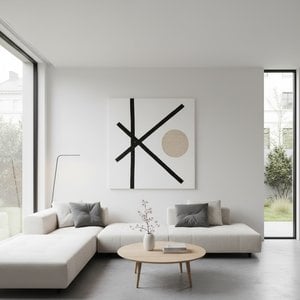
Discover how minimalist art elevates modern interiors. Explore the transformative power of geometric sculptures, tactile textures, and curated simplicity to create a luxurious, tranquil sanctuary in your home through expert design principles.

Master the nuances of three-dimensional art with our expert guide. Explore sculptural history, from Phidias to Neoclassicism, and learn to evaluate materiality, form, and technique like a true connoisseur. Elevate your collection with profound insights into the world of sculpture.

 Send
Send Share
Share
 Details
 Guide
Guide

 Download
 Similars
 Diaporama
 Stats
Stats


 Read More






































 Glass option is only available in size under 110 CM


