A Quiet Intrusion: The Intimacy of Metsu’s Masterpiece
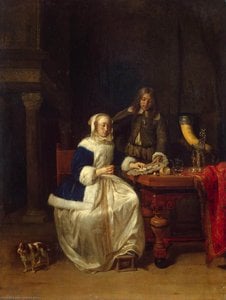
In the soft, amber glow of a seventeenth-century Dutch interior, a single moment is suspended in time, caught between the act of creation and the sting of discovery. Gabriel Metsu’s “The Letter-Writer Surprised,” painted around 1662, is far more than a mere domestic scene; it is a psychological drama played out in the hushed tones of a bourgeois home. As we gaze upon the woman seated at her desk, her focus entirely consumed by the parchment before her, we feel the weight of the unseen observer. The painting invites us into a world where every fold of fabric and every flicker of candlelight tells a story of secret thoughts and social boundaries. For the collector or the lover of fine art, this work offers a profound window into the Dutch Golden Age, capturing that delicate, fleeting instant when privacy is breached by a sudden, unexpected presence.
The composition is a masterclass in the Baroque use of chiaroscuro, where light does not merely illuminate but actively sculpts the narrative. Metsu employs a dramatic contrast between deep, velvety shadows and luminous highlights to draw the eye toward the central figures. The light spills across the woman’s linen attire and the textured surface of the wooden table, lending an almost tactile realism to the scene. This technique, reminiscent of the legendary Vermeer, creates a sense of three-dimensional depth that pulls the viewer into the room. One can almost hear the scratch of the quill against paper and the heavy silence that follows the man's sudden appearance. The presence of objects like the violin resting nearby and the glint of a wine glass adds layers of sensory richness, suggesting a life of cultured leisure interrupted by a moment of tension.
Symbolism and the Art of Observation
Beyond its technical brilliance, “The Letter-Writer Surprised” is rich with the symbolic language characteristic of the Dutch genre painting. The act of letter writing itself was often a metaphor for intimacy, longing, and the exchange of private emotions. By placing a man in the periphery—seemingly attentive yet subtly distanced—Metsu explores the complex interplay between presence and absence. Is he a protector, or is his gaze an intrusion? This ambiguity is what gives the painting its enduring emotional impact. The carefully placed books and musical instruments serve as emblems of a refined, intellectual lifestyle, yet they also ground the scene in a tangible reality that resonates with anyone who appreciates the beauty of domestic tranquility.
For those looking to bring a sense of historical elegance and contemplative depth into a contemporary space, this masterpiece serves as an incomparable focal point. Whether placed in a sunlit study or a sophisticated dining room, a high-quality reproduction of Metsu’s work commands attention through its quiet power. It does not shout for recognition; instead, it rewards the patient observer with subtle nuances of expression and a timeless atmosphere of grace. To possess such a piece is to hold a fragment of history—a beautifully rendered testament to the human desire to capture the ephemeral beauty of life's most private moments.
Questions & Answers
What mood and emotion come together in "The Letter-Writer Surprised"?
The recorded mood of "The Letter-Writer Surprised" by Gabriel Metsu is elegant, and its emotional tone is romantic.
Which room is "The Letter-Writer Surprised" by Gabriel Metsu recommended for, given its colors?
Considering its earthy colors, "The Letter-Writer Surprised" is suggested for a living room.
What are the author and date of "The Letter-Writer Surprised"?
The author of "The Letter-Writer Surprised" is Gabriel Metsu, and the work is dated 1662.



 Preview
 Buy Hand Made Painting
 Send
Send Share
Share
 Details
 Guide
Guide

 Download
 Similars
 X-Ray
X-Ray Diaporama
 Q&A
Q&A Stats
Stats


 Read More






































 Glass option is only available in size under 110 CM