Preview AR preview Buy Hand Made Painting Switch to Digital Image Send
Details Guide Add to favorites Download Similars X-Ray Diaporama Stats

LA RIBOTEUSE

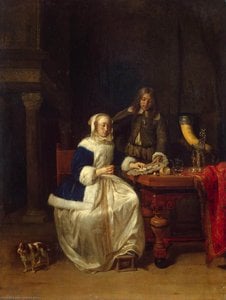
Discover Gabriel Metsu’s ‘La Riboteuse,’ a stunning Dutch Golden Age portrait of an elderly woman. Explore its rich detail, chiaroscuro & symbolic beauty – a timeless masterpiece.

Discover Gabriel Metsu (1629-1667), a Dutch Golden Age painter celebrated for his genre scenes, portraits & interiors. Influenced by Rembrandt & Vermeer, Metsu's art captured daily life with exquisite detail and symbolism.

Giclée / Art Print

Museum-quality giclée or canvas print with fast production and flexible finish options. ( Buy Hand Made Painting Switch to Digital Image)

Corner sample of the P118B picture frame: moulded polystyrene, 5 cm wide and 3 cm thick
P118B $10
Corner sample of the P118H picture frame: moulded polystyrene, 5 cm wide and 3 cm thick
P118H $10
Corner sample of the P118W picture frame: moulded polystyrene, 5 cm wide and 3 cm thick
P118W $10
Corner sample of the P438Z picture frame: moulded polystyrene, 5.5 cm wide and 3.5 cm thick
P438Z $10
Corner sample of the P508JH picture frame: moulded polystyrene, 7 cm wide and 3.5 cm thick
P508JH $12
Corner sample of the P508YH picture frame: moulded polystyrene, 7 cm wide and 3.5 cm thick
P508YH $12
Corner sample of the P805H picture frame: moulded polystyrene, 5 cm wide and 3.5 cm thick
P805H $10
Corner sample of the P805Z picture frame: moulded polystyrene, 5 cm wide and 3.5 cm thick
P805Z $10
Corner sample of the P919BZ picture frame: moulded polystyrene, 7 cm wide and 3.5 cm thick
P919BZ $10
Corner sample of the P919G picture frame: moulded polystyrene, 7 cm wide and 3.5 cm thick
P919G $10
Corner sample of the P919XJ picture frame: moulded polystyrene, 7 cm wide and 3.5 cm thick
P919XJ $10
Corner sample of the P959ZH picture frame: moulded polystyrene, 5 cm wide and 3 cm thick
P959ZH $10
Corner sample of the P968JZ picture frame: moulded polystyrene, 6 cm wide and 4 cm thick
P968JZ $12
Corner sample of the W106C picture frame: solid wood, 5 cm wide and 3 cm thick
W106C $8
Corner sample of the W218G picture frame: solid wood, 5 cm wide and 3 cm thick
W218G $10
Corner sample of the W218JH picture frame: solid wood, 5 cm wide and 3 cm thick
W218JH $8
Corner sample of the W218Y picture frame: solid wood, 5 cm wide and 3 cm thick
W218Y $10
Corner sample of the W307PJ picture frame: solid wood, 6 cm wide and 3 cm thick
W307PJ $10
Corner sample of the W316G picture frame: solid wood, 6 cm wide and 3 cm thick
W316G $10
Corner sample of the W316PJ picture frame: solid wood, 6 cm wide and 3 cm thick
W316PJ $8
Corner sample of the W316Y picture frame: solid wood, 6 cm wide and 3 cm thick
W316Y $10
Corner sample of the W398PJ picture frame: solid wood, 5 cm wide and 3 cm thick
W398PJ $8
Corner sample of the W4111J picture frame: solid wood, 6.5 cm wide and 3.5 cm thick
W4111J $10
Corner sample of the W500HY picture frame: solid wood, 7 cm wide and 5 cm thick
W500HY $15
Corner sample of the W500JH picture frame: solid wood, 7 cm wide and 5 cm thick
W500JH $15
Corner sample of the W692G picture frame: solid wood, 8 cm wide and 4 cm thick
W692G $12
Corner sample of the W849H picture frame: solid wood, 5 cm wide and 3 cm thick
W849H $8
Corner sample of the W940BG picture frame: solid wood, 7.5 cm wide and 4.5 cm thick
W940BG $15
Corner sample of the W953PJ picture frame: solid wood, 6 cm wide and 3.5 cm thick
W953PJ $8

Standard
custom
CM
INCH

Pick from our preset sizes that match the artwork's original proportions.

width
height

Type the width and the height you need, to fit your frame or your wall. A print can only be cut, never made bigger than the picture, so a size with a different shape loses a part of the image. We send you a digital mockup to approve before we print anything. The picture shown on this page does not show the real cut — only the mockup does.

Worldwide Delivery () in 2 weeks instead of standard 4/5 weeks. (24 October)

Free Worldwide Express Shipping
High-Quality Linen Canvas
Full Shipping Insurance
Customs Tax Refund Guarantee
True Color Matching Guarantee
100-Day Return Policy (Defects Only)
100% Money-Back Guarantee
Bulk Discount Offer

Total Price

$ 69

LA RIBOTEUSE

Giclée / Art Print

Reproduction Size

-

Total Price

$ 69

Quick Facts

  • Subject or theme: Domesticity, elderly woman
  • Title: La Riboteuse
  • Location: Private Collection
  • Year: c. 1665
  • Medium: Oil on canvas

Art Quiz

There is only one correct answer for each question.

Question 1:
What artistic movement is most closely associated with Gabriel Metsu’s ‘La Riboteuse’?
Question 2:
The presence of jugs in the painting likely symbolizes:
Question 3:
Which technique is most prominently used by Metsu to create the painting’s rich texture?
Question 4:
The lighting in ‘La Riboteuse’ is characterized by:
Question 5:
What does the woman’s aged appearance suggest about Metsu's approach to portraying his subjects?

A Quiet Moment in Delft: Gabriel Metsu’s *La Riboteuse*

Gabriel Metsu's La Riboteuse (The Washerwoman) is not merely a portrait; it’s a carefully constructed tableau of domesticity, steeped in the subtle nuances of Dutch Golden Age realism. Painted around 1665, this intimate scene offers a rare glimpse into the everyday life of a woman – an elderly washerwoman – rendered with a remarkable sensitivity and attention to detail that speaks volumes about Metsu's artistic vision. The painting immediately draws the viewer in with its muted palette of browns, ochres, and creams, punctuated by the vibrant red and white of the jugs she holds. These earthy tones evoke the warmth of a humble home and the tangible textures of linen and wood, grounding the scene in a believable reality.

The Master of Subtle Detail: Metsu’s Technique

Metsu's skill lies not in grand gestures or dramatic compositions, but rather in his meticulous rendering of ordinary objects and figures. He was known as an “eclectic artist,” experimenting with various genres – history paintings, still lifes, portraits, and genre scenes – yet consistently employing a remarkably consistent approach to detail. Observe the layering of thin glazes of oil paint, building up color and form gradually; this technique, characteristic of the Dutch Golden Age, creates a remarkable sense of depth and texture. The impasto brushstrokes, particularly evident in the folds of her dress and the rough surface of the jugs, lend a tactile quality to the image, inviting us to almost reach out and touch it. The use of *chiaroscuro*, with its strong contrasts between light and shadow, sculpts the woman’s face and defines the surrounding objects, adding volume and drama without resorting to overt theatricality.

Symbolism Within the Everyday

While seemingly a simple depiction of a washerwoman at her work, La Riboteuse is rich in subtle symbolism. The jugs, prominently displayed, are not just props; they represent the labor and domesticity that defined much of life in 17th-century Holland. The woman’s age and weathered face speak to a life lived, marked by hardship and resilience – a common theme in Dutch art of the period. Her thoughtful expression, perhaps tinged with melancholy, suggests a quiet dignity and an acceptance of her lot. The shallow depth of field further emphasizes the subject, creating a sense of intimacy and drawing our attention solely to this solitary figure within her domestic sphere. The composition itself, centered around the woman, reinforces her importance within the scene, elevating her from mere background element to the focal point of the artwork.

A Window into Delft: Historical Context

Gabriel Metsu’s life remains somewhat shrouded in mystery, adding to the allure of his work. Born in Leiden in 1629 and tragically dying at a young age in 1667, he worked primarily for the prominent Van der Veer family in Delft, serving as their court painter. This intimate connection with a wealthy merchant household likely shaped his artistic sensibilities, encouraging him to capture the quiet dignity of everyday life within a refined aesthetic. *La Riboteuse* reflects this sensibility perfectly – it’s not an idealized portrayal of wealth or power, but rather a respectful and nuanced observation of a woman's existence. The painting stands as a testament to Metsu’s ability to find beauty and significance in the commonplace, offering us a poignant glimpse into the world of Delft during the Dutch Golden Age.

Questions & Answers

What atmosphere would a reproduction of "LA RIBOTEUSE" by Gabriel Metsu bring to a room?

"LA RIBOTEUSE" by Gabriel Metsu has a calm atmosphere and is recommended for a living room. The mood is what the work brings to the space around it.

Did "LA RIBOTEUSE" stay in its artist's homeland?

No - the artwork is kept abroad. "LA RIBOTEUSE" is held in France, while Gabriel Metsu was born in Netherlands.

What other names is Gabriel Metsu known by?

Other names recorded for Gabriel Metsu, creator of "LA RIBOTEUSE", include Gabriël Metsu.


Artist Biography

**a life of artistic exploration**

gabriël metsu, a dutch painter from the netherlands, lived a life marked by artistic exploration and innovation. born in 1629, metsu's work embodied the spirit of the dutch golden age, a period renowned for its prolific artistic output. this biography delves into the life and works of this enigmatic figure, whose contributions to the art world continue to fascinate.

**early life and influences**

metsu was born in 1629, the son of jacques metsu, a tapestry worker and painter originally from hainault. this eclectic background likely influenced gabriel's early interest in diverse artistic techniques. the family's move to leiden, where metsu grew up, exposed him to various cultural influences.

**artistic career**

metsu's career was marked by an adherence to no single style or technique, earning him the title of "a highly eclectic artist." his work spanned history paintings, still lifes, portraits, and genre works. notably, only 14 of his 133 works are dated, leaving much to be discovered about his creative process.
  • rembrandt van rijn's influence on metsu's early work is evident, particularly in his use of light and color.
  • metsu's move to amsterdam in 1655 marked a significant shift in his style, with more emphasis on domestic interiors and genre scenes.
  • his training of michiel van musscher and joost van geel reflects his commitment to the artistic community.

**notable works and legacy**

metsu's paintings often featured young women, market scenes, and old people, drawing from popular emblems. a notable example is the poultry seller, which showcases his use of symbolism. key works:

**museums and collections**

metsu's works can be found in various museums, including the rijksmuseum in amsterdam. for more information on his art and to explore other dutch golden age painters, visit /en/art/show/art-d3c627-en/ for a comprehensive overview. **conclusion:** gabriel metsu's life and art are a testament to the innovative spirit of the dutch golden age. his eclectic style, though sometimes enigmatic, has left an indelible mark on the world of art. as we continue to uncover more about his life and works, we are reminded of the profound impact he had on the development of western art.
  • for a deeper understanding of the dutch golden age, refer to [https://en.wikipedia.org/wiki/dutch_golden_age_painting](https://en.wikipedia.org/wiki/dutch_golden_age_painting).
  • explore more of metsu's works and those of his contemporaries at [https://WahooArt.com/@/gabriel-metsu](https://WahooArt.com/@/gabriel-metsu).

**references:**

Gabriel Metsu

Gabriel Metsu

1629 - 1667 , Netherlands

Quick Facts

  • Artistic Movement Or Style: Dutch Golden Age painting
  • Artists Or Movements Influenced By This Artist:
    • Michiel van Musscher
    • Joost van Geel
  • Artists Who Influenced This Artist:
    • Rembrandt van Rijn
    • Johannes Vermeer
  • Date Of Birth: 1629
  • Date Of Death: 1667
  • Full Name: Gabriel Metsu
  • Nationality: Dutch
  • Notable Artworks:
    • The Sick Child
    • Poultry Seller
    • Portrait of the Hinlopen Family
  • Place Of Birth: Leiden, Netherlands
Explore artworks organized by themes, styles, and characteristics.