


Museum-quality giclée or canvas print with fast production and flexible finish options. ( Buy Hand Made Painting Switch to Digital Image)





























Pick from our preset sizes that match the artwork's original proportions.

Type the width and the height you need, to fit your frame or your wall. A print can only be cut, never made bigger than the picture, so a size with a different shape loses a part of the image. We send you a digital mockup to approve before we print anything. The picture shown on this page does not show the real cut — only the mockup does.
Worldwide Delivery () in 2 weeks instead of standard 4/5 weeks. (21 November)
Fruit still-life
Reproduction Size
A stone ledge holds the weight of a heavy, silent abundance. Under a single light source from the upper left, the world emerges from a dark, indeterminate void. Peaches, heavy with juice, sit near the cool, pale translucence of white grapes. The surface of an oyster shell glistens with a wet, pearlescent sheen, contrasting against the velvety skin of fruit. A moth rests quietly, its papery wings a delicate interruption to the dense arrangement. Everything is caught in a moment of ripening, just before the inevitable decay begins.
The composition follows a strict, pyramidal structure, pulling the eye through a landscape of textures and light. Each object carries a quiet weight, anchored by the hard, horizontal line of the stone. The arrangement speaks of the fleeting nature of life through its specific, tactile details:
Though rendered in oil on canvas, the work carries a precision that mirrors the meticulous nature of its creator. The light creates deep shadows and bright highlights, giving the fruit a heavy, three-dimensional volume. There is a tension between the soft, organic shapes of the peaches and the hard, unyielding stone. The detail in the translucent grapes and the fine textures of the moth suggests a hand accustomed to the exacting demands of fine lines. It is a study of light and shadow, capturing the precise instant where ripeness meets the shadow.
The medium of "Fruit still-life" by Joris van Son is oil on canvas. Reproductions aim to render the appearance of this technique.
The format of "Fruit still-life" is portrait, and the original measures 48.0 x 33.0cm. Both are useful when planning a reproduction.
The perceived brightness of "Fruit still-life" by Joris van Son is deep_shadow. It can be matched to the light of the intended space.

Born in Antwerp, Belgium, Joris van Son was a Flemish still life painter who became a master in the Guild of Saint Luke of Antwerp during the 1643/1644 guild year. His artistic output was diverse, encompassing various sub-genres of still life, including fruit still lifes, flower pieces, banquet still lifes, vanitas still lifes, garland paintings, and pronkstillevens. He was also known for painting fish still lifes representing the Four Elements. His work was highly regarded by collectors, appearing in the collections of traders such as Geraert van Dorth and artists like Victor Wolfvoet.
Van Son's technical skill was particularly evident in his ability to render the physical qualities of fruit, such as the hairiness of peaches. In his garland paintings, he often collaborated with figure artists like Erasmus Quellinus II, Pieter Boel, and Frans Wouters, creating compositions where fruit or flower garlands framed devotional or secular images. His later work in the late 1650s transitioned into more modest still lifes with restrained composition and coloring, such as his depictions of fruit baskets, lobsters, and oysters.
The artist's personal life included membership in the pious bachelor society, the Sodaliteit van de Bejaerde Jongmans, in 1647. He was married to the mother of his children, Cornelia van Heulens, with whom he had a daughter, Maria Chatharina, and a son, Jan Frans. While Joris van Son died in Antwerp in 1667, his son Jan Frans went on to become a still life painter who worked in England.
Van Son's studio served as a training ground for several pupils, including:

1623 - 1667 , Belgium
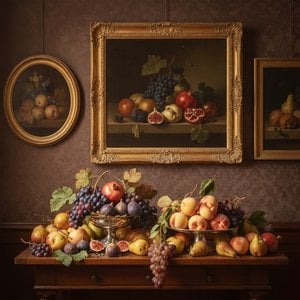
Discover the profound beauty of fruit still life paintings. Explore the rich symbolism, Baroque mastery, and timeless allure of nature's bounty through an art-historical lens, perfect for collectors and enthusiasts of classical fine art.
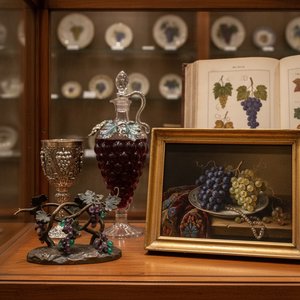
Embark on a visual journey through the world's most exquisite grape-themed masterpieces. Discover the technical brilliance of Baroque masters and learn how to curate timeless, hand-painted oil reproductions for your luxury collection with WahooArt.com.

Discover the opulent world of fruit still life masterpieces. From Baroque chiaroscuro to Impressionist light, explore the artistry of nature's bounty through museum-quality, hand-painted oil reproductions and bespoke commissions for the discerning art collector.

Explore the profound beauty of fruit arrangement masterpieces. From Dutch Golden Age opulence to Baroque chiaroscuro, discover the art history, symbolism, and timeless elegance of classical still life paintings for the discerning collector.

Explore the history of citrus in art from Baroque masters to Van Gogh. Discover the evolution of botanical beauty today.
 Preview

 Send
 Share
 Details
 Guide


 Download
 Similars
 X-Ray
 Diaporama
 Q&A

 Stats


 Read More









 Glass option is only available in size under 110 CM


