
Artist Biography
A Norwegian Voice in the Impressionist Chorus
Frits Thaulow, a name perhaps less immediately recognizable than Monet or Renoir, nevertheless occupies a significant and compelling space within the narrative of 19th-century Impressionism. Born Johan Frederik Thaulow in Oslo (then Christiania) in 1847, he wasn’t simply *influenced* by the French movement; he actively participated in it, bringing a distinctly Scandinavian sensibility to its exploration of light, atmosphere, and modern life. His story is one of artistic pilgrimage, bridging the cool, dramatic landscapes of Norway with the burgeoning avant-garde scene of Paris, ultimately forging a style uniquely his own—one deeply rooted in naturalism yet infused with an Impressionistic shimmer. Thaulow’s lineage provided him with both privilege and intellectual stimulation; his father was a prosperous chemist, and his mother came from the respected Munch family (a connection that places him within the orbit of Edvard Munch, though their artistic paths diverged). This background afforded him access to education at the Royal Academy of Drawing in Oslo and later, crucial formative studies in Copenhagen and Karlsruhe under Hans Gude, a pivotal figure in Norwegian landscape painting.
From Scandinavian Shores to French Light
The early seeds of Thaulow’s artistic vision were sown amidst the rugged beauty of his native Norway. However, a turning point arrived with his journey to Skagen, Denmark, in 1879. This coastal village was rapidly becoming a magnet for artists drawn by its unique light and the raw authenticity of life along the North Sea. Alongside Christian Krohg, a lifelong friend and fellow artist, Thaulow immersed himself in capturing the lives of fishermen, the drama of the sea, and the ever-changing moods of the Danish coastline. This experience proved transformative, pushing him beyond traditional academic techniques towards a more direct engagement with observation and a looser, more expressive brushstroke. It was here that he began to truly grapple with the fleeting effects of light—a hallmark of Impressionism—and to develop his signature ability to depict water in all its nuanced glory. But Skagen wasn’t an end point; it was a stepping stone. In 1892, Thaulow made the momentous decision to relocate to France, initially hoping to capture the vibrancy of Parisian life. He quickly discovered, however, that the bustling metropolis didn't resonate with his artistic temperament. The sprawling urban landscape lacked the intimate connection to nature he craved.
The Quiet Charm of Rural France
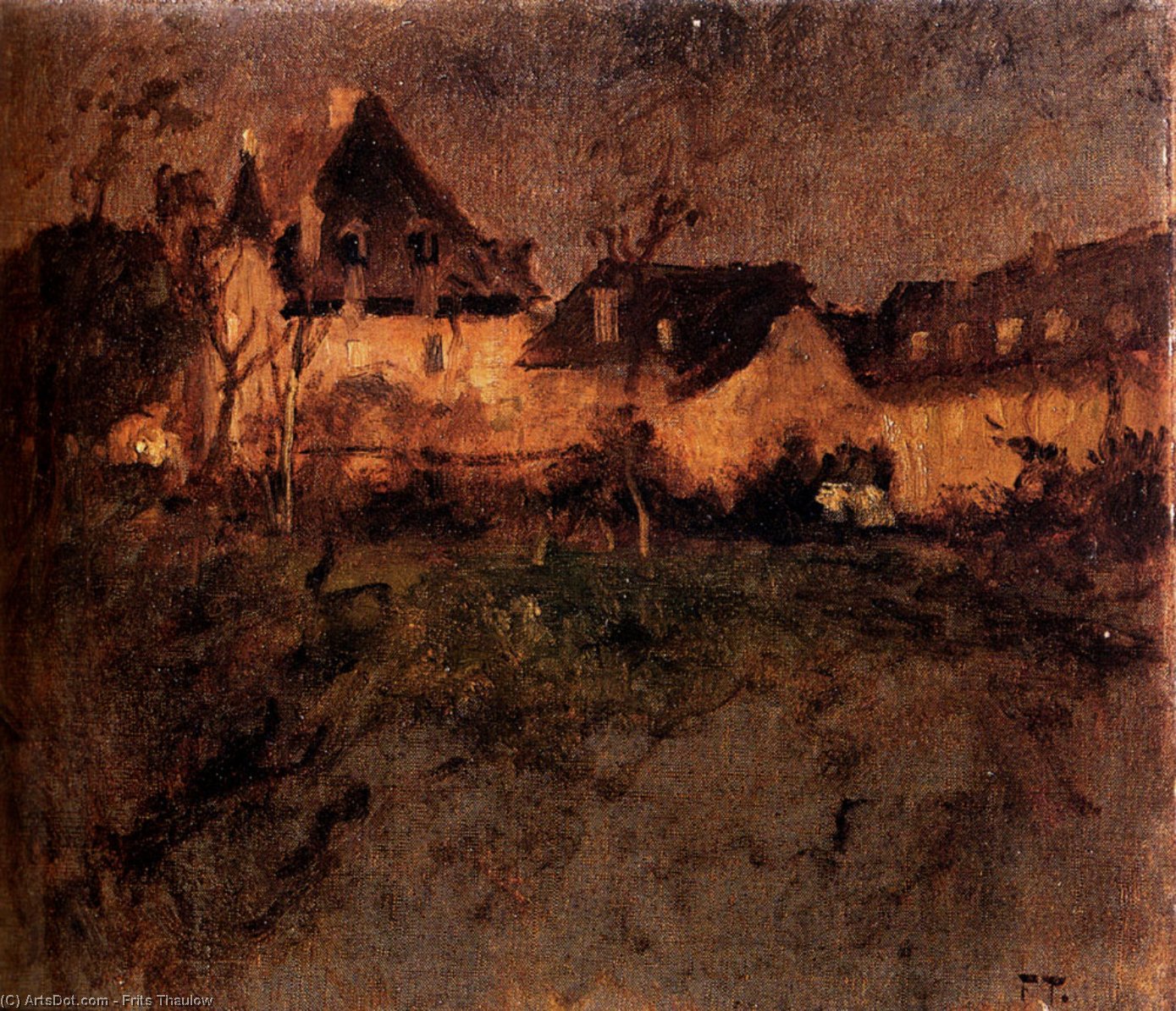
Instead, Thaulow found inspiration in the smaller towns and villages scattered across the French countryside. He settled for periods in Montreuil-sur-Mer, Dieppe, Quimperle in Brittany, and finally Beaulieu-sur-Dordogne, each location offering a unique palette of light, color, and atmosphere. It was here, away from the clamor of Paris, that he truly flourished. His paintings from this period are characterized by a serene lyricism, depicting tranquil rivers, snow-covered streets, and the gentle rhythms of rural life. He wasn’t interested in grand narratives or dramatic events; rather, he focused on capturing the quiet beauty of everyday moments—a woman carrying water, a horse-drawn carriage traversing a snowy lane, sunlight filtering through trees along a riverbank. His technique became increasingly refined, employing broken brushstrokes and subtle color variations to create an impression of shimmering light and atmospheric depth. He wasn’t merely *representing* nature; he was attempting to convey its ephemeral qualities—its fleeting moods and ever-changing appearance. During his time in Dieppe, Thaulow integrated into a vibrant artistic community, befriending artists like Charles Conder and even encountering the notorious Aubrey Beardsley, demonstrating his engagement with broader cultural currents of the era.
Legacy and Recognition
Thaulow’s contributions to Norwegian and European art were widely recognized during his lifetime. He received numerous accolades, including appointments as a Commander of the Royal Norwegian Order of St. Olav and membership in the French Legion of Honor. His work was exhibited extensively throughout Europe and garnered critical acclaim for its poetic sensibility and technical mastery. Despite this recognition, Thaulow’s reputation has perhaps been somewhat overshadowed by his more famous Impressionist contemporaries. However, a renewed appreciation for his unique artistic vision is emerging. Today, his paintings are held in prominent collections around the world, including the National Gallery of Norway, the Hermitage Museum in St. Petersburg, and the Busch-Reisinger Museum at Harvard University. Winter at Simoa River, Fra Beaulieu, and A Morning River Scene stand as testaments to his skill, showcasing his ability to capture not just a visual likeness of a place but also its emotional resonance. Frits Thaulow’s legacy lies in his ability to synthesize the principles of Impressionism with a distinctly Scandinavian aesthetic, creating works that are both visually captivating and deeply evocative—a quiet master who continues to enchant viewers with his serene depictions of nature and the beauty of everyday life.
Personal Life
Thaulow’s personal life mirrored the artistic journey he undertook. He married Ingeborg Charlotte Gad in 1874, but the marriage dissolved in 1886. A year later, he found happiness again with Alexandra Lasson, daughter of a noted Norwegian attorney. This union produced three children: Harald, Ingrid, and Christian. His family life provided him with stability and inspiration, though his artistic pursuits often required extended periods away from home. He died unexpectedly in Volendam, Netherlands, in 1906 at the age of 59, leaving behind a rich and enduring body of work that continues to inspire artists and art lovers alike.

