

Museum-quality giclée or canvas print with fast production and flexible finish options. ( Buy Hand Made Painting Switch to Digital Image)





























Pick from our preset sizes that match the artwork's original proportions.

You may enter your own dimensions to fit a specific frame or space. If your selected size does not match the original image's proportions, we will either crop the artwork or extend the image with a mirrored or solid-fill edge. A digital mockup will be sent for your approval before production begins.
Please note that the on-screen preview does not reflect the actual cropping or extension. Only the mockup will accurately show the final composition.
While custom sizes are available, we recommend selecting a dimension from the predefined list to preserve the original proportions.
Worldwide Delivery () in 2 weeks instead of standard 4/5 weeks. (22 September)


Silhouette
Reproduction Size
Frederick Carl Frieseke’s “Silhouette” is more than just a portrait; it's an invitation. Painted in 1933, this oil on canvas captures a moment of profound stillness – a woman lost in thought, gazing out from a window, her presence radiating a serene and almost melancholic beauty. The painting immediately draws the viewer into its quiet world, a testament to Frieseke’s mastery of Impressionist technique and his ability to evoke emotion through subtle details.
Frieseke was a key figure in American Impressionism, deeply influenced by the French masters like Monet and Renoir. His work is characterized by loose brushstrokes, an emphasis on capturing fleeting moments of light and atmosphere, and a focus on depicting everyday scenes with remarkable sensitivity. “Silhouette” exemplifies these qualities perfectly. The artist’s technique – delicate, almost translucent layers of paint – creates a luminous effect, as if the scene is bathed in soft, diffused sunlight. This approach wasn't merely about replicating what was seen; it was about conveying an *impression* of light and emotion.
Created in 1933, “Silhouette” reflects a period of significant artistic change. Frieseke’s relocation to Paris in 1898 proved pivotal, immersing him in the heart of the Impressionist movement. The painting's quiet contemplation also resonates with the broader cultural trends of the early 20th century – a growing interest in introspection and the beauty of the natural world. His earlier training at the Art Institute of Chicago provided a solid foundation, while his time in Paris allowed him to refine his style and develop a unique artistic voice.
The title itself, “Silhouette,” immediately suggests mystery and shadow – hinting at the unseen world that occupies the woman’s thoughts. The act of gazing out the window is a universal symbol of longing, reflection, and perhaps even a touch of melancholy. Frieseke masterfully captures this emotional resonance, inviting viewers to project their own feelings and interpretations onto the scene. “Silhouette” isn't just a beautiful painting; it’s an evocative meditation on solitude, beauty, and the human condition.


1874 - 1939 , United States of America

Master the nuances of Impressionism vs. Post-Impressionism with our expert guide. Explore the revolutionary shift from Monet’s fleeting light to Van Gogh’s emotional depth. Discover how these iconic movements continue to inspire fine art collectors and modern interiors today.
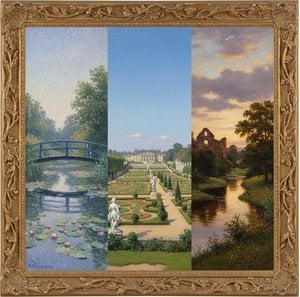
Embark on a visual journey through the serene beauty of gardens and parks in fine art. Discover how master artists capture nature's tranquility through impressionistic blooms and classical landscapes to bring timeless elegance into your home collection.

 Preview
 Send
Send Share
Share
 Details
 Guide
Guide

 Download
 Similars
 X-Ray
X-Ray Diaporama
 Stats
Stats


 Read More







 Glass option is only available in size under 110 CM


