Preview AR preview Buy Hand Made Painting Switch to Digital Image Send
Details Guide Add to favorites Download Similars X-Ray Diaporama Stats

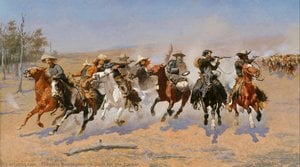
The Trooper

Experience the dynamic energy of Frederic Remington's 1891 American Western masterpiece, The Trooper, capturing the spirit of the desert frontier; discover this iconic piece today.

Explore the captivating world of Frederic Remington (1861-1909), master of Western American art! Discover iconic paintings of cowboys, Native Americans & frontier life – a true American legend.

Giclée / Art Print

Museum-quality giclée or canvas print with fast production and flexible finish options. ( Buy Hand Made Painting Switch to Digital Image)

Corner sample of the P118B picture frame: moulded polystyrene, 5 cm wide and 3 cm thick
P118B $10
Corner sample of the P118H picture frame: moulded polystyrene, 5 cm wide and 3 cm thick
P118H $10
Corner sample of the P118W picture frame: moulded polystyrene, 5 cm wide and 3 cm thick
P118W $10
Corner sample of the P438Z picture frame: moulded polystyrene, 5.5 cm wide and 3.5 cm thick
P438Z $10
Corner sample of the P508JH picture frame: moulded polystyrene, 7 cm wide and 3.5 cm thick
P508JH $12
Corner sample of the P508YH picture frame: moulded polystyrene, 7 cm wide and 3.5 cm thick
P508YH $12
Corner sample of the P805H picture frame: moulded polystyrene, 5 cm wide and 3.5 cm thick
P805H $10
Corner sample of the P805Z picture frame: moulded polystyrene, 5 cm wide and 3.5 cm thick
P805Z $10
Corner sample of the P919BZ picture frame: moulded polystyrene, 7 cm wide and 3.5 cm thick
P919BZ $10
Corner sample of the P919G picture frame: moulded polystyrene, 7 cm wide and 3.5 cm thick
P919G $10
Corner sample of the P919XJ picture frame: moulded polystyrene, 7 cm wide and 3.5 cm thick
P919XJ $10
Corner sample of the P959ZH picture frame: moulded polystyrene, 5 cm wide and 3 cm thick
P959ZH $10
Corner sample of the P968JZ picture frame: moulded polystyrene, 6 cm wide and 4 cm thick
P968JZ $12
Corner sample of the W106C picture frame: solid wood, 5 cm wide and 3 cm thick
W106C $8
Corner sample of the W218G picture frame: solid wood, 5 cm wide and 3 cm thick
W218G $10
Corner sample of the W218JH picture frame: solid wood, 5 cm wide and 3 cm thick
W218JH $8
Corner sample of the W218Y picture frame: solid wood, 5 cm wide and 3 cm thick
W218Y $10
Corner sample of the W307PJ picture frame: solid wood, 6 cm wide and 3 cm thick
W307PJ $10
Corner sample of the W316G picture frame: solid wood, 6 cm wide and 3 cm thick
W316G $10
Corner sample of the W316PJ picture frame: solid wood, 6 cm wide and 3 cm thick
W316PJ $8
Corner sample of the W316Y picture frame: solid wood, 6 cm wide and 3 cm thick
W316Y $10
Corner sample of the W398PJ picture frame: solid wood, 5 cm wide and 3 cm thick
W398PJ $8
Corner sample of the W4111J picture frame: solid wood, 6.5 cm wide and 3.5 cm thick
W4111J $10
Corner sample of the W500HY picture frame: solid wood, 7 cm wide and 5 cm thick
W500HY $15
Corner sample of the W500JH picture frame: solid wood, 7 cm wide and 5 cm thick
W500JH $15
Corner sample of the W692G picture frame: solid wood, 8 cm wide and 4 cm thick
W692G $12
Corner sample of the W849H picture frame: solid wood, 5 cm wide and 3 cm thick
W849H $8
Corner sample of the W940BG picture frame: solid wood, 7.5 cm wide and 4.5 cm thick
W940BG $15
Corner sample of the W953PJ picture frame: solid wood, 6 cm wide and 3.5 cm thick
W953PJ $8

Standard
custom
CM
INCH

Pick from our preset sizes that match the artwork's original proportions.

width
height

Type the width and the height you need, to fit your frame or your wall. A print can only be cut, never made bigger than the picture, so a size with a different shape loses a part of the image. We send you a digital mockup to approve before we print anything. The picture shown on this page does not show the real cut — only the mockup does.

Worldwide Delivery () in 2 weeks instead of standard 4/5 weeks. (22 October)

Free Worldwide Express Shipping
High-Quality Linen Canvas
Full Shipping Insurance
Customs Tax Refund Guarantee
True Color Matching Guarantee
100-Day Return Policy (Defects Only)
100% Money-Back Guarantee
Bulk Discount Offer

Total Price

$ 69

The Trooper

Giclée / Art Print

Reproduction Size

-

Total Price

$ 69

Quick Facts

  • Artistic style: American Western art
  • Year: 1891
  • Subject or theme: Man riding a horse in the desert
  • Title: The Trooper

Art Quiz

There is only one correct answer for each question.

Question 1:
In what year was Frederic Remington's painting 'The Trooper' created?
Question 2:
What is the primary subject matter depicted in 'The Trooper'?
Question 3:
Which artistic technique is noted as being used by Remington in 'The Trooper' to create depth and volume?
Question 4:
Frederic Remington was particularly fascinated by which geographical region for his artwork?
Question 5:
What type of medium was 'The Trooper' painted in?

The Enduring Spirit of the American Frontier

To gaze upon Frederic Remington's "The Trooper" is not merely to observe a painting; it is to step directly into the heart of the American West at the turn of the twentieth century. This oil on canvas, executed in 1891, captures a moment suspended between action and reflection—a tableau vivant brimming with untamed energy. The scene unfolds under an imagined vast sky, depicting a lone rider astride his powerful horse traversing the arid expanse of the desert. It is a masterful study in movement, where every sinew visible beneath the saddle leather speaks of endurance and raw vitality. Remington possessed an unparalleled gift for bottling the spirit of this legendary frontier life, making the viewer feel the grit underfoot and the whisper of the wind across the open plains.

Mastery in Brushstroke and Tone

Technically, "The Trooper" is a breathtaking display of academic skill married to visceral emotion. Remington employed bold, confident brushstrokes that lend the entire composition a palpable sense of immediacy. Observe how he utilizes chiaroscuro; the interplay between deep shadow and brilliant sunlight sculpts the forms—the musculature of the horses, the folds in the rider's worn clothing—giving everything an almost three-dimensional weight. The palette itself is crucial to its power, dominated by earthy tones: ochres, burnt siennas, and dusty browns that evoke the very soil beneath the hooves. Yet, these muted colors are punctuated by vivid accents, drawing the eye to the rider's determined posture and the glint of his accoutrements.

Symbolism of Man, Horse, and Landscape

Beyond the immediate drama, the painting resonates with profound symbolism. The horse itself is perhaps the most potent symbol—it represents freedom, partnership, and the sheer power required to conquer or traverse such a monumental landscape. The rider, armed and resolute, embodies the archetype of the American pioneer, forever moving forward into the unknown. Furthermore, the inclusion of other figures and horses receding into the background adds layers of narrative depth. They suggest community, shared struggle, and the endless journey that defined so much of the West's mythology. It speaks to a time when life was lived on the edge of civilization, where survival depended on skill, grit, and the bond between man and beast.

A Timeless Echo for Modern Spaces

For the collector or designer seeking art with narrative weight, "The Trooper" offers more than mere decoration; it offers a conversation piece steeped in American history. Its dynamic energy prevents it from feeling static, making it an ideal focal point in a grand hall, a study, or any space that wishes to evoke a sense of adventure and enduring spirit. While the subject matter is rooted in a bygone era, the feelings it evokes—the yearning for open spaces, the romance of self-reliance—are utterly timeless. Owning a reproduction allows one to bring this magnificent echo of the frontier into the contemporary sanctuary, celebrating the artistry and the myth that Frederic Remington so brilliantly captured.

Questions & Answers

What emotion does the American Western Art work "The Trooper" convey?

Within the American Western Art movement, "The Trooper" is recorded with an energetic tone.

Does "The Trooper" by Frederic Remington use strong contrasts or soft harmonies?

The color composition of "The Trooper" by Frederic Remington combines a bold contrast with a strong color unity harmony.

How do I preview a reproduction of "The Trooper" by Frederic Remington?

To preview a reproduction of "The Trooper" by Frederic Remington, open the artwork's Preview page.


Artist Biography

A Chronicler of the Vanishing West: The Life and Art of Frederic Remington

Frederic Sackrider Remington, born in Canton, New York, on October 4, 1861, wasn’t a product of the Wild West he so vividly depicted; rather, he was an Easterner who forged his artistic identity through fascination and dedicated study. His lineage hinted at a life far removed from dusty trails and cavalry charges – French Basque ancestry mingled with staunchly Republican New England roots, a father who was a Civil War colonel and newspaper editor, and connections to the famed Remington Arms dynasty through distant cousins. Yet, it was an early exposure to military themes, coupled with a restless spirit and a keen eye for storytelling, that set him on a path toward becoming arguably the most recognizable artist of the American West. His childhood moved to Bloomington, Illinois, then back to Canton and finally Ogdensburg, New York, but his imagination remained captivated by tales of frontier life. Though initially steered towards a military education at Vermont Episcopal Institute, Remington’s true calling lay not in following orders, but in observing and interpreting the world around him through art. A brief stint at Yale University confirmed this; football and sketching held far more appeal than formal academic pursuits.

From Illustrator to Painter: Forging an Artistic Vision

Remington’s artistic journey began not with grand canvases, but with ink and paper. His first published work, a cartoon for the *Yale Courant*, signaled an early aptitude for capturing action and narrative. A pivotal trip to Montana in 1881 ignited his lifelong obsession with the West. This wasn't merely a tourist’s gaze; Remington sought to immerse himself in the culture, observing cowboys, Native Americans, and the landscape itself. He initially attempted ranching and mining ventures, but these proved unsuccessful, freeing him to fully dedicate himself to art. Returning East, he quickly established himself as an illustrator for magazines like *Harper's Weekly* and *Collier’s*, his dynamic depictions of Western scenes captivating a national audience hungry for stories of the frontier. These illustrations weren’t simply reportage; they were infused with drama, energy, and a romanticized vision of the West that resonated deeply with the public imagination. It was through this work that Remington honed his skills in composition, capturing movement, and conveying emotion – qualities that would later define his paintings. He received minimal formal training beyond some drawing classes at Yale and a short period at the Art Students League, developing instead a distinctive style characterized by energetic brushwork, bold colors, and a focus on realism blended with dramatic flair.

Capturing a Vanishing World: Themes and Style

Remington’s art is inextricably linked to a specific moment in American history – the twilight of the Old West. His canvases are populated by iconic figures: rugged cowboys driving cattle, stoic Native Americans facing displacement, and U.S. Cavalry soldiers engaged in both heroic battles and tragic conflicts. He didn't shy away from depicting the harsh realities of frontier life, but his work often leans towards a romanticized portrayal, emphasizing courage, adventure, and the clash of cultures. His paintings aren’t simply historical documents; they are evocative narratives that explore themes of heroism, loss, and the inevitable march of progress. Remington's style evolved over time, moving from tighter, more academic renderings to looser, more expressive brushwork. He was a master of capturing movement – horses galloping across the plains, cowboys wrestling steers, soldiers charging into battle. He often employed quick sketches and photographs as reference material, but his art always transcended mere imitation, imbued with his own unique vision and emotional intensity. Notable works like *My Ranch*, *Waiting in the Moonlight*, *Ridden Down* (1905), and *The Long-Horn Cattle Sign* (1908) exemplify his ability to capture both the grandeur and the vulnerability of the American West.

Legacy and Enduring Influence

Frederic Remington died unexpectedly in 1909 at the age of 48, leaving behind a vast body of work that continues to captivate audiences today. His impact on Western art is undeniable; he didn’t just depict the West, he helped *define* it for generations of Americans. He established a visual language for the frontier – an iconography of cowboys, Indians, and cavalrymen that became deeply ingrained in popular culture.
  • His work inspired countless other artists, including N.C. Wyeth and Zane Grey.
  • The Frederic Remington Art Museum in Ogdensburg, New York, stands as a testament to his enduring legacy, preserving an extensive collection of his paintings, sculptures, and archival materials.
  • His art continues to be exhibited in major museums across the country, including the Metropolitan Museum of Art and the Amon Carter Museum of American Art.
Remington’s depictions, while sometimes criticized for their romanticized portrayal of the West, offer a valuable glimpse into a pivotal era in American history. He captured not just what *was*, but also what people *believed* about the West – its myths, its legends, and its enduring appeal. He remains a powerful symbol of the American spirit—a chronicler of a vanishing world who transformed it into an enduring artistic legacy.
Frederic Remington

Frederic Remington

1861 - 1909 , United States of America

Quick Facts

  • Full Name: Frederic Sackrider Remington
  • Nationality: American
  • Date Of Birth: 1861
  • Date Of Death: 1909
  • Place Of Birth: Canton, United States of America
  • Notable Artworks:
    • My Ranch
    • Waiting in the Moonlight
    • Ridden Down (1905)
    • The Long-Horn Cattle Sign
  • Artistic Movement Or Style: Western American Art
  • Artists Or Movements Influenced By This Artist:
    • N.C. Wyeth
    • Zane Grey
Explore artworks organized by themes, styles, and characteristics.