A Life Immersed in Landscape: The World of Fred Tom Sibley
Fred Tom Sibley, a name perhaps less heralded than some of his contemporaries, nevertheless occupies a significant niche within the pantheon of 19th and early 20th-century landscape painters. His canvases breathe with an intimate understanding of nature, particularly the rugged beauty of Wales and the serene charm of rural England. While biographical details remain somewhat elusive – a common fate for artists whose focus lay more on observation than self-promotion – Sibley’s work speaks volumes about his dedication to capturing the essence of place. Born in Richmond Hill, Surrey, in 1837, he embarked on a journey that led him through diverse landscapes, from the northern reaches of Northumberland to the heart of Wales, ultimately settling into a life deeply intertwined with the natural world.
Early Influences and Artistic Development
Sibley’s early artistic training remains largely undocumented. However, his paintings reveal an affinity for the Barbizon school and the emerging Tonalist movement. The Barbizons, with their emphasis on direct observation of nature and a muted palette, clearly resonated with Sibley's aesthetic sensibilities. He eschewed dramatic compositions in favor of subtle harmonies and atmospheric effects. His time spent in Keswick, Northumberland, likely proved formative, exposing him to the grandeur of mountainous terrain and fostering a deep appreciation for light and shadow. Later, his relocation to Chelsea suggests an engagement with the London art scene, though he appears to have remained largely independent, forging his own path rather than aligning himself rigidly with any particular school or group.
The Welsh Years: A Focus on Rural Life
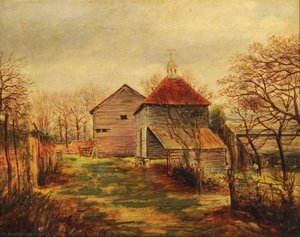
It was in Wales that Sibley truly found his artistic voice. He settled there around the mid-19th century and dedicated himself to depicting the country’s picturesque mills, meadows, and mountains. His paintings from this period are characterized by a remarkable sense of tranquility and an almost palpable connection to the land. Old Mill, for example, is not merely a representation of a structure; it's a nostalgic evocation of rural life, imbued with a gentle warmth and balanced composition that draws the viewer into the scene. He masterfully captured the interplay of light on stone and water, creating an atmosphere of peaceful contemplation. His works often feature scenes around Betws-y-Coed, capturing the idyllic beauty of Cox’s Meadow and other local landmarks.
Technique and Style: A Subtle Mastery
Sibley's technique was characterized by a delicate touch and a restrained palette. He favored oil on canvas, employing subtle gradations of color to create atmospheric depth and luminosity. Unlike the bold brushwork of some Impressionists, Sibley’s application was refined and precise, allowing him to render intricate details with remarkable clarity. Mountain Tarn at Dolwyddelan, exemplifies his ability to convey the vastness of a landscape while simultaneously capturing its intimate beauty. He wasn't interested in grand spectacle; rather, he sought to reveal the quiet poetry inherent in nature’s forms. His paintings are not about imposing a vision onto the landscape but about faithfully recording what he observed with sensitivity and skill.
Legacy and Historical Significance
Although Sibley did not achieve widespread fame during his lifetime, his work has garnered increasing appreciation in recent years. He represents a vital link between the Barbizon tradition and the Tonalist movement, offering a unique perspective on rural life in 19th-century Britain. His paintings provide valuable insights into the changing landscape of Wales and England, documenting scenes that have since vanished or been transformed by time. His enduring appeal lies in his ability to evoke a sense of peace and tranquility, reminding us of the beauty and fragility of the natural world. While details about his life remain sparse, Fred Tom Sibley’s legacy lives on through the evocative landscapes he so lovingly captured – mountains, mills, and meadows that continue to resonate with viewers today.



 Preview
 Buy Print
 Send
Send Share
Share
 Details

 Download
 Similars
 X-Ray
X-Ray Diaporama


 Read More






































 Glass option is only available in size under 110 CM