


x

 OilWallArtBaroque
 1633Early Modern
 66.0 x 78.0 cm
Hand-painted oil on canvas in your size and frame, made to order by our artists.





























Pick from our preset sizes that match the artwork's original proportions.

You may enter your own dimensions to fit a specific frame or space. If your selected size does not match the original image's proportions, we will either crop the artwork or extend the painting with additional hand-painted elements. A digital mockup will be sent for your approval before production begins.
Please note that the on-screen preview does not reflect the actual cropping or extension. Only the mockup will accurately show the final composition.
While custom sizes are available, we recommend selecting a dimension from the predefined list to preserve the original proportions.
Worldwide Delivery () in 3/4 weeks instead of standard 5 weeks. (1 July). No compromise on quality.


Malle Babbe
Reproduction Size
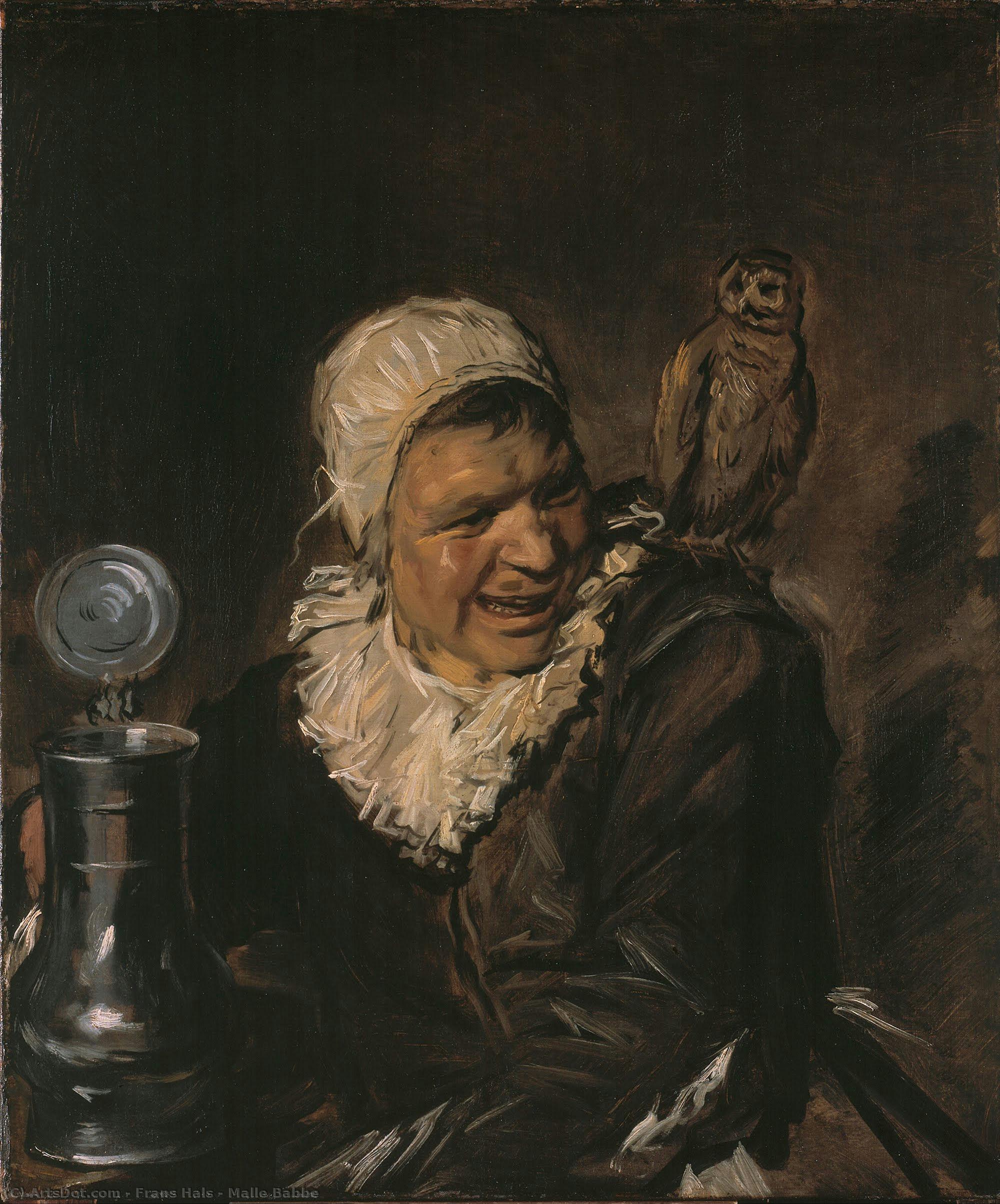
In the vast tapestry of the Dutch Golden Age, few portraits capture the raw, unbridled spirit of humanity quite like Frans Hals’s Malle Babbe. This masterpiece serves as more than just a likeness; it is a window into the vibrant, often gritty, and deeply expressive soul of seventeenth-century Haarlem. The subject, famously known as "Malle Babbe" (Mad Babbe), is presented not with the stiff, aristocratic poise typical of formal portraiture, but with a startling sense of immediacy. As she gazes toward the viewer, her expression—a mixture of mirth and wildness—breaks the fourth wall, inviting us into a moment of spontaneous life that feels as though it were captured by a modern lens rather than a seventeenth-century brush.
The composition is anchored by the woman’s commanding presence, her face illuminated by a light that seems to emanate from her very character. Perched upon her shoulder, a large bird adds a layer of whimsical complexity to the scene, acting as a symbolic companion to her untamed nature. While the background hints at the presence of others, they remain secondary to the psychological depth of the protagonist. The painting’s aged, vintage patina lends it an air of timelessness, making it a piece that does not merely sit on a wall but breathes within a room, offering a sense of historical weight and narrative mystery.
To behold Malle Babbe is to witness the revolutionary technique of Frans Hals at the height of his powers. Eschewing the painstaking, microscopic detail favored by many of his contemporaries, Hals embraced a loose and expressive brushstroke that would later inspire the Impressionists. His ability to use rapid, visible strokes to define texture—the softness of skin, the weight of fabric, and the intricate feathers of the bird—creates a sense of movement and vitality. This "alla prima" approach allows the light to dance across the canvas, catching the edges of her features and creating a rhythmic energy that keeps the eye constantly wandering through the composition.
For the discerning collector or interior designer, this technique offers an unparalleled emotional resonance. The painting does not demand attention through sheer scale or gold leaf, but through its textural richness and the palpable sense of motion. When rendered as a high-quality reproduction, these bravura brushstrokes retain their character, providing a sophisticated focal point that adds depth and a "lived-in" elegance to any curated space. It is a work that rewards close inspection, revealing new layers of light and shadow with every glance.
Integrating a piece as historically significant as Malle Babbe into a contemporary setting requires an eye for balance and storytelling. For those designing luxury interiors, this portrait offers a magnificent contrast to minimalist or modern aesthetics. The warmth of the aged tones and the organic energy of the subject can soften the sharp lines of modern architecture, providing a soulful anchor to a room. It serves as a conversation starter, a piece of history that brings a sense of narrative complexity to a home or gallery.
Whether placed in a sunlit study or a moody, dimly lit library, the painting’s ability to evoke emotion remains constant. It is an investment in atmosphere. By bringing this work into a collection, one is not merely acquiring an image, but capturing a fragment of the Dutch Golden Age—a celebration of life, laughter, and the beautiful imperfection of the human spirit. It is a profound choice for those who seek art that transcends mere decoration to become a true inhabitant of their space.


Frans Hals I was a Dutch painter born in Antwerp, Belgium, around 1580. Though his early life remains somewhat shrouded in mystery, he rose to become one of the most important figures of the Dutch Golden Age, celebrated for his innovative portraiture and genre scenes.
Details surrounding Hals’s formative years are scarce. It is believed he received initial artistic training in Antwerp, a prominent center for painting at the time. However, due to religious and political turmoil, his family relocated to Haarlem in the Netherlands. He became a member of the Haarlem Guild of St. Luke in 1610, marking the formal beginning of his professional career.
Hals distinguished himself through a remarkably fresh and spontaneous style. Unlike many of his contemporaries who favored meticulous detail, Hals employed a loose and expressive brushstroke. This technique imbued his paintings with a sense of immediacy and vitality, capturing the personality and character of his subjects in a way that was revolutionary for its time.
While Hals produced a wide range of works, he is best known for his portraits. Some of his most celebrated paintings include:
He also created compelling genre scenes – depictions of everyday life – that offered glimpses into Dutch society.
Determining Hals’s direct influences is challenging, as he developed a highly individual style. However, it's likely he was aware of the work of earlier Flemish painters like Pieter Bruegel the Elder. His innovative approach to portraiture profoundly impacted subsequent generations of artists.
Frans Hals I played a crucial role in shaping Dutch painting during the Golden Age. His work reflects the burgeoning prosperity and individualism of the Netherlands at that time. He moved away from rigid formality towards a more naturalistic and expressive style, leaving an enduring legacy on the art world.
Today, his paintings are highly sought after and can be found in major museums worldwide, including the Frans Hals Museum in Haarlem, which houses the largest collection of his work. His contributions continue to inspire artists and captivate audiences centuries later.

1580 - 1585 , Belgium
Explore 10 iconic portrait paintings – from Mona Lisa to Van Gogh’s self-portraits. Discover the stories behind these masterpieces, artistic techniques & find museum-quality art reproductions for your home at WahooArt.com.
Commission a timeless oil portrait from skilled artists at WahooArt. Preserve your family's legacy with museum-quality paintings, crafted to cherish for generations. Expert guidance & personalized service.
Explore the captivating world of vintage portrait art! Discover styles, techniques & the enduring appeal of 19th-century masterpieces. Expert restoration, custom reproductions & appraisal services at WahooArt.

Discover the perfect artistic style for your wedding portrait! Explore realism, impressionism & more. Commission a timeless heirloom with expert guidance. Learn from .

Commission a timeless custom portrait from skilled artists. Preserve your family's legacy with museum-quality artwork & expert guidance. Explore the enduring value of fine art.


Stay updated with the latest art news, exclusive offers, and decoration ideas.
Tell us about your project and our art experts will provide you with 3 personalized art suggestions.
Let Us Curate 3 Options Just for You - Free!
 Buy print
 Send
Send Share
Share
 Details

 Download
 Similars
 X-Ray
X-Ray Diaporama






 Read more
 Glass option is only available in size under 110 CM


