
x


 Oil On PanelDutch Golden Age
 1626Early Modern
 22.0 x 17.0 cm
 Metropolitan Museum of Art
Museum-quality giclée or canvas print with fast production and flexible finish options. ( Buy Hand Made Painting Buy Image)





























Pick from our preset sizes that match the artwork's original proportions.

You may enter your own dimensions to fit a specific frame or space. If your selected size does not match the original image's proportions, we will either crop the artwork or extend the image with a mirrored or solid-fill edge. A digital mockup will be sent for your approval before production begins.
Please note that the on-screen preview does not reflect the actual cropping or extension. Only the mockup will accurately show the final composition.
While custom sizes are available, we recommend selecting a dimension from the predefined list to preserve the original proportions.
Worldwide Delivery () in 2 weeks instead of standard 4/5 weeks. (28 August)


Anna van der Aar
Reproduction Size
Frans Hals’s “Anna van der Aar,” completed in 1626, stands as a cornerstone of Dutch Baroque portraiture—a masterful distillation of observation and expressive brushwork that transcends mere likeness to convey profound psychological depth. This captivating painting resides within the Metropolitan Museum of Art’s collection, offering visitors an unparalleled opportunity to experience firsthand the brilliance of Hals’s artistic vision.
The subject herself is presented with remarkable composure—a woman adorned in a dark dress and ruffled collar, her gaze directed outwards towards the window. Hals eschewed meticulous detail typical of his contemporaries, prioritizing instead a technique characterized by loose, impasto strokes that capture the fleeting nuances of light and shadow. This deliberate disregard for conventional realism serves to heighten the painting’s emotional resonance.
Beyond its formal qualities, “Anna van der Aar” resonates with symbolic significance. The window serves as a visual metaphor for introspection—suggesting that Anna contemplates her surroundings while simultaneously engaging in an internal dialogue. Hals's masterful brushstrokes capture not just the physical appearance of his sitter but also her inner state, conveying a sense of quiet dignity and understated elegance.
Considered alongside works by Adam Frans van der Meulen and Vincent I Laurensz van der Vinne—artists who similarly explored themes of human emotion and psychological realism—Hals’s “Anna van der Aar” exemplifies the apex of Dutch Baroque painting. Its enduring appeal lies in its ability to evoke a powerful emotional response, inviting viewers to contemplate the complexities of human experience.
For those seeking inspiration or desiring to adorn their homes with a piece of art history, WahooArt.com offers exceptional reproductions of Hals’s “Anna van der Aar,” meticulously crafted to preserve the original artwork's vibrancy and textural detail. Explore our collection today!

Frans Hals I was a Dutch painter born in Antwerp, Belgium, around 1580. Though his early life remains somewhat shrouded in mystery, he rose to become one of the most important figures of the Dutch Golden Age, celebrated for his innovative portraiture and genre scenes.
Details surrounding Hals’s formative years are scarce. It is believed he received initial artistic training in Antwerp, a prominent center for painting at the time. However, due to religious and political turmoil, his family relocated to Haarlem in the Netherlands. He became a member of the Haarlem Guild of St. Luke in 1610, marking the formal beginning of his professional career.
Hals distinguished himself through a remarkably fresh and spontaneous style. Unlike many of his contemporaries who favored meticulous detail, Hals employed a loose and expressive brushstroke. This technique imbued his paintings with a sense of immediacy and vitality, capturing the personality and character of his subjects in a way that was revolutionary for its time.
While Hals produced a wide range of works, he is best known for his portraits. Some of his most celebrated paintings include:
He also created compelling genre scenes – depictions of everyday life – that offered glimpses into Dutch society.
Determining Hals’s direct influences is challenging, as he developed a highly individual style. However, it's likely he was aware of the work of earlier Flemish painters like Pieter Bruegel the Elder. His innovative approach to portraiture profoundly impacted subsequent generations of artists.
Frans Hals I played a crucial role in shaping Dutch painting during the Golden Age. His work reflects the burgeoning prosperity and individualism of the Netherlands at that time. He moved away from rigid formality towards a more naturalistic and expressive style, leaving an enduring legacy on the art world.
Today, his paintings are highly sought after and can be found in major museums worldwide, including the Frans Hals Museum in Haarlem, which houses the largest collection of his work. His contributions continue to inspire artists and captivate audiences centuries later.

1580 - 1585 , Belgium

Journey through the Golden Age with our guide to the Top 10 Dutch Baroque masterpieces! Explore iconic paintings by Rembrandt, Vermeer & Frans Hals. Find museum-quality art reproductions and elevate your home decor at WahooArt.com.

Journey through Rembrandt van Rijn's 25 most iconic paintings & etchings. Explore Dutch Golden Age masterpieces, dramatic chiaroscuro, and timeless portraits. Find museum-quality art reproductions to elevate your home decor on WahooArt.com.
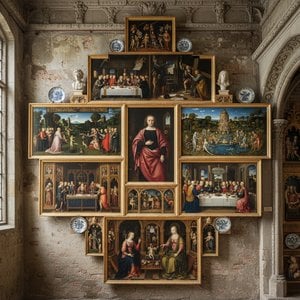
Journey into the Early Netherlandish Renaissance! Explore 10 iconic paintings by Jan van Eyck, Rogier van der Weyden & more. Discover stunning detail, symbolism, and oil painting techniques. Find museum-quality art reproductions for your home at WahooArt.com.

Explore the revolutionary portraiture of Frans Hals I, a master of the Dutch Golden Age. Discover his innovative techniques, captivating character studies & lasting impact on art history. Learn more at WahooArt.

Explore the revolutionary art of Hugo van der Goes – a master of Early Netherlandish painting renowned for his dramatic realism, psychological depth & profound influence on Renaissance artists. Discover his iconic works and lasting legacy.


Stay updated with the latest art news, exclusive offers, and decoration ideas.
Tell us about your project and our art experts will provide you with 3 personalized art suggestions.
Let Us Curate 3 Options Just for You - Free!

 Preview
 Send
Send Share
Share
 Details

 Download
 Similars
 X-Ray
X-Ray Diaporama
 Read More







 Glass option is only available in size under 110 CM


