Frank Stella’s ‘Shoubeegi’: A Symphony of Geometric Energy
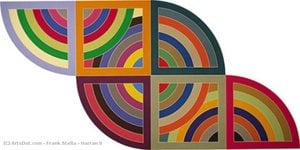
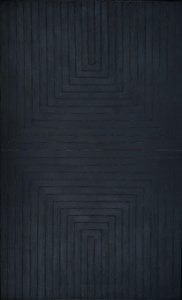
Frank Stella's “Shoubeegi,” completed in 1978, is more than just a painting; it’s an immersive experience, a vibrant explosion of color and form that embodies the artist’s revolutionary approach to abstraction. This work, characteristic of Stella’s mature style, showcases his mastery of geometric composition and his fearless exploration of texture and space – elements that continue to resonate with collectors and art enthusiasts today. The piece immediately commands attention with its dynamic layering, a deliberate disruption of traditional two-dimensional boundaries that invites the viewer into a world of controlled chaos.
- Geometric Abstraction: Stella’s signature style is evident in the artwork's reliance on precise geometric shapes – primarily curvilinear forms interwoven with angular grids. This juxtaposition creates a compelling tension, reflecting a fascination with both order and disorder.
- Bold Color Palette: The use of intense hues—fiery reds, sunny yellows, deep blues, and verdant greens—is not merely decorative; it’s strategically employed to heighten the visual impact and create a sense of movement within the composition.
- Three-Dimensionality: Through careful manipulation of paint thickness and surface texture, Stella elevates the canvas beyond its traditional role, creating a palpable sense of depth and volume that further enhances the artwork's dynamism.
Technique and Materials – A Calculated Chaos
The creation of “Shoubeegi” demonstrates Stella’s meticulous technique and his innovative use of materials. Primarily executed in acrylic paint on a shaped canvas or relief panel, the work showcases layers of color applied with deliberate precision. Thick outlines delineate each form, providing definition while simultaneously contributing to the overall sense of energetic movement. The artist's skillful manipulation of surface texture – some areas deliberately rough, others smooth and polished – adds another layer of complexity and visual interest. The choice of acrylic paint was crucial; its quick-drying properties allowed for rapid layering and experimentation, a hallmark of Stella’s working process.
- Acrylic Paint: The primary medium, chosen for its vibrant color saturation and ability to be applied in thick layers.
- Shaped Canvas/Panel: The unconventional support allowed Stella to fully realize his three-dimensional vision, extending the painted surface beyond the conventional plane.
- Adhesives (Possible): Likely used to secure elements or create textural variations within the composition.
Symbolism and Emotional Resonance – A Dialogue of Forces
While “Shoubeegi” is fundamentally abstract, its underlying themes invite contemplation. The interplay between the ordered grid and the seemingly random organic shapes suggests a dialogue between control and spontaneity, structure and chaos. This tension mirrors broader philosophical concerns about the nature of reality and the human condition. Stella’s work isn't simply about visual pleasure; it’s an invitation to engage with complex ideas through the language of form and color. The vibrant palette evokes feelings of energy, excitement, and perhaps even a touch of controlled exhilaration – emotions that resonate deeply within the viewer.
Historical Context & Legacy
Created in 1978, “Shoubeegi” firmly places itself within the context of Frank Stella’s career, a period marked by his rejection of Abstract Expressionism and his embrace of geometric abstraction. Influenced by artists like Josef Albers and Hans Hofmann, Stella sought to strip painting down to its essential elements – color, shape, and line – creating works that were both intellectually stimulating and visually arresting. His work anticipated the Pop Art movement’s interest in mass production techniques and vibrant imagery, while simultaneously forging a distinctly personal path within the realm of abstract art. Today, “Shoubeegi” remains a powerful example of Stella's innovative spirit and his enduring contribution to the history of modern art.
Questions & Answers
From which country does the Pop Art work "Shoubeegi" come?
The Pop Art work "Shoubeegi" was made by an artist born in United States of America.
What type of artwork is "Shoubeegi" by Frank Stella?
"Shoubeegi" is a wall art piece.
What technique and style characterize "Shoubeegi" by Frank Stella?
In "Shoubeegi", the acrylic on canvas technique meets the Pop Art movement.



 Preview
 Buy Hand Made Painting
 Send
Send Share
Share
 Details
 Guide
Guide

 Download
 Similars
 X-Ray
X-Ray Diaporama
 Q&A
Q&A Stats
Stats


 Read More






































 Glass option is only available in size under 110 CM


![Abstract Composition [triptych] — Vaclav Vytlacil, Abstract Expressionism](/media/artworks/images-thumb/08/3c/083c0675045645fd42d4e6c6d63f1ced.jpg)