The Visionary Eye of François Stroobant
François Stroobant (1819–1916) stands as a profound testament to the enduring fascination of Belgian Romantic landscape painting, a master who seamlessly blended meticulous observation with an expressive, soulful artistic vision. Born in Brussels amidst the burgeoning artistic fervor of the nineteenth century, Stroobant’s long life spanned a transformative era in European culture—a period defined by both rapid scientific advancement and a deep, nostalgic yearning for beauty rooted in tradition. Alongside his brother, the esteemed lithographer Louis-Constantin Stroobant, François contributed to a rich legacy of Belgian artistry, embodying a shared commitment to capturing the grandeur of the natural and architectural world with unparalleled precision.
His artistic journey was forged in the prestigious halls of the Brussels Académie des Beaux-Arts, where he studied between 1832 and 1847. Under the guidance of influential masters, Stroobant developed a versatile technical foundation that would define his later works. From François-Joseph Navez, he inherited a rigorous dedication to classical realism; from Paul Lauters, he learned the delicate art of tonal harmonies and atmospheric perspective; and from François-Antoine Bossuet, he drew inspiration for the expressive power of color. These formative years were not merely about learning technique but about cultivating a disciplined eye capable of translating the vastness of the landscape into the intimate language of oil and lithography.
A Journey Through Light and Stone
Driven by an adventurous spirit, Stroobant’s canvas became a diary of his travels across the European continent. His wanderings took him through the Netherlands, France, Germany, Switzerland, Italy, Spain, and Hungary, each region offering new textures, lights, and architectural wonders to document. This extensive exploration allowed him to move beyond simple depiction, instead creating immersive experiences that invited viewers to inhabit different eras and environments. Whether capturing the haunting, melancholic beauty of the Ruins of the Abbey of Villers or the bustling, historic vitality of the Courtyard of the Palace of Marguerite of Austria in Mechelen, his work remains anchored in a profound respect for historical truth.
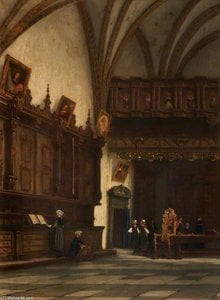
In his architectural renderings, Stroobant displayed a remarkable mastery of academic realism. He possessed an uncanny ability to render the weight of stone, the steep pitch of roofs, and the intricate facades of Renaissance splendor with such clarity that the buildings seem to breathe. His technique often involved a rich layering of oil paint to achieve textural depth, using a palette of earthy ochres, grays, and deep reds to evoke a sense of timelessness. While his style is firmly rooted in realism, there remains a subtle romantic sensibility in how he manipulated light and shadow, imbuing even the most static structures with a sense of quiet contemplation and nostalgic grace.
Legacy and Artistic Distinction
Beyond his individual canvases, Stroobant’s contribution to the Belgian art community was both academic and civic. In 1865, he demonstrated his dedication to the future of art by becoming the founder and first director of the Académie des Beaux-Arts at Molenbeek-Saint-Jean in Brussels. His lifelong commitment to excellence and his ability to bridge the gap between Romantic emotion and scientific observation earned him significant recognition, including being named an Officer in the Order of Leopold in 1878.
The enduring significance of François Stroobant lies in his ability to capture the ephemeral nature of light against the permanence of history. His works serve as windows into a bygone Europe, preserving the architectural majesty and natural splendor of the nineteenth century for future generations. Through his meticulous lithographs and evocative oil paintings, he remains a vital figure in the canon of Belgian art, reminding us that true mastery lies in the ability to see the world not just as it is, but as it feels.


 Preview
 Send
Send Share
Share
 Details
 Guide
Guide

 Download
 Similars
 X-Ray
X-Ray Diaporama
 Q&A
Q&A Stats
Stats Read More
 Switch to Print





































 Glass option is only available in size under 110 CM