Museum-quality giclée or canvas print with fast production and flexible finish options. ( Buy Hand Made Painting Buy Image)





























Pick from our preset sizes that match the artwork's original proportions.

You may enter your own dimensions to fit a specific frame or space. If your selected size does not match the original image's proportions, we will either crop the artwork or extend the image with a mirrored or solid-fill edge. A digital mockup will be sent for your approval before production begins.
Please note that the on-screen preview does not reflect the actual cropping or extension. Only the mockup will accurately show the final composition.
While custom sizes are available, we recommend selecting a dimension from the predefined list to preserve the original proportions.
Worldwide Delivery () in 2 weeks instead of standard 4/5 weeks. (6 September)


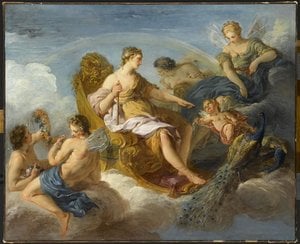
HERCULE ET OMPHALE
Reproduction Size
François Lemoyne's "Hercules et Omphale," painted circa 1724, isn’t merely a depiction of a myth; it’s a carefully constructed tableau brimming with the sensual allure and intellectual complexities characteristic of Rococo art. Held within the hallowed halls of the Louvre Museum, this painting offers a captivating glimpse into a world where heroic strength is playfully inverted, gender roles are subtly challenged, and the very notion of servitude becomes a site of unexpected intimacy. Lemoyne, a key figure in reviving the grand allegorical traditions of his predecessors, masterfully blends classical restraint with the exuberant spirit of the era, creating an image that continues to resonate with its layered meanings.
The scene unfolds within a richly detailed landscape—a backdrop of rolling hills and distant mountains—that anchors the narrative. At the heart of this composition stands Hercules, rendered in the robust physicality typical of Rubens’ influence, yet subtly softened by Lemoyne's delicate brushwork. He is presented not as a conquering warrior, but as a figure engaged in an almost domestic activity: spinning wool alongside Omphale, the Lydian queen who, through a twist of fate and divine decree, held him captive for a year. This seemingly simple act—a hero performing a traditionally feminine task—immediately establishes the painting’s central tension. The arrangement is carefully pyramidal, with Hercules as its apex, drawing the eye to his powerful form while simultaneously highlighting Omphale's seated position, inviting the viewer into their shared space.
Lemoyne’s skill lies not just in depicting physical forms but also in conveying emotion through subtle gestures and carefully chosen symbols. Hercules’ posture—relaxed yet alert—suggests a willingness to engage with this unconventional arrangement, while Omphale's gaze is both curious and possessive. The inclusion of Cupid, perched at Hercules’ foot, adds an element of playful mischief, hinting at the erotic undertones that permeate the scene. The contrast between their clothing – Hercules in a flowing robe reminiscent of a woman’s garment, Omphale adorned with his lion skin—is particularly striking, visually embodying the reversal of roles and challenging conventional notions of masculinity and femininity. The lion's skin itself is a potent symbol, representing both power and vulnerability, strength and captivity.
The painting’s aesthetic is firmly rooted in the Rococo style—characterized by its elegance, sensuality, and lavish ornamentation. Lemoyne employs a masterful use of glazing techniques to create smooth transitions between colors and achieve a remarkably realistic rendering of textures. The warm palette—dominated by reds, golds, and browns—evokes a sense of opulence and luxury, while cooler greens and blues in the background provide visual contrast and depth. The artist’s attention to detail is evident in every brushstroke, from the meticulously rendered folds of fabric to the subtle shading on the figures' skin. The use of linear perspective creates a convincing illusion of space, drawing the viewer into the scene and emphasizing the intimacy of the interaction between Hercules and Omphale.
"Hercules et Omphale" is more than just a beautiful painting; it’s a complex meditation on power, gender, and the nature of desire. It reflects a broader trend in 18th-century art—a willingness to explore unconventional themes and challenge established norms. The story itself, rooted in Greek mythology, has been interpreted through various lenses throughout history, often serving as a metaphor for social and political upheaval. Lemoyne’s version, however, transcends mere allegory, offering a captivating glimpse into a world where the boundaries of identity are blurred and the familiar is playfully subverted. Reproductions of this iconic work continue to captivate audiences today, reminding us of the enduring power of art to provoke thought and inspire emotion.


1688 - 1737 , France

Embark on a sophisticated journey through the eternal allure of mythological art. Discover how master painters breathe life into ancient legends, from Greek deities to Baroque masterpieces, and learn to curate these timeless narratives within your own exquisite art collection.
Discover the exquisite allure of Rococo art. Explore a curated guide to 18th-century French masterpieces, from Watteau to Fragonard, and learn how hand-painted oil reproductions can bring timeless elegance and luxury to your sophisticated interior design collection.

Immerse yourself in the splendor of Rococo art. Discover the era of elegance through masterworks by Watteau and Fragonard. Explore themes of romance, aristocratic leisure, and gilded ornamentation in this definitive guide to 18th-century French opulence.

Discover the breathtaking elegance of Rococo portraiture. Explore an expert guide to 18th-century mastery, from pastel palettes to aristocratic grandeur, and learn how to bring this era of opulence into your home through museum-quality oil reproductions.

 Preview
 Send
Send Share
Share
 Details

 Download
 Similars
 X-Ray
X-Ray Diaporama

 Read More







 Glass option is only available in size under 110 CM