Museum-quality giclée or canvas print with fast production and flexible finish options. ( Buy Hand Made Painting Switch to Digital Image)





























Pick from our preset sizes that match the artwork's original proportions.

You may enter your own dimensions to fit a specific frame or space. If your selected size does not match the original image's proportions, we will either crop the artwork or extend the image with a mirrored or solid-fill edge. A digital mockup will be sent for your approval before production begins.
Please note that the on-screen preview does not reflect the actual cropping or extension. Only the mockup will accurately show the final composition.
While custom sizes are available, we recommend selecting a dimension from the predefined list to preserve the original proportions.
Worldwide Delivery () in 2 weeks instead of standard 4/5 weeks. (16 September)


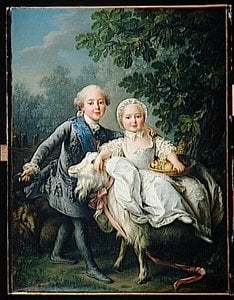
LE COMTE DE NOGENT
Reproduction Size
François Hubert Drouais's "Le Comte de Nogent," painted in the heart of 18th-century France, is more than just a portrait; it’s a meticulously crafted window into a world of aristocratic leisure and refined beauty. Executed with the characteristic delicacy of the Rococo style, this oval oil painting captures a young nobleman – likely a member of the Nogent family, from which the work derives its title – in an exquisitely posed moment of contemplative grace. The scene unfolds against a subtly textured dark green backdrop, partially obscured by a landscape that hints at the pleasures of the countryside, creating a sense of both intimacy and expansive possibility.
Drouais, a prominent painter of his era, was deeply embedded within the artistic circles of Paris, serving as a favored artist for royalty and nobility. His skill lay in capturing not just physical likeness but also the very essence of his subjects – their personalities, social standing, and even their inner lives. “Le Comte de Nogent” exemplifies this approach; the young man’s posture, the tilt of his head, and the subtle expression on his face all speak volumes about his character and status.
The painting's beauty is rooted in Drouais’s masterful command of the Rococo technique. Notice the smooth, almost porcelain-like quality of the skin tones – a hallmark of the style, achieved through layering thin glazes of oil paint to create an illusion of luminosity and depth. The fabrics are rendered with astonishing detail; the elaborate pink and gold jacket, adorned with delicate frills, appears incredibly tactile, while the lace trim around his collar and cuffs is meticulously depicted. The artist’s use of light is particularly noteworthy – it's soft, diffused, bathing the subject in a gentle glow that enhances his youthful appearance.
Close examination reveals Drouais’s meticulous approach to texture. The wig, a symbol of status during this period, is rendered with individual strands meticulously painted to mimic its voluminous form. Similarly, the roses in the ornate pot – a recurring motif in Rococo art symbolizing love and beauty – are depicted with vibrant color and realistic detail, adding a touch of romanticism to the scene. The artist skillfully employs linear perspective to create a sense of depth, guiding the viewer’s eye through the composition from the foreground figure to the distant landscape.
“Le Comte de Nogent” is deeply embedded within the cultural context of 18th-century France. The portrait reflects the aristocratic values of the time – a focus on elegance, refinement, and leisure. The young nobleman’s pose, with his hand resting lightly on a book (often a signifier of intellect and status), suggests a cultivated mind and a life devoted to intellectual pursuits. The inclusion of the roses further reinforces this theme, linking the subject to ideals of beauty and romance.
Furthermore, the painting offers a glimpse into the social dynamics of the era. The young nobleman’s reaching gesture towards the bouquet of roses can be interpreted as an invitation – a subtle display of charm and confidence. The setting itself, with its hints of the countryside, speaks to the importance of rural estates and the aristocratic lifestyle centered around them. It's a scene frozen in time, capturing a moment of youthful indulgence within a world of privilege and social decorum.
Reproductions of “Le Comte de Nogent” offer a remarkable opportunity to bring this exquisite work of art into your home or office. Whether you’re an art collector, an interior designer seeking to evoke the elegance of the Rococo period, or simply someone who appreciates beautiful artistry, this painting holds enduring appeal. The meticulous detail, vibrant colors, and evocative symbolism create a captivating visual experience that transcends time.
Consider how the painting's composition – the balanced arrangement of figures and elements, the use of light and shadow – can inform your own design choices. The delicate textures and rich color palette can be echoed in fabrics, furnishings, and decorative objects to create a space that is both sophisticated and inviting. “Le Comte de Nogent” serves as a timeless reminder of the power of art to transport us to another era and inspire our creativity.


1727 - 1775 , France

Discover the exquisite allure of Rococo art. Explore a curated guide to 18th-century French masterpieces, from Watteau to Fragonard, and learn how hand-painted oil reproductions can bring timeless elegance and luxury to your sophisticated interior design collection.

Discover the breathtaking elegance of Rococo portraiture. Explore an expert guide to 18th-century mastery, from pastel palettes to aristocratic grandeur, and learn how to bring this era of opulence into your home through museum-quality oil reproductions.

Immerse yourself in the splendor of Rococo art. Discover the era of elegance through masterworks by Watteau and Fragonard. Explore themes of romance, aristocratic leisure, and gilded ornamentation in this definitive guide to 18th-century French opulence.

 Preview
 Send
Send Share
Share
 Details

 Download
 Similars
 X-Ray
X-Ray Diaporama
 Stats
Stats

 Read More







 Glass option is only available in size under 110 CM