Rococo
 1745
1745 32.0 x 33.0 cm
 Calouste Gulbenkian Foundation
Museum-quality giclée or canvas print with fast production and flexible finish options. ( Buy Hand Made Painting Switch to Digital Image)





























Pick from our preset sizes that match the artwork's original proportions.

You may enter your own dimensions to fit a specific frame or space. If your selected size does not match the original image's proportions, we will either crop the artwork or extend the image with a mirrored or solid-fill edge. A digital mockup will be sent for your approval before production begins.
Please note that the on-screen preview does not reflect the actual cropping or extension. Only the mockup will accurately show the final composition.
While custom sizes are available, we recommend selecting a dimension from the predefined list to preserve the original proportions.
Worldwide Delivery () in 2 weeks instead of standard 4/5 weeks. (10 September)


Pastoral Scene
Reproduction Size
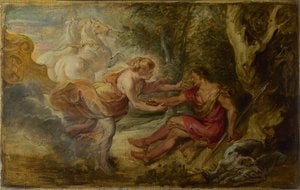
François Boucher’s “Pastoral Scene,” painted in 1745, isn't merely a depiction of a rural landscape; it’s a carefully constructed invitation into an idealized world—a sanctuary of innocence and leisure nestled within the heart of France. The painting immediately draws the viewer in with its soft palette of browns, beiges, and muted greens, evoking a sense of gentle warmth and timeless serenity. Two young figures – a boy and girl – are seated amidst a rocky outcrop, seemingly lost in quiet contemplation as they engage with paper, suggesting an early lesson or perhaps simply a shared moment of innocent amusement. The scene is populated by sheep grazing peacefully nearby, reinforcing the theme of harmonious coexistence between humanity and nature.
Boucher’s masterful command of Rococo style is evident throughout. The composition adheres to classical principles of balance and symmetry, yet it's infused with a distinctly playful spirit. The figures are rendered with exquisite detail – their youthful faces alight with curiosity, their clothing flowing gracefully—while the surrounding landscape is treated with a delicate touch, emphasizing texture through subtle variations in tone and hatching. Notice how Boucher expertly uses light to sculpt form, creating a sense of depth and volume that invites the viewer to step into the scene.
The painting’s remarkable detail is achieved using a technique known as dry point etching, a method favored by Boucher during this period. This process involved scratching a copper plate with a needle, creating a textured surface that would then be inked and pressed onto paper. The resulting image possesses a unique tactile quality—a subtle roughness that adds to the painting’s overall sense of intimacy and immediacy. The meticulous hatching and cross-hatching create a rich tapestry of tones, suggesting both the solidity of the rocks and the softness of the sheep's wool. This technique is particularly effective in conveying the texture of drapery and the delicate details of the children’s clothing.
Furthermore, Boucher’s use of color is restrained yet evocative. He avoids bright, saturated hues, opting instead for a muted palette that contributes to the painting's overall sense of tranquility. The browns and beiges create a warm, earthy atmosphere, while the greens suggest the lushness of the surrounding landscape. The subtle variations in tone—from the darkest shadows to the lightest highlights—are expertly rendered, creating a dynamic interplay of light and shadow that brings the scene to life.
“Pastoral Scene” is rich in symbolic meaning. The setting itself – a secluded rocky outcrop with grazing sheep – represents the idealized concept of the “locus amoenus,” or beautiful place, a recurring motif in pastoral literature and art. This idyllic landscape embodies notions of harmony, innocence, and escape from the complexities of urban life. The children’s engagement with paper hints at the importance of education and learning, suggesting that this peaceful setting is also a space for intellectual growth. The sheep, traditionally associated with simplicity and humility, further reinforce this theme.
Beyond its immediate visual appeal, “Pastoral Scene” speaks to broader cultural values—the appreciation of nature, the celebration of childhood, and the pursuit of a simpler, more fulfilling way of life. It’s a testament to Boucher's ability to capture not just a scene but also an entire mood—a feeling of quiet contemplation, gentle joy, and profound connection with the natural world. Reproductions of this work offer a window into a bygone era, inviting us to pause, reflect, and rediscover the beauty that can be found in the simplest of moments.

François Boucher (1703-1770) was a pivotal figure in 18th-century French art, renowned as one of the most celebrated painters of the Rococo era. His work embodies the elegance, sensuality, and playful spirit that defined this influential style.
Born on September 29, 1703, in Paris, France, François Boucher’s artistic journey began under the tutelage of his father, Jean Boucher, a painter himself. At the age of seventeen, he caught the eye of François Lemoyne, leading to a brief but impactful apprenticeship. He further honed his skills with engraver Jean-François Cars before achieving a significant milestone: winning the prestigious Grand Prix de Rome in 1720.
Boucher’s time in Italy, following his win at the Grand Prix, proved formative. Upon returning to France, he was admitted to the Académie Royale de Peinture et de Sculpture in 1731. His *morceau de réception*, “Rinaldo and Armida” (1734), immediately established him as a master of the Rococo style. This period saw his artistic voice fully emerge, characterized by delicate brushwork, pastel palettes, and an emphasis on mythological and pastoral themes.
Boucher’s oeuvre is remarkably diverse, encompassing mythology, portraiture, genre scenes, and decorative arts. Some of his most celebrated works include:
Recurring themes in Boucher’s work include love, beauty, leisure, and the idealized world of mythology. His paintings often evoke a sense of playful eroticism and refined elegance.
Boucher's influence extended far beyond painting. He designed costumes and sets for the theater, created tapestries for the Beauvais workshops, and collaborated with the Gobelins Manufactory. His appointment as *Premier Peintre du Roi* in 1765 cemented his status as the leading artist of the French Rococo.
While later critics questioned the perceived superficiality of Rococo art, Boucher’s impact on subsequent generations is undeniable. He influenced artists such as Jean-Honoré Fragonard and contributed significantly to the development of Neoclassicism through his students.
François Boucher's work provides a valuable window into the tastes and values of 18th-century French society. His paintings reflect the aristocratic culture of the era, characterized by luxury, refinement, and a pursuit of pleasure. He remains a significant figure in art history, celebrated for his technical skill, artistic innovation, and enduring contribution to the Rococo style.

1703 - 1770 , France

Discover the breathtaking elegance of Rococo portraiture. Explore an expert guide to 18th-century mastery, from pastel palettes to aristocratic grandeur, and learn how to bring this era of opulence into your home through museum-quality oil reproductions.

Discover the exquisite allure of Rococo art. Explore a curated guide to 18th-century French masterpieces, from Watteau to Fragonard, and learn how hand-painted oil reproductions can bring timeless elegance and luxury to your sophisticated interior design collection.

Immerse yourself in the splendor of Rococo art. Discover the era of elegance through masterworks by Watteau and Fragonard. Explore themes of romance, aristocratic leisure, and gilded ornamentation in this definitive guide to 18th-century French opulence.

Elevate your artistic practice with this expert guide to mastering the line. Discover advanced techniques in graphite, charcoal, and contour drawing designed for art students seeking technical precision and expressive depth in their fine art studies.

 Preview
 Send
Send Share
Share
 Details

 Download
 Similars
 X-Ray
X-Ray Diaporama
 Stats
Stats Read More







 Glass option is only available in size under 110 CM