
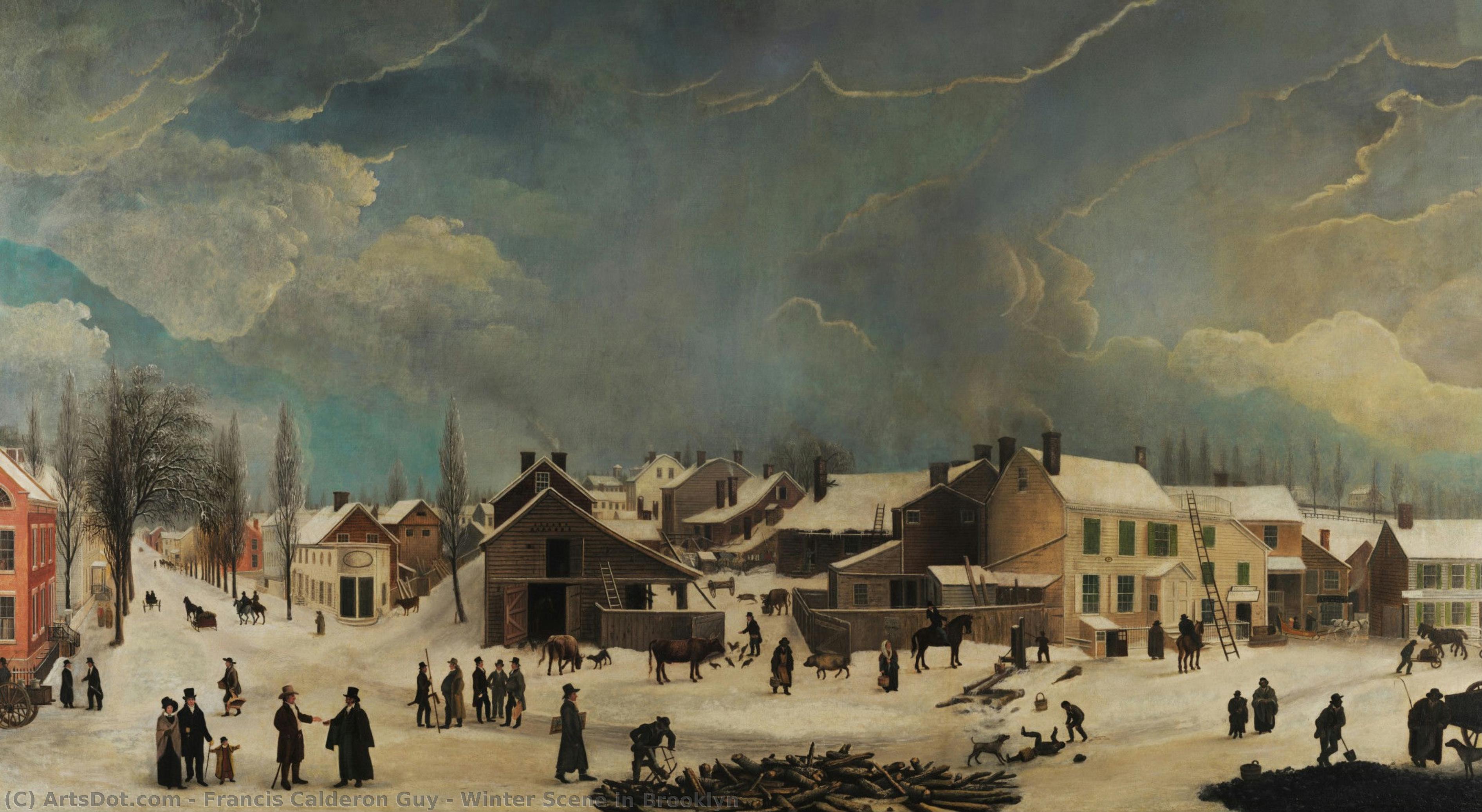
 Oil On CanvasWallArtRealism
 182019th Century
 147.0 x 269.0 cm
 Crystal Bridges Museum of American Art
Museum-quality giclée or canvas print with fast production and flexible finish options. ( Buy Hand Made Painting Switch to Digital Image)
Pick from our preset sizes that match the artwork's original proportions.

You may enter your own dimensions to fit a specific frame or space. If your selected size does not match the original image's proportions, we will either crop the artwork or extend the image with a mirrored or solid-fill edge. A digital mockup will be sent for your approval before production begins.
Please note that the on-screen preview does not reflect the actual cropping or extension. Only the mockup will accurately show the final composition.
While custom sizes are available, we recommend selecting a dimension from the predefined list to preserve the original proportions.
Worldwide Delivery () in 2 weeks instead of standard 4/5 weeks. (21 September)


Winter Scene in Brooklyn
Reproduction Size

Born in Grasse, Provence, in 1732, Jean-Honoré Fragonard’s life was a testament to the shifting currents of French art during the Rococo period. Unlike his contemporaries who often pursued careers within the rigid structures of the Royal Academy, Fragonard forged his own path, becoming renowned for his exquisitely sensual and playful paintings that captured the spirit of aristocratic leisure and romantic intrigue. His career, spanning from the 1760s to his death in 1806, is characterized by a remarkable fluidity of style, blending influences from Italian Baroque masters like Luca Giordano and Rubens with a distinctly French sensibility.
Fragonard’s early artistic training was rooted in the studio of François Boucher at the Académie Royale de Peinture et Sculpture. This formative period instilled within him a deep understanding of composition, color theory, and the conventions of Rococo painting. However, Fragonard quickly distinguished himself through his innovative approach to subject matter and technique. He rejected the traditional historical or mythological themes favored by the Academy, instead focusing on scenes of domestic life, courtship, and flirtation – subjects that resonated with the tastes of a wealthy clientele eager for depictions of pleasure and romance.
Fragonard’s paintings are instantly recognizable for their vibrant color palettes, loose brushwork, and masterful use of light and shadow. He employed a technique known as “alla prima,” working directly onto the canvas without underdrawing or preliminary sketches. This approach resulted in a sense of spontaneity and immediacy that is characteristic of his most celebrated works. His brushstrokes are often rapid and energetic, creating a shimmering effect that captures the fleeting beauty of the scenes he depicts.
Among Fragonard’s most celebrated works are *The Swing* (1767-68), a quintessential example of Rococo pleasure and intrigue, and *Saint Mary Magdalene Penitent* (c. 1763), which showcases his ability to infuse religious subject matter with sensual beauty. His paintings were immensely popular during his lifetime, admired for their elegance, wit, and emotional resonance.
Despite his initial success, Fragonard's fortunes declined after the French Revolution. His works were deemed decadent and frivolous, and he faced financial hardship in his later years. However, his legacy as one of the most important painters of the Rococo period endures. He remains celebrated for his innovative style, his masterful use of color and light, and his ability to capture the essence of human desire and beauty.
Fragonard's art flourished during a time of significant social and cultural change in France. The Rococo period, which spanned roughly from 1730 to 1789, was characterized by a shift away from the formality and restraint of the Baroque era towards a more relaxed, sensual, and pleasure-oriented aesthetic. The rise of the aristocracy and the increasing emphasis on leisure and entertainment provided fertile ground for Fragonard’s artistic explorations.

1760 - 1820 , United Kingdom

Journey through 19th century art with WahooArt! Explore 10 iconic paintings – from Monet & Renoir to Courbet – and discover the stories behind Romanticism, Realism & Impressionism. Find museum-quality reproductions for your home decor. Explore the full collection online!
Explore the evolution of cityscape painting with WahooArt. Discover key artists from Realism to contemporary movements & invest in timeless urban visions. Expert guidance, museum-quality reproductions.

Explore the evolution of cityscape painting from Realism to contemporary art. Discover key artists & invest in timeless urban visions with WahooArt's expert guidance and museum-quality reproductions.

Delve into the haunting world of Francis Bacon with WahooArt. Explore 25 iconic paintings, from his visceral portraits to powerful triptychs. Discover the stories behind these masterpieces & find museum-quality art reproductions for your home. Explore the full collection online!

Explore 10 famous snow paintings by Monet, Degas & more! Discover the stories behind these serene winter landscapes and iconic artworks. Find museum-quality art reproductions for your home at WahooArt.com.

 Preview
 Send
Send Share
Share
 Details
 Guide
Guide

 Download
 Similars
 X-Ray
X-Ray Diaporama
 Stats
Stats Read More




































 Glass option is only available in size under 110 CM


