The artwork displayed on this page is protected by copyright law, which means we cannot legally create or sell an identical reproduction. This protection is enforced under international agreements such as the Berne Convention and by national laws, including those outlined by the U.S. Copyright Law - Title 17.
This method fully complies with copyright regulations because it does not involve copying or duplicating the protected artwork. Instead, it is a creative reinterpretation - a new painting that is influenced by the original but not identical to it.
Museum-quality giclée or canvas print with fast production and flexible finish options. ( Buy Hand Made Painting
Switch to Digital Image)
Pick from our preset sizes that match the artwork's original proportions.
Type the width and the height you need, to fit your frame or your wall. A print can only be cut, never made bigger than the picture, so a size with a different shape loses a part of the image. We send you a digital mockup to approve before we print anything. The picture shown on this page does not show the real cut — only the mockup does.
Worldwide Delivery () in 2 weeks instead of standard 4/5 weeks. (28 October)
Triptych 2
Reproduction Size
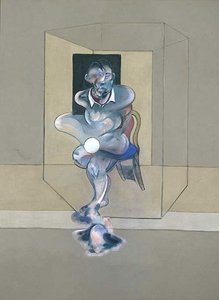
Francis Bacon's "Triptych 2" presents a stark and unsettling vision of the human condition, a world stripped bare of comfort and illusion. This triptych, comprised of three distinct yet interconnected paintings, embodies the artist’s signature style – a brutal honesty rendered in oil paint that confronts viewers with primal anxieties and the inherent loneliness of existence. The photograph captures not just images, but fragments of a psychological landscape, echoing themes prevalent throughout Bacon's oeuvre: isolation, fear, and the grotesque distortion of the human form.
Each panel within "Triptych 2" depicts a moment of intense interaction, yet these moments are fraught with tension and ambiguity. The first painting showcases a solitary figure engaged in a seemingly innocuous activity – playing with a ball – but the oppressive darkness of the room suggests a profound sense of detachment and perhaps even despair. The second panel portrays dancers on stage, their movements frozen in a moment of apparent ecstasy, yet the composition hints at a desperate struggle for control or recognition. Finally, the third painting presents a disturbing tableau of two men, one holding a weapon, immediately introducing an element of threat and violence. The repetition of figures across the three panels reinforces the idea of fractured identities and the inescapable nature of human connection – often fraught with danger.
Bacon’s technique is characterized by a deliberate rejection of traditional representation. He employs thick, gestural brushstrokes, layering paint to create surfaces that appear almost sculptural. The use of black and white photography here emphasizes the raw physicality of his process, stripping away any potential for color distraction and intensifying the emotional impact. His figures are rendered with an unsettling distortion – elongated limbs, contorted faces, and a palpable sense of suffering. This technique isn’t merely stylistic; it's a deliberate attempt to bypass rational thought and tap directly into the viewer’s subconscious, triggering feelings of unease and discomfort. The influence of Surrealism is evident in his exploration of dreamlike imagery and psychological states, but Bacon transcends mere imitation, forging a uniquely personal and profoundly unsettling style.
"Triptych 2" was created during a period of immense social and political upheaval – the aftermath of World War II. The anxieties of the time, coupled with Bacon’s own troubled personal life (marked by instability and emotional detachment), fueled his artistic exploration of human vulnerability. The recurring motif of confinement—represented by the dark rooms and enclosed spaces—can be interpreted as a metaphor for the psychological prisons we create for ourselves. The gun in the third panel is not simply a symbol of violence, but perhaps a representation of the destructive forces within humanity itself. Bacon’s work reflects a broader artistic trend of the 20th century, moving away from representational art towards abstraction and exploring the darker aspects of human experience.
“Triptych 2” is not a comfortable viewing experience. It demands engagement, forcing the viewer to confront uncomfortable truths about themselves and the world around them. Bacon’s work continues to resonate with audiences today because it speaks to universal anxieties – fear of isolation, loss of control, and the inherent absurdity of existence. As one of the most influential artists of the 20th century, Francis Bacon's legacy lies in his unflinching honesty and his ability to translate profound emotional experience into a powerfully visual language. A hand-painted reproduction of “Triptych 2” offers a unique opportunity to own a piece of this artistic genius, bringing its unsettling beauty and intellectual depth into your space.
The tense emotion of "Triptych 2" accompanies its Expressionist Abstraction style.
"Triptych 2" can be examined layer by layer on the artwork's X-Ray page, a viewer inspired by a conservator's light bench with eleven optical readings of the image.
A Stats page exists for "Triptych 2". It charts the monthly visits of the artwork and of the artist's other works, with country and language breakdowns.
To look at a Francis Bacon canvas is to encounter a direct assault on the nervous system. He did not seek to decorate; he sought to capture the raw, often terrifying reality of existence through a distinctive and disturbing realism. While his contemporaries drifted toward the safety of abstraction, Bacon anchored himself in the human form, though he stripped that form of any dignity or comfort. His work functions as a visceral response to the mid-twentieth century, translating anxiety and physical vulnerability into smeared, violent colors and contorted limbs.
The power of his imagery stems from a refusal to look away from degradation. He utilized oils with a fluidity that allowed for the depiction of flesh that seems to be dissolving or bruising under pressure. By placing figures within geometric structures—transparent cages or architectural space-frames—he forced a sense of claustrophobia upon the viewer. These frames were not mere compositional tools; they were devices to concentrate the image and trap the subject in a state of permanent isolation.
Bacon’s path to the canvas was far from academic. Born in Dublin, Ireland, his early years were marked by instability and a difficult relationship with his parents. He moved through London, Berlin, and Paris, living a life that was often as turbulent as his later paintings. Before he was recognized as a painter, he worked as an interior designer and decorator. This period of his life produced tangible, structured objects:
This background in design provided a structural foundation that would later manifest in his use of cubic, architectural framing. He was a self-taught artist who bypassed the traditional art school route, instead absorbing influences through direct observation and chance encounters. His transition from decorator to painter was catalyzed by seeing Picasso’s work in Paris, which revealed the possibilities of using organic, bone-like structures to distort the human image.
Bacon’s visual language was built from a specific set of cinematic and classical references. He did not invent his horrors in a vacuum; he reconfigured existing imagery to suit a more primal purpose. The screaming face, a recurring motif, finds its roots in the visceral imagery of Sergei Eisenstein's film Battleship Potemkin. Similarly, his fascination with the distortion of the body was informed by the works of Picasso and the studies of motion by Eadweard Muybridge.
His most famous reinterpretations involved taking established authority and breaking it. In his series of works based on Velázquez’s Portrait of Pope Innocent X, he transformed a dignified papal figure into a nightmarish, screaming specter. He used the concept of the crucifixion not as a religious statement, but as an armature to hang sensations of suffering. This approach allowed him to explore universal themes of mortality and the human condition without the distraction of spiritual solace.
Bacon’s significance lies in his ability to confront the darker corners of the soul with brutal honesty. He rejected the polished beauty of traditional portraiture in favor of an unflinching portrayal of agony and isolation. His later works, while often utilizing lighter colors, maintained this core intensity, focusing on the psychological weight of his subjects, including his lover George Dyer. He remains a central figure because he provided a visual language for the twentieth century's deepest anxieties, ensuring that the image of the suffering human remains impossible to ignore.

1909 - 1992 , Ireland