

The artwork displayed on this page is protected by copyright law, which means we cannot legally create or sell an identical reproduction. This protection is enforced under international agreements such as the Berne Convention and by national laws, including those outlined by the U.S. Copyright Law - Title 17.
This method fully complies with copyright regulations because it does not involve copying or duplicating the protected artwork. Instead, it is a creative reinterpretation - a new painting that is influenced by the original but not identical to it.
Museum-quality giclée or canvas print with fast production and flexible finish options. ( Buy Hand Made Painting Switch to Digital Image)





























Pick from our preset sizes that match the artwork's original proportions.

Type the width and the height you need, to fit your frame or your wall. A print can only be cut, never made bigger than the picture, so a size with a different shape loses a part of the image. We send you a digital mockup to approve before we print anything. The picture shown on this page does not show the real cut — only the mockup does.
Worldwide Delivery () in 2 weeks instead of standard 4/5 weeks. (31 October)
head vi, 1949
Reproduction Size
To stand before Francis Bacon’s Head VI is to witness an unflinching confrontation with the very depths of human experience. Painted in 1949, this unsettling masterpiece serves as a profound window into the psychological disintegration and existential dread that gripped Europe in the wake of World War II. The painting does not merely depict a man; it captures a moment of pure, unadulterated anguish. Through a distorted visage and a mouth frozen in a silent, harrowing scream, Bacon presents a subject caught in the throes of terror. The figure appears hunched and collapsing, a vulnerable soul navigating an airless void, making the artwork an enduring symbol of mortality and the fragility of our existence.
The technical execution of the piece is as visceral as its subject matter. Eschewing traditional meticulous detail, Bacon employed a method he termed the “squeeze technique,” applying paint thickly with his hands or a palette knife to create textured surfaces that seem to pulsate with an unsettling, living energy. This physicality allows the canvas to embody the very torment it portrays. The composition is dominated by a sickly, jaundiced yellow hue, a color choice that acts as a visual metaphor for decay and mental deterioration. Within this chromatic landscape, the figure is often placed within a glass cage-like structure behind curtain-like drapery, creating a suffocating atmosphere where the subject appears trapped by his very surroundings.
The power of Head VI lies in its ability to translate historical trauma into universal symbols. Emerging from a period scarred by the devastation of war and the chilling reality of London's bombing raids, Bacon’s work reflects a broader preoccupation with the loss of certainty. The open mouth, perhaps the painting’s most potent symbol, transcends simple vocalization; it represents repressed emotion and the primal terror of the human condition. This motif finds its roots in the cinematic drama of silent films, where exaggerated expressions were used to convey deep-seated psychological states, yet Bacon strips away the artifice to reveal a raw, terrifying truth.
Furthermore, the artwork draws subtle inspiration from the Old Masters, specifically referencing the work of Diego Velázquez. By reinterpreting elements of classical portraiture through a lens of modern horror, Bacon creates a tension between tradition and iconoclasm. For collectors and lovers of fine art, this piece offers more than mere decoration; it provides a profound emotional resonance. It is an invitation to grapple with the darker recesses of consciousness and to find beauty in the courageous exploration of truth. Whether viewed as a cornerstone of post-war expressionism or a haunting psychological study, Head VI remains a seminal achievement that continues to provoke, disturb, and ultimately illuminate the complexities of being human.
The art-historical classification of "head vi, 1949" by Francis Bacon is Expressionism, in the Modern period.
Other names recorded for Francis Bacon, creator of "head vi, 1949", include Anthony Edward Mortimer Bacon, Christina Winifred Firth Bacon, Jessie Lightfoot.
"head vi, 1949" is available as a fine art print on cotton canvas or archival canvas paper. Orders are placed on its Fine Art Print page, in the size of your choice.

To look at a Francis Bacon canvas is to encounter a direct assault on the nervous system. He did not seek to decorate; he sought to capture the raw, often terrifying reality of existence through a distinctive and disturbing realism. While his contemporaries drifted toward the safety of abstraction, Bacon anchored himself in the human form, though he stripped that form of any dignity or comfort. His work functions as a visceral response to the mid-twentieth century, translating anxiety and physical vulnerability into smeared, violent colors and contorted limbs.
The power of his imagery stems from a refusal to look away from degradation. He utilized oils with a fluidity that allowed for the depiction of flesh that seems to be dissolving or bruising under pressure. By placing figures within geometric structures—transparent cages or architectural space-frames—he forced a sense of claustrophobia upon the viewer. These frames were not mere compositional tools; they were devices to concentrate the image and trap the subject in a state of permanent isolation.
Bacon’s path to the canvas was far from academic. Born in Dublin, Ireland, his early years were marked by instability and a difficult relationship with his parents. He moved through London, Berlin, and Paris, living a life that was often as turbulent as his later paintings. Before he was recognized as a painter, he worked as an interior designer and decorator. This period of his life produced tangible, structured objects:
This background in design provided a structural foundation that would later manifest in his use of cubic, architectural framing. He was a self-taught artist who bypassed the traditional art school route, instead absorbing influences through direct observation and chance encounters. His transition from decorator to painter was catalyzed by seeing Picasso’s work in Paris, which revealed the possibilities of using organic, bone-like structures to distort the human image.
Bacon’s visual language was built from a specific set of cinematic and classical references. He did not invent his horrors in a vacuum; he reconfigured existing imagery to suit a more primal purpose. The screaming face, a recurring motif, finds its roots in the visceral imagery of Sergei Eisenstein's film Battleship Potemkin. Similarly, his fascination with the distortion of the body was informed by the works of Picasso and the studies of motion by Eadweard Muybridge.
His most famous reinterpretations involved taking established authority and breaking it. In his series of works based on Velázquez’s Portrait of Pope Innocent X, he transformed a dignified papal figure into a nightmarish, screaming specter. He used the concept of the crucifixion not as a religious statement, but as an armature to hang sensations of suffering. This approach allowed him to explore universal themes of mortality and the human condition without the distraction of spiritual solace.
Bacon’s significance lies in his ability to confront the darker corners of the soul with brutal honesty. He rejected the polished beauty of traditional portraiture in favor of an unflinching portrayal of agony and isolation. His later works, while often utilizing lighter colors, maintained this core intensity, focusing on the psychological weight of his subjects, including his lover George Dyer. He remains a central figure because he provided a visual language for the twentieth century's deepest anxieties, ensuring that the image of the suffering human remains impossible to ignore.

1909 - 1992 , Ireland

Immerse yourself in the visceral world of Francis Bacon. Explore 25 iconic masterpieces, from distorted figures to haunting portraits. Discover the stories behind these expressionist legends and find museum-quality art reproductions for your collection at WahooArt.com.
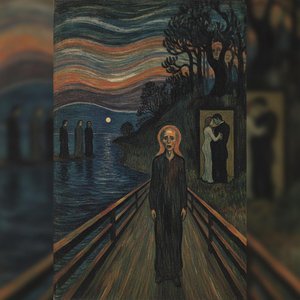
Journey through the raw emotion of Expressionism with our curated guide to Edvard Munch's top 25 masterpieces. Explore the stories behind his most iconic works and find museum-quality art reproductions for your collection. Discover all masterpieces on WahooArt.com.
 Preview
 Send
Send Share
Share
 Details
 Guide
Guide

 Download
 Similars
 X-Ray
X-Ray Diaporama
 Q&A
Q&A Stats
Stats

 Read More









 Glass option is only available in size under 110 CM


