

Hand-painted oil on canvas in your size and frame, made to order by our artists. ( Switch to Print Switch to Digital Image)





























Pick from our preset sizes that match the artwork's original proportions.

You may enter your own dimensions to fit a specific frame or space. If your selected size does not match the original image's proportions, we will either crop the artwork or extend the painting with additional hand-painted elements. A digital mockup will be sent for your approval before production begins.
Please note that the on-screen preview does not reflect the actual cropping or extension. Only the mockup will accurately show the final composition.
While custom sizes are available, we recommend selecting a dimension from the predefined list to preserve the original proportions.
Worldwide Delivery () in 3/4 weeks instead of standard 5 weeks. (21 September). No compromise on quality.


figures in a garden, 1936
Reproduction Size
Francis Bacon's “Figures in a Garden,” painted in 1936, isn’t merely a depiction of a landscape; it’s a visceral plunge into the anxieties and uncertainties simmering beneath the surface of modern society. Born in Dublin and deeply influenced by the turbulent events unfolding across Europe during this period – the rise of fascism, the looming threat of war, and the lingering trauma of World War I – Bacon sought to capture not just what he saw, but how it *felt*. This painting is a prime example of his signature style: a deliberately unsettling blend of Expressionism, Surrealism, and a raw, almost brutal honesty that challenged conventional notions of beauty and representation. The work immediately confronts the viewer with a scene of profound unease – three distorted figures trapped within a claustrophobic space, seemingly imprisoned by an unseen force.
The composition itself is deliberately unbalanced, creating an immediate sense of disorientation. The central figure, rendered with elongated limbs and a vaguely animalistic quality, appears to be struggling within a cage-like structure – not a literal one, but rather a suggestion of confinement, both physical and psychological. To the left lies a reddish-brown form, reminiscent of a dog or perhaps even a distorted human torso, suggesting vulnerability and decay. The background is deliberately blurred, comprised of indistinct trees and foliage that contribute to the overall sense of isolation and unease. Bacon wasn’t interested in creating a realistic representation; instead, he employed distortion as a means of conveying intense emotional states – fear, anxiety, and perhaps even despair. The muted earth tones—greens, browns, and grays—dominate the canvas, punctuated by jarring bursts of red that heighten the sense of tension and impending doom.
Bacon’s technique is characterized by loose, gestural brushstrokes – a deliberate rejection of academic precision. The paint is applied in thick layers, creating a palpable texture that adds depth and physicality to the image. He utilized oil paints on canvas, allowing for rich color saturation and the ability to build up complex forms through layering. Notice how the lines outlining the cage-like structure are more defined than the figures themselves, emphasizing the feeling of entrapment. The artist’s disregard for traditional perspective – flattening the space and creating a sense of immediacy—further contributes to the painting's unsettling effect. It’s as if we’re peering directly into the raw emotions of the subjects, unmediated by any illusion of distance or reality.
“Figures in a Garden” was created during a period of immense social and political upheaval. The rise of totalitarian regimes across Europe cast a long shadow over the art world, prompting artists to grapple with themes of power, control, and human vulnerability. Bacon’s work can be seen as a response to this climate of fear and uncertainty. The painting's symbolism is layered and open to interpretation. The cage represents not just physical confinement but also the psychological constraints imposed by society, tradition, and perhaps even one’s own internal demons. The distorted figures reflect the fragmentation of the human psyche – the sense that we are all trapped within our own minds, struggling to maintain a semblance of sanity in a chaotic world. Considering Bacon's personal life—his unstable childhood and complex relationship with his father—adds another layer of understanding to this powerfully evocative work.


1909 - 1992 , Ireland

Explore the rich history of gardens in painting! Discover masterpieces from Renaissance to Impressionism & beyond. Learn about symbolism, artists like Monet & Klimt, and find your perfect artwork at WahooArt.

Explore the rich symbolism of the red dress in art history! From ancient power displays to iconic portraits like Cézanne’s 'Madame Cezanne', discover the cultural and artistic significance behind this captivating color. Expert analysis & insights.
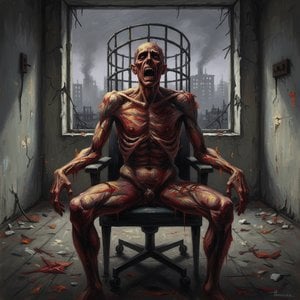
Explore the profound existential anguish of Francis Bacon's art. Discover how trauma shaped his iconic paintings & lasting influence on modern expressionism. A guide for discerning collectors.

Explore 25 iconic Mark Rothko paintings that define Abstract Expressionism. Discover the stories, colors & emotions behind these masterpieces. Find museum-quality art reproductions and curated decor ideas at WahooArt.com.

Delve into the haunting world of Francis Bacon with WahooArt. Explore 25 iconic paintings, from his visceral portraits to powerful triptychs. Discover the stories behind these masterpieces & find museum-quality art reproductions for your home. Explore the full collection online!

 Preview
 Send
Send Share
Share
 Details
 Guide
Guide

 Download
 Similars
 X-Ray
X-Ray Diaporama
 Stats
Stats

 Read More







 Glass option is only available in size under 110 CM


