

Museum-quality giclée or canvas print with fast production and flexible finish options. ( Buy Hand Made Painting Switch to Digital Image)





























Pick from our preset sizes that match the artwork's original proportions.

You may enter your own dimensions to fit a specific frame or space. If your selected size does not match the original image's proportions, we will either crop the artwork or extend the image with a mirrored or solid-fill edge. A digital mockup will be sent for your approval before production begins.
Please note that the on-screen preview does not reflect the actual cropping or extension. Only the mockup will accurately show the final composition.
While custom sizes are available, we recommend selecting a dimension from the predefined list to preserve the original proportions.
Worldwide Delivery () in 2 weeks instead of standard 4/5 weeks. (9 September)


crucifixion, 1965 left
Reproduction Size
Francis Bacon's "Study No. 1," painted in 1953, stands as a cornerstone of his oeuvre and arguably one of the most unsettling images produced during the mid-century artistic canon. More than just a depiction of a man slumped on the floor—a posture that immediately conveys vulnerability and despair—the painting operates on multiple levels of psychological complexity, inviting viewers into a confrontation with primal anxieties about mortality and the fragility of human existence.
Painted in the wake of World War II and amidst the pervasive anxieties of the Cold War era, “Study No. 1” reflects the broader cultural preoccupation with trauma and existential dread. Bacon himself experienced considerable personal hardship during this period—including a devastating divorce and the loss of his nanny—and these experiences undoubtedly informed his artistic vision. The painting’s bleak palette and unsettling imagery resonate powerfully with the psychological landscape of its time.
"Study No. 1" is replete with symbolic references that contribute to its profound emotional resonance. The dark cloth draped over the figure’s face represents concealment and repression—a refusal to confront uncomfortable truths. Similarly, the distorted musculature suggests a struggle against internal forces—a battle for control amidst overwhelming emotion.
Ultimately, “Study No. 1” compels viewers to confront the darkest recesses of human experience. It’s not a painting that offers comfort or reassurance; rather, it demands engagement—forcing us to acknowledge our own mortality and grapple with anxieties about suffering. Bacon's masterful manipulation of color and form achieves this effect brilliantly—creating an image that lingers in the mind long after viewing, prompting reflection on the complexities of human emotion.


1909 - 1992 , Ireland

Explore the profound psychological depth of Expressionist portraiture. From Munch to Schiele, discover how distorted forms and visceral brushstrokes unmask raw human emotion in this definitive guide for art enthusiasts and collectors.
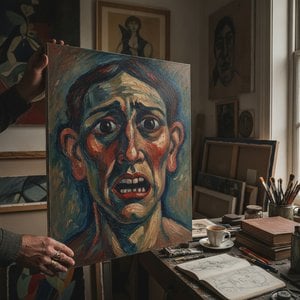
Discover the profound power of Expressionist art. From the raw intensity of Edvard Munch to the visceral textures of Neo-Expressionism, explore how subjective emotion and distorted reality define this movement. An expert guide for discerning collectors seeking depth and soul in fine art.

Embark on a journey through the subconscious with our expert guide to Surrealism. Discover the profound symbolism of masters like Dalí and Ernst, exploring how dreamlike imagery reshaped art history and continues to inspire collectors and enthusiasts worldwide.

Explore the profound emotional depth of Expressionist painting. From the bold colors of Emil Nolde to the distorted forms of Kirchner, discover how this movement redefined art through raw feeling and visceral texture in our expert guide to art history.

 Preview
 Send
Send Share
Share
 Details

 Download
 Similars
 X-Ray
X-Ray Diaporama
 Stats
Stats
 Read More







 Glass option is only available in size under 110 CM


