

The artwork displayed on this page is protected by copyright law, which means we cannot legally create or sell an identical reproduction. This protection is enforced under international agreements such as the Berne Convention and by national laws, including those outlined by the U.S. Copyright Law - Title 17.
This method fully complies with copyright regulations because it does not involve copying or duplicating the protected artwork. Instead, it is a creative reinterpretation - a new painting that is influenced by the original but not identical to it.
Museum-quality giclée or canvas print with fast production and flexible finish options. ( Buy Hand Made Painting Switch to Digital Image)
Pick from our preset sizes that match the artwork's original proportions.

Type the width and the height you need, to fit your frame or your wall. A print can only be cut, never made bigger than the picture, so a size with a different shape loses a part of the image. We send you a digital mockup to approve before we print anything. The picture shown on this page does not show the real cut — only the mockup does.
Worldwide Delivery () in 2 weeks instead of standard 4/5 weeks. (23 October)
‘Patternary span 2’ (installation view)
Reproduction Size

Ghanaian artist Francis Anim Sakyi is a compelling figure in contemporary African art, renowned for his immersive installations that grapple with themes of cultural heritage, memory, and the complexities of identity. His work transcends mere visual representation; it’s an active engagement with history, community, and the very fabric of Ghanaian society. Born in Accra, Sakyi's artistic journey began not within formal institutions but through a deep-seated connection to his ancestral roots and the vibrant street culture of his city.
Sakyi’s early influences were profoundly shaped by the rich tapestry of Ghanaian textiles – kente cloth, batik, and adinkra symbols. These patterns, laden with historical narratives and symbolic meanings, became a central element in his artistic vocabulary. He initially began experimenting with these materials as a sculptor, creating intricate three-dimensional forms that echoed the geometric precision and layered symbolism of traditional designs. However, it was through a pivotal encounter with the concept of ‘patternary’ – a term coined by artist David Hockney to describe the way we perceive visual information – that Sakyi's work truly took flight. This realization led him to explore the idea of patterns as not just decorative elements but as conduits for memory and cultural transmission, transforming his sculptures into dynamic, interactive installations.
Sakyi’s most celebrated works, such as ‘Patternary span 2,’ exemplify this approach. These large-scale installations are meticulously constructed from recycled materials – discarded fabrics, plastic sheeting, and found objects – arranged in complex, layered patterns that evoke the rhythms of Ghanaian life. The use of repurposed materials is not merely a stylistic choice; it’s a deliberate statement about sustainability, resourcefulness, and the cyclical nature of history. Each installation becomes a living narrative, inviting viewers to trace the connections between past and present, tradition and modernity.
A key element of Sakyi's process involves collaborating with communities in Ghana. He often works directly with local artisans and craftspeople, incorporating their skills and knowledge into his installations. This collaborative approach ensures that his work is deeply rooted in the cultural context of its creation, fostering a sense of shared ownership and collective memory. The ‘Accra 89plus Workshop,’ documented extensively by Google Arts & Culture, highlights this commitment to community engagement, bringing together a diverse group of young Ghanaian artists to explore themes of identity, heritage, and social change.
Beyond the immediate influence of Ghanaian textiles, Sakyi’s work draws inspiration from a wide range of sources. The Treasure Museum of the Basilica of Saint Francis in Assisi, with its collection of sacred art and relics, speaks to his interest in exploring themes of spirituality and cultural legacy. Furthermore, his engagement with contemporary issues – particularly those related to social justice and environmental sustainability – is evident in his use of recycled materials and his commitment to community-based projects. His work also reflects a deep understanding of the history of slavery and its enduring impact on African societies, as evidenced by his 2015 performance piece, ‘The Return of the Slaves,’ which confronted the legacy of transatlantic trade through a powerful immersive experience.
Technically, Sakyi’s installations are characterized by their intricate layering, dynamic composition, and use of light and shadow. He masterfully manipulates texture and color to create visually arresting effects that draw viewers into his world. His work is not simply about creating beautiful objects; it's about crafting immersive experiences that stimulate the senses and provoke reflection.
Francis Anim Sakyi’s art has garnered significant recognition within both Ghana and the international art community. Exhibitions in Accra, London, and New York have showcased his innovative approach to contemporary African art. His work has been featured in prominent publications such as Artfacts and Google Arts & Culture, further amplifying its reach and impact. Sakyi's commitment to social engagement, sustainable practices, and collaborative storytelling positions him as a leading voice in the ongoing dialogue about identity, memory, and the future of African art.

Ghana
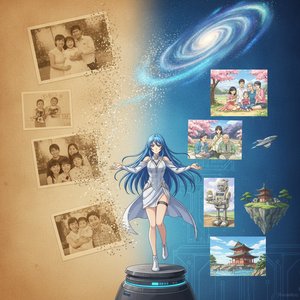
Step into the spotlight with WahooArt's AI-driven transformation. Turn your photos into stunning, hand-painted anime oil masterpieces. Experience the perfect fusion of cutting-edge technology and museum-grade craftsmanship to create a timeless pop-culture legacy for your home.

 Preview
 Send
Send Share
Share
 Details
 Guide
Guide

 Download
 Similars
 X-Ray
X-Ray Diaporama
 Stats
Stats


 Read More






































 Glass option is only available in size under 110 CM


![Legend Of St Francis - [11] - St Francis Before The Sultan (trial By Fire) — Giotto Di Bondone, Proto-renaissance](/media/artworks/images-thumb/0d/32/0d328acfb6c90f7ef32707586e86044b.jpg)
![Life Of Saint Francis - [01] - Stigmatization Of Saint Francis — Giotto Di Bondone, Early Renaissance](/media/artworks/images-thumb/fd/6a/fd6ae2a8f5e88e0ace6b86a21d020ded.jpg)
![Legend Of St Francis - [12] - Ecstasy Of St Francis — Giotto Di Bondone, Proto-renaissance](/media/artworks/images-thumb/04/ab/04abd6d876609c25d110143ce0fae9c5.jpg)
![Legend Of St Francis - [24] - Canonization Of St Francis — Giotto Di Bondone, Gothic](/media/artworks/images-thumb/81/9b/819b5f0656848eb5cb3fcd40fd5756aa.jpg)
![Life Of Saint Francis - [07] - Vision Of The Ascension Of St Francis — Giotto Di Bondone, Gothic Revival](/media/artworks/images-thumb/71/2e/712ed3190eed1271478f0e69b3d0ec03.jpg)

![Life Of Saint Francis - [04] - Death And Ascension Of St Francis — Giotto Di Bondone, Italian Renaissance](/media/artworks/images-thumb/08/8b/088b102b13c1a379233690905590f156.jpg)

