x
PreviewPreview AR previewAR preview Buy Print Buy PrintBuy Image Buy Image SendSend
DetailsDetails Add to favorites Add to favorites DownloadDownload SimilarsSimilars X-RayX-Ray DiaporamaDiaporama

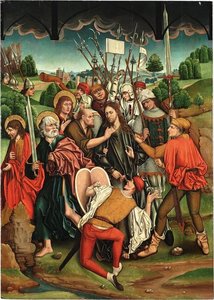
The Blessing Christ

Fernando Gallego's 'The Blessing Christ,' painted in 1492, exemplifies the Hispano-Flemish style with intricate detail and vibrant colors—a masterpiece reflecting religious devotion during the Renaissance.

Fernando Gallego (c. 1440-1507) was a key Castilian painter of the Hispano-Flemish style. Known for detailed religious altarpieces, vivid illusionism & works like the Retablo of Ciudad Rodrigo. Explore his legacy!

Hand Made Oil Reproduction

Hand-painted oil on canvas in your size and frame, made to order by our artists. (Buy Print Buy PrintBuy Image Buy Image)

P118B $10
P118H $10
P118W $10
P438Z $10
P508JH $12
P508YH $12
P805H $10
P805Z $10
P919BZ $10
P919G $10
P919XJ $10
P959ZH $10
P968JZ $12
W106C $8
W218G $10
W218JH $8
W218Y $10
W307PJ $10
W316G $10
W316PJ $8
W316Y $10
W398PJ $8
W4111J $10
W500HY $15
W500JH $15
W692G $12
W849H $8
W940BG $15
W953PJ $8

Standard
custom
CM
INCH

Pick from our preset sizes that match the artwork's original proportions.

width
height

You may enter your own dimensions to fit a specific frame or space. If your selected size does not match the original image's proportions, we will either crop the artwork or extend the painting with additional hand-painted elements. A digital mockup will be sent for your approval before production begins.
Please note that the on-screen preview does not reflect the actual cropping or extension. Only the mockup will accurately show the final composition.
While custom sizes are available, we recommend selecting a dimension from the predefined list to preserve the original proportions.

Examples of what can be changed: Replace face with customer photo; Add pet (e.g., replace cat with dog); Include hidden message in background; Change background landscape or elements.
After order, WahooArt.com team will email client for instructions and provide a mockup preview

Worldwide Delivery () in 3/4 weeks instead of standard 5 weeks. (29 August). No compromise on quality.

why_choose_icon
Free Worldwide Express Shipping
why_choose_icon
High-Quality Linen Canvas
why_choose_icon
Full Shipping Insurance
why_choose_icon
Customs Tax Refund Guarantee
why_choose_icon
True Color Matching Guarantee
why_choose_icon
60-Day Return Policy (Defects Only)
why_choose_icon
100% Money-Back Guarantee
why_choose_icon
Bulk Discount Offer

Total Price

$ 272

reproduction

The Blessing Christ

Reproduction Medium

Reproduction Size

-

Total Price

$ 272

Quick Facts

  • Artistic style: Hispano-Flemish Style
  • Subject or theme: Religious scene of Christ blessing
  • Title: The Blessing Christ
  • Artist: Fernando Gallego
  • Dimensions: 169 x 132 cm

Art Quiz

There is only one correct answer for each question.

Question 1:
What is the primary religious subject matter depicted in 'The Blessing Christ'?
Question 2:
Which artistic style is Fernando Gallego noted for mastering?
Question 3:
According to the description, what are some prominent colors used in the painting that emphasize its religious significance?
Question 4:
What type of objects or formats did Fernando Gallego frequently produce, according to his biography?
Question 5:
What year was 'The Blessing Christ' painted?

The Divine Radiance of Fernando Gallego's Blessing Christ

To stand before this magnificent depiction of The Blessing Christ is to step directly into the devotional heart of late 15th-century Spain. This panel, executed by the masterful hand of Fernando Gallego, transcends mere religious illustration; it is a vibrant tapestry woven from faith, artistry, and profound spiritual energy. The central figure, Jesus Christ, enthroned and raising his hands in benediction, commands immediate reverence. His presence radiates an almost palpable sense of divine authority, yet this power is softened by the surrounding celestial chorus. Gallego has captured that perfect moment where the eternal meets the earthly, inviting the viewer into a sacred, richly decorated narrative space.

A Fusion of Styles: The Hispano-Flemish Touch

Fernando Gallego stands as a pivotal figure in art history, an artist whose genius lay in synthesizing disparate artistic currents. As a master of the Hispano-Flemish Style, his work speaks volumes about the cultural exchange occurring between Northern European realism and the burgeoning grandeur of the Italian Renaissance within Spain. One can observe the meticulous detail characteristic of Flemish painting—the crisp rendering of drapery, the lifelike quality of the surrounding figures, even the inclusion of a humble dog near the base, grounding the divine scene in relatable reality. The palette itself, dominated by deep reds and opulent golds, is not merely decorative; it serves to amplify the sacred weight of the subject matter, drawing the eye inexorably toward Christ’s blessing.

Symbolism Woven into Gold and Pigment

Every element within this composition seems imbued with symbolic meaning. The surrounding angels, depicted in various states of song or musical accompaniment, form a heavenly choir supporting the central mystery. They are not mere background decoration; they are active participants in the divine proclamation. Consider the placement of the figures: the solemn individual on the far left, the attendant at the center-left, and the figure standing behind Christ to the right—each contributes to the narrative depth, suggesting a community gathered before the divine word. Even the inclusion of a bird near the upper right corner adds an element of natural symbolism, perhaps representing the soul or the spirit ascending toward heaven.

Craftsmanship for the Modern Devotional Space

The sheer intricacy of this piece, dating from 1492, speaks to the painstaking labor and devotion required by Gallego’s workshop. The ornate quality suggests its original function as a centerpiece altarpiece or retablo, designed not just to be viewed, but to inspire awe within a grand ecclesiastical setting. For the contemporary collector or designer, owning a reproduction of this work is acquiring more than just art; it is curating an atmosphere of profound contemplation. The rich texture and historical weight captured in these pigments offer an unparalleled opportunity to infuse any space—be it a chapel, library, or drawing-room—with timeless, spiritual grandeur.


Artist Biography

Fernando Gallego: A Master of the Hispano-Flemish Style

Fernando Gallego, a name often shrouded in mystery yet deeply resonant within Spanish art history, was a Castilian painter who flourished during the late 15th and early 16th centuries. Born around 1440 in Salamanca and tragically dying sometime before 1507, his life spanned a pivotal era of artistic transition – the convergence of Northern European realism with burgeoning Italian Renaissance ideals. Gallego’s legacy isn't defined by grand, solitary masterpieces but rather by a prolific output of meticulously crafted religious panels, particularly altarpieces and retablos, that offer invaluable insights into the visual culture of his time. While definitive biographical details remain scarce, tracing his work through attributions and historical records paints a compelling picture of an artist deeply influenced by Flemish painting, especially the works of Rogier van der Weyden, yet firmly rooted in the Spanish artistic tradition.

Early Life and Artistic Training – A Shadow of Uncertainty

The precise origins of Fernando Gallego’s artistic training remain elusive, a characteristic that has long intrigued art historians. Despite speculation linking him to workshops in Salamanca and beyond, concrete evidence is remarkably limited. He likely began his career in the vibrant artistic environment of Castile and Extremadura, regions renowned for their rich religious patronage during this period. The prevailing theory suggests a strong connection to Flemish painting, particularly the naturalistic handling of form and technical mastery evident in Rogier van der Weyden’s work – a style characterized by its meticulous detail, deep emotional resonance, and sophisticated use of light and shadow. Early Netherlandish painting, with its vivid illusionism and complex iconography, exerted a profound influence on Gallego's approach to composition and figure depiction. It is believed he may have spent time studying in Flanders, though this remains unconfirmed. Interestingly, the work attributed to him often shares stylistic similarities with Francisco Gallego, his likely workshop assistant – a relationship that adds another layer of complexity to understanding Gallego’s artistic development.

A Flourishing Career: Altarpieces and Retablos

Gallego's career was largely dedicated to the creation of small panels intended for incorporation into larger altarpieces, or retablos. These devotional works were central to religious life in 15th-century Spain, serving as focal points for worship and visual narratives within churches and chapels. Gallego’s skill lay not just in his technical proficiency – evidenced by the smooth application of paint, precise rendering of drapery, and realistic portrayal of human figures – but also in his ability to imbue these scenes with a palpable sense of drama and emotional intensity. He frequently depicted biblical stories, saints' lives, and episodes from Christian history, often employing a carefully orchestrated balance between realism and symbolic representation. A particularly noteworthy example is the Retablo of Ciudad Rodrigo, a monumental work undertaken in collaboration with Master Bartolomé, showcasing Gallego’s meticulous attention to detail and his ability to integrate multiple narratives within a single panel. The scale of this project – a testament to the importance of religious art at the time – highlights Gallego's standing as a leading artist in Castile.

Notable Works and Artistic Techniques

Among Gallego’s surviving works, several stand out for their artistic merit and historical significance. The “Madonna of the Catholic Kings,” housed at the Getty Museum, exemplifies his masterful use of color, light, and composition to create a deeply moving depiction of the Virgin Mary and Christ Child. The “Ara” (Sky of Salamanca), a vast ceiling mural adorning the University of Salamanca, represents an exceptional achievement – a monumental undertaking that demonstrates Gallego’s ambition and technical skill. This fresco, depicting astronomical scenes and constellations, showcases his ability to translate complex scientific concepts into visually engaging imagery. Gallego primarily worked with oil on panel, though he also utilized tempera in his early works. His meticulous attention to detail, combined with his understanding of perspective and spatial relationships, resulted in a remarkably realistic and lifelike quality in his paintings. He was known for painstakingly individualizing the figures within his scenes, enhancing their dramatic appeal while simultaneously demonstrating his technical prowess.

Legacy and Historical Significance

Fernando Gallego’s impact on Spanish art is significant despite the limited documentation surrounding his life. He represents a crucial link between the early Flemish influences that shaped 15th-century Spain and the burgeoning Renaissance style that would soon dominate the artistic landscape. His work provides valuable insights into the religious beliefs, social customs, and artistic practices of his time. While often overshadowed by more celebrated contemporaries, Gallego’s contribution to the development of Spanish painting is undeniable. The continued study of his retablos and panels offers a window into the devotional world of 15th-century Spain, revealing a wealth of information about religious iconography, artistic techniques, and the lives of those who commissioned and viewed these powerful works of art. His legacy endures through the beauty and emotional resonance of his paintings, reminding us of the enduring power of visual storytelling to connect with audiences across centuries.
Fernando Gallego

Fernando Gallego

1440 - 1507 , Spain

Quick Facts

  • Artistic Movement Or Style: Hispano-Flemish
  • Artists Who Influenced This Artist: ['Rogier van der Weyden']
  • Date Of Birth: c. 1440, Salamanca
  • Date Of Death: 1507, Salamanca
  • Full Name: Fernando Gallego
  • Nationality: Castilian
  • Notable Artworks:
    • Sky of Salamanca
    • Retablo of Ciudad Rodrigo
    • Pietà (Getty Museum)
  • Place Of Birth: Salamanca, Spain
Explore artworks organized by themes, styles, and characteristics.