Purchase a high-resolution, enhanced digital image, far superior to the online preview.
Each file is meticulously prepared by our in-house specialists using advanced tools and expert manual retouching. We ensure every image has exceptional clarity, precise color accuracy, and fine detail.
The final file is delivered via email within 72 hours, optimized for immediate use in professional, editorial, and print environments. This is the same quality trusted by top-tier design studios, publishers, and galleries.
Download a high-resolution file for personal display, printing, and creative projects. ( Switch to Print Buy Hand Made Painting)
When you choose WahooArt.com, you're not just getting an image - you're receiving a professionally enhanced digital artwork, crafted with precision and backed by a satisfaction guarantee. Here's everything that comes with your order, automatically:
Your high-resolution digital image file will be emailed to you within 72 hours of ordering - ready for immediate use.
Your artwork is professionally optimized using advanced AI tools and manual editing, ensuring maximum detail, clarity, and color accuracy.
Accidentally deleted or lost your file? No worries - we'll resend it to you anytime, free of charge.
Enjoy your artwork instantly with zero customs, duties, or delivery fees - digital downloads are always tax-free.
We ensure your digital image reflects the original colors as closely as possible using professional tools and color management.
If you're not satisfied with your digital image, we'll revise it or refund 100% within 100 days - no questions asked.
Not satisfied? Get a full refund within 100 days of receiving your digital file - no questions asked.
Buy 3 images, save 10% - Buy 5, save 15% - Buy 10+, save 20%. Great for creative projects, galleries, and agencies.
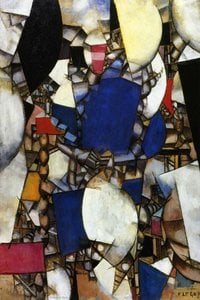
In the vibrant tapestry of twentieth-century avant-garde art, few threads are as bold and structurally sound as those woven by Fernand Léger. His untitled (743 3) composition serves as a breathtaking window into an abstracted reimagining of urban existence, where the chaotic pulse of the city is distilled into a rhythmic dance of geometry. Rather than offering a literal window onto a streetscape, Léger invites us into a dreamlike realm where buildings and organic forms merge into a singular, stylized vision. The canvas is dominated by striking, bold shapes that suggest the soaring heights of architecture and the skeletal grace of abstracted trees, all arranged in a deliberate asymmetry that compels the viewer’s eye to wander across the surface, discovering new intersections of color and form with every glance.
The emotional resonance of this piece lies in its unique ability to balance tension with harmony. There is a subtle, almost haunting sense of detachment within the flattened perspective; by minimizing depth, Léger distances the scene from the grit of everyday reality, elevating the cityscape to a plane of pure aesthetic contemplation. For the collector or interior designer, this work offers a sophisticated emotional anchor—a piece that conveys the controlled chaos of modern life while maintaining an air of serene, structured elegance. It is a visual symphony of modernity, capturing that fleeting moment where the industrial and the organic exist in a state of perfect, geometric equilibrium.
To understand this masterpiece, one must delve into Léger’s revolutionary "Tubism," a distinctive evolution of Cubism that replaced the fragmented planes of his contemporaries with cylindrical, tubular forms. This technique breathes a muscular, mechanical energy into the work, celebrating the strength and dynamism of the industrial age. The application of color is remarkably purposeful; using what appears to be the flat, decisive strokes of gouache or acrylic, Léger employs a palette that is both vibrant and carefully curated. There is no room for the ambiguity of soft brushwork here; instead, every edge is sharply defined, creating a sense of order and architectural permanence that mirrors the very structures it depicts.
This stylistic choice reflects Léger’s profound fascination with the aesthetics of progress. As a pioneer who found beauty in the metallic sheen and rhythmic precision of machinery, he utilized clean lines and streamlined patterns that whisper of the Art Deco movement. The artwork does not merely represent a city; it engineers an experience of one. For those seeking to infuse a contemporary space with intellectual depth and historical significance, this reproduction offers more than just decoration. It provides a profound connection to a period of radical transformation, bringing the high-voltage hum of the machine age into the quiet sanctuary of the modern home.
Beyond its striking visual impact, untitled (7433) stands as a testament to Léger’s enduring legacy as a bridge between the abstract experiments of the early 1900s and the populist energy of later movements like Pop Art. His ability to translate the complex, often alienating experience of urban industrialization into an accessible, figurative aesthetic is nothing short of masterful. The work avoids the coldness of pure abstraction by retaining a sense of recognizable life, even if that life is reimagined through a lens of geometric precision.
Integrating such a piece into a curated collection or a high-end interior design project allows for a dialogue between history and modernity. The verticality of the composition lends itself to creating a sense of height and grandeur in a room, while the bold, primary-adjacent tones can serve as a focal point that energizes neutral palettes. Owning a reproduction of this caliber is an invitation to inhabit Léger’s world—a world where every cylinder, every stripe, and every shape vibrates with the eternal heartbeat of human progress and the unyielding beauty of form.
clay (#d36646) is the leading color of "untitled (7433)" by Fernand Léger.
Fernand Léger used the gouache technique for "untitled (7433)". The technique defines the material nature of the original work.
Other names recorded for Fernand Léger, creator of "untitled (7433)", include Joseph Fernand Henri Léger.


1881 - 1955 , France

 Preview
 Send
Send Share
Share
 Details
 Guide
Guide

 Download
 Similars
 X-Ray
X-Ray Diaporama
 Stats
Stats

 Read More