Purchase a high-resolution, enhanced digital image, far superior to the online preview.
Each file is meticulously prepared by our in-house specialists using advanced tools and expert manual retouching. We ensure every image has exceptional clarity, precise color accuracy, and fine detail.
The final file is delivered via email within 72 hours, optimized for immediate use in professional, editorial, and print environments. This is the same quality trusted by top-tier design studios, publishers, and galleries.
Download a high-resolution file for personal display, printing, and creative projects. ( Switch to Print Buy Hand Made Painting)
When you choose WahooArt.com, you're not just getting an image - you're receiving a professionally enhanced digital artwork, crafted with precision and backed by a satisfaction guarantee. Here's everything that comes with your order, automatically:

Your high-resolution digital image file will be emailed to you within 72 hours of ordering - ready for immediate use.

Your artwork is professionally optimized using advanced AI tools and manual editing, ensuring maximum detail, clarity, and color accuracy.

Accidentally deleted or lost your file? No worries - we'll resend it to you anytime, free of charge.

Enjoy your artwork instantly with zero customs, duties, or delivery fees - digital downloads are always tax-free.

We ensure your digital image reflects the original colors as closely as possible using professional tools and color management.

If you're not satisfied with your digital image, we'll revise it or refund 100% within 100 days - no questions asked.

Not satisfied? Get a full refund within 100 days of receiving your digital file - no questions asked.

Buy 3 images, save 10% - Buy 5, save 15% - Buy 10+, save 20%. Great for creative projects, galleries, and agencies.
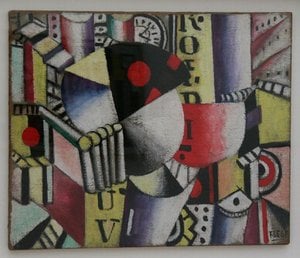
Fernand Léger’s “Still Life with Plaster Mask” is not merely a depiction of objects arranged on a surface; it's an invitation into a world where form, geometry, and the echoes of industrialization converge. Painted around 1914, during a pivotal period in Léger’s artistic evolution – a time when he moved away from the rigid constraints of Cubism towards a more expressive, almost populist style – this work embodies his fascination with the machine age while retaining a distinctly human sensibility. The central figure, a plaster mask, immediately commands attention. It's not a realistic representation but rather an abstracted form, hinting at anonymity and perhaps even a veiled identity. Léger’s deliberate simplification of shapes—the cylindrical forms reminiscent of pipes and gears, characteristic of his “Tubism”—suggests a world increasingly dominated by mechanical processes, yet the mask itself retains a certain theatricality, recalling ancient ritual objects and the power of disguise.

(Image: A traditional mask from Ravensburg Fasnet, illustrating the historical and ritual significance of masks)
Léger’s artistic journey is inextricably linked to the development of Cubism. Initially influenced by Picasso and Braque, he developed his own distinctive approach – “Tubism” – which prioritized simplified geometric forms, particularly cylinders, cones, and cubes. This style was a direct response to the dynamism and fragmentation he observed in the burgeoning industrial landscape. However, unlike many of his contemporaries who retreated into pure abstraction, Léger sought to integrate modernity directly into his work. “Still Life with Plaster Mask” demonstrates this brilliantly; the mask itself becomes a visual embodiment of this integration – a fragmented, stylized representation that simultaneously evokes both ancient symbolism and contemporary mechanics. The surrounding objects—a cup, a bowl, an umbrella—are treated with similar geometric precision, contributing to the painting’s overall sense of ordered chaos.
The addition of the umbrella, positioned high in the composition, introduces an element of unexpected lightness and perhaps even vulnerability against the backdrop of industrial forms. It's a subtle detail that adds depth to the work, suggesting a human presence within this machine-dominated world. Interestingly, Léger’s exploration of masks during this period coincided with his own experiences in World War I, where he witnessed firsthand the dehumanizing effects of mechanized warfare. The mask, therefore, can be interpreted as a symbol of both anonymity and the loss of individual identity – themes that resonated deeply within him.
Executed in oil on canvas, “Still Life with Plaster Mask” showcases Léger’s masterful control of color and form. He employs a limited palette—primarily primary colors punctuated by black and white—to create a sense of clarity and visual impact. The brushstrokes are bold and decisive, emphasizing the geometric shapes and contributing to the painting's overall dynamism. The use of canvas itself is integral to the work’s aesthetic; Léger deliberately avoids illusionistic depth, instead focusing on the flat surface and the interplay of shapes and colors. This approach aligns with his desire to represent the world as it *appears* rather than as it *is*, reflecting a commitment to capturing the essence of modern experience.
Beyond its formal qualities, “Still Life with Plaster Mask” carries a profound symbolic weight. The mask, as a recurring motif in Léger’s work, represents not just anonymity but also transformation, disguise, and the potential for rebirth. It speaks to our desire to conceal ourselves from the world, yet simultaneously invites us to explore hidden aspects of our own identities. The painting's overall mood is one of quiet contemplation—a subtle tension between the ordered precision of industrial forms and the inherent mystery of human existence. It’s a work that rewards repeated viewing, revealing new layers of meaning with each encounter. A high-quality reproduction allows us to appreciate Léger’s innovative approach to modern art and his enduring legacy as a pioneer of abstraction.


1881 - 1955 , France

 Preview
 Send
Send Share
Share
 Details
 Guide
Guide

 Download
 Similars
 X-Ray
X-Ray Diaporama
 Stats
Stats

 Read More