Preview AR preview Switch to Print Switch to Digital Image Send
Details Guide Add to favorites Download Similars X-Ray Diaporama Stats

Postcard

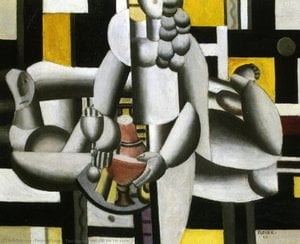
Explore Fernand Léger’s vibrant ‘Postcard,’ a captivating depiction of three women surrounded by birds and botanical elements—a bold fusion of abstraction and observation emblematic of the early 20th century's machine aesthetic. Discover this stunning reproduction and bring Léger’s artistic vision home.

Discover Fernand Léger (1881-1955): Pioneer of Cubism & 'Tubism'! Explore bold paintings celebrating modern life, machinery, and the human form – a key forerunner to Pop Art.

Hand Made Oil Reproduction

Hand-painted oil on canvas in your size and frame, made to order by our artists. ( Switch to Print Switch to Digital Image)

Corner sample of the P118B picture frame: moulded polystyrene, 5 cm wide and 3 cm thick
P118B $10
Corner sample of the P118H picture frame: moulded polystyrene, 5 cm wide and 3 cm thick
P118H $10
Corner sample of the P118W picture frame: moulded polystyrene, 5 cm wide and 3 cm thick
P118W $10
Corner sample of the P438Z picture frame: moulded polystyrene, 5.5 cm wide and 3.5 cm thick
P438Z $10
Corner sample of the P508JH picture frame: moulded polystyrene, 7 cm wide and 3.5 cm thick
P508JH $12
Corner sample of the P508YH picture frame: moulded polystyrene, 7 cm wide and 3.5 cm thick
P508YH $12
Corner sample of the P805H picture frame: moulded polystyrene, 5 cm wide and 3.5 cm thick
P805H $10
Corner sample of the P805Z picture frame: moulded polystyrene, 5 cm wide and 3.5 cm thick
P805Z $10
Corner sample of the P919BZ picture frame: moulded polystyrene, 7 cm wide and 3.5 cm thick
P919BZ $10
Corner sample of the P919G picture frame: moulded polystyrene, 7 cm wide and 3.5 cm thick
P919G $10
Corner sample of the P919XJ picture frame: moulded polystyrene, 7 cm wide and 3.5 cm thick
P919XJ $10
Corner sample of the P959ZH picture frame: moulded polystyrene, 5 cm wide and 3 cm thick
P959ZH $10
Corner sample of the P968JZ picture frame: moulded polystyrene, 6 cm wide and 4 cm thick
P968JZ $12
Corner sample of the W106C picture frame: solid wood, 5 cm wide and 3 cm thick
W106C $8
Corner sample of the W218G picture frame: solid wood, 5 cm wide and 3 cm thick
W218G $10
Corner sample of the W218JH picture frame: solid wood, 5 cm wide and 3 cm thick
W218JH $8
Corner sample of the W218Y picture frame: solid wood, 5 cm wide and 3 cm thick
W218Y $10
Corner sample of the W307PJ picture frame: solid wood, 6 cm wide and 3 cm thick
W307PJ $10
Corner sample of the W316G picture frame: solid wood, 6 cm wide and 3 cm thick
W316G $10
Corner sample of the W316PJ picture frame: solid wood, 6 cm wide and 3 cm thick
W316PJ $8
Corner sample of the W316Y picture frame: solid wood, 6 cm wide and 3 cm thick
W316Y $10
Corner sample of the W398PJ picture frame: solid wood, 5 cm wide and 3 cm thick
W398PJ $8
Corner sample of the W4111J picture frame: solid wood, 6.5 cm wide and 3.5 cm thick
W4111J $10
Corner sample of the W500HY picture frame: solid wood, 7 cm wide and 5 cm thick
W500HY $15
Corner sample of the W500JH picture frame: solid wood, 7 cm wide and 5 cm thick
W500JH $15
Corner sample of the W692G picture frame: solid wood, 8 cm wide and 4 cm thick
W692G $12
Corner sample of the W849H picture frame: solid wood, 5 cm wide and 3 cm thick
W849H $8
Corner sample of the W940BG picture frame: solid wood, 7.5 cm wide and 4.5 cm thick
W940BG $15
Corner sample of the W953PJ picture frame: solid wood, 6 cm wide and 3.5 cm thick
W953PJ $8

Standard
custom
CM
INCH

Pick from our preset sizes that match the artwork's original proportions.

width
height

Type the width and the height you need, to fit your frame or your wall. This is hand-painted, so for a size with a different shape the artist can paint a bit more around the picture, or cut a bit — you choose. We send you a digital mockup to approve before the painting starts. The picture shown on this page does not show the real result — only the mockup does.

Examples of what can be changed: Replace face with customer photo; Add pet (e.g., replace cat with dog); Include hidden message in background; Change background landscape or elements.
After order, WahooArt.com team will email client for instructions and provide a mockup preview

Worldwide Delivery () in 3/4 weeks instead of standard 5 weeks. (16 October). No compromise on quality.

Free Worldwide Express Shipping
High-Quality Linen Canvas
Full Shipping Insurance
Customs Tax Refund Guarantee
True Color Matching Guarantee
100-Day Return Policy (Defects Only)
100% Money-Back Guarantee
Bulk Discount Offer

Total Price

$ 272

Postcard

Reproduction Medium

Reproduction Size

-

Total Price

$ 272

Quick Facts

  • Location: Private Collection
  • Artist: Fernand Léger
  • Medium: Painting
  • Movement: Cubism
  • Subject or theme: Women; Birds; Clock; Plant

A Symphony of Form and Color: The Modernist Vision of Fernand Léger

In the vibrant tapestry of early twentieth-century modernism, few works capture the rhythmic pulse of the machine age as evocatively as Fernand Léger’s "Postcard." Painted during his most prolific creative era between 1925 and 1930, this masterpiece serves as a profound meditation on the intersection of human tradition and technological progress. At first glance, the viewer is greeted by three women, poised in a moment of quiet contemplation as they hold books to their chests. Yet, beneath this serene surface lies Léger’s signature Tubism—a style that celebrates the beauty of cylindrical forms and the geometric precision of an industrializing world. The painting does not merely depict a scene; it constructs a visual language where the organic and the mechanical dance in a delicate, colorful equilibrium.

The technique employed by Léger is nothing short of transformative. While his contemporaries often retreated into pure abstraction, Léger utilized a sophisticated blend of Cubist fragmentation and bold, saturated color palettes to create an illusionistic depth that defies simple representation. The figures are rendered with simplified, almost sculptural shapes, yet they possess a weight and presence that feels remarkably tangible. Through masterful tonal modulation, he breathes life into the canvas, allowing light to play across the geometric planes of the women’s garments and the surrounding environment. This approach creates a sense of movement and vitality, making the artwork feel less like a static image and more like a living, breathing fragment of a modern metropolis.

Symbolism and the Harmony of Contrasts

Beyond its striking aesthetic, "Postcard" is rich with symbolic layers that invite deep intellectual engagement. Léger masterfully weaves elements of nature into an otherwise mechanized composition to suggest a world where progress and biology coexist. The inclusion of two birds—one soaring near the top left and another nestled toward the bottom right—acts as a poignant metaphor for freedom and the boundless aspirations of the human spirit. These organic flourishes are balanced by the presence of a potted plant, which embodies resilience and the enduring strength of life amidst the steel and stone of urban existence. Even the prominent clock positioned at the upper center serves as a silent narrator, reminding us of the relentless march of time that shapes both our personal histories and the evolution of art itself.

For the discerning collector or interior designer, this artwork offers more than just visual splendor; it provides an emotional anchor. The juxtaposition of the women’s intellectual pursuits—symbolized by their books—against a backdrop of industrial geometry creates a narrative of intellectual grace within a fast-paced world. It is a piece that commands attention in any sophisticated space, offering a sense of structured calm and historical depth. Whether placed in a contemporary gallery setting or a classic study, "Postcard" inspires a sense of wonder, reminding us that even in an age of machines, the human soul remains the ultimate architect of beauty.

Questions & Answers

Where can I find a guide to "Postcard"?

A Guide page is available for "Postcard" by Fernand Léger: a printable factsheet about the artwork, designed for students and classroom use.

In which movement and which era is "Postcard" by Fernand Léger placed?

"Postcard" belongs to the Geometric Abstraction movement, and its creator worked in the Modern era.

What mood does "Postcard" by Fernand Léger express within Geometric Abstraction?

The reflective emotion of "Postcard" accompanies its Geometric Abstraction style.


Artist Biography

A Life Forged in Form: The World of Fernand Léger

Fernand Léger, born Joseph Fernand Henri Léger in 1881 amidst the rural landscapes of Argentan, Normandy, stands as a pivotal figure in the evolution of modern art. His journey from the farmlands of his youth to the forefront of Parisian avant-garde circles is a testament to an unwavering artistic vision and a relentless pursuit of capturing the spirit of the machine age. Unlike many of his contemporaries who embraced abstraction as a retreat from representation, Léger sought to *integrate* modernity – its dynamism, its mechanical forms, its very essence – into a new visual language that was both powerfully abstract and deeply rooted in the observable world. His early life, steeped in the physicality of agricultural labor, provided a grounding contrast to the industrialized future he would so passionately depict. Initially destined for architecture, Léger’s path shifted towards painting after arriving in Paris around 1900, supporting himself through drafting work while honing his artistic skills. This period was marked by traditional academic training, but it wasn't until encountering the groundbreaking work of Paul Cézanne that a true transformation began to unfold.

The Birth of ‘Tubism’ and the Section d’Or

Cézanne’s retrospective in 1907 acted as a catalyst, liberating Léger from conventional representation and propelling him towards a more geometric and structural approach. He began dismantling forms, analyzing their underlying structures, and rebuilding them on canvas with a newfound emphasis on solidity and volume. This exploration quickly led him into the orbit of Cubism, but Léger wasn’t content to simply replicate the styles of Picasso or Braque. Instead, he developed his own distinct idiom – a personal form of Cubism that critics playfully dubbed “Tubism.” Characterized by cylindrical forms, flattened planes, and bold color contrasts, Tubism celebrated the machine aesthetic long before it became a widespread artistic preoccupation. It was an art born from observing the burgeoning industrial world, recognizing beauty in its functional shapes and mechanical rhythms. This period saw Léger actively participating in the avant-garde scene, joining forces with artists like Jean Metzinger, Henri Le Fauconnier, Francis Picabia, and Marcel Duchamp within the Puteaux Group, also known as the Section d’Or (The Golden Section). The group explored mathematical principles of harmony and proportion, seeking to infuse their art with a sense of order and rationality. Their collective investigations pushed the boundaries of artistic expression, laying the groundwork for future developments in abstract art.

War, Mechanization, and a New Aesthetic

The outbreak of World War I profoundly impacted Léger’s life and work. Serving at the front from 1914 to 1916 exposed him to the brutal realities of modern warfare – artillery barrages, aerial combat, and the dehumanizing effects of mechanized conflict. This experience didn't lead to disillusionment or a rejection of modernity; rather, it solidified his fascination with machines and their power. Sketches made during his service documented the stark beauty of military technology, transforming instruments of destruction into subjects of artistic contemplation. Upon returning to civilian life, Léger’s aesthetic underwent a further evolution. His paintings began to reflect a more streamlined, mechanistic sensibility, celebrating the dynamism and efficiency of the industrial world. *Soldier with a Pipe* (1916) exemplifies this shift, showcasing simplified forms and bold colors that evoke the feeling of mechanical precision. This wasn't merely an aesthetic choice; it was a philosophical statement – an affirmation of modernity’s potential for progress and renewal, even in the wake of devastating conflict.

Legacy and Lasting Influence

In his post-war years, Léger continued to explore the intersection of art and industry, creating works that celebrated modern life with a unique blend of abstraction and figuration. His *Paysages animés* (Animated Landscapes) series from 1921 showcased figures and animals seamlessly integrated into streamlined compositions, blurring the boundaries between organic and inorganic forms. He also experimented with sculpture and filmmaking, expanding his artistic practice beyond the confines of traditional painting. Léger’s influence on subsequent generations of artists is undeniable. His bold simplification of form, his embrace of industrial imagery, and his celebration of popular culture anticipated the emergence of Pop Art decades later. Artists like Roy Lichtenstein and Andy Warhol owe a clear debt to Léger's pioneering work. He bridged the gap between abstract art and figurative representation, demonstrating that it was possible to create works that were both intellectually rigorous and visually engaging. Today, Fernand Léger’s paintings are held in major museums worldwide, including the Musée d'Art et d'Histoire in France and the Musée National Fernand Léger, dedicated solely to his work. He remains a towering figure of 20th-century art – a visionary who dared to find beauty in the machine age and to translate its energy onto canvas with unparalleled boldness and originality. His legacy is not merely as a painter, but as a prophet of modernity. A true pioneer whose work continues to resonate with audiences today.
Fernand Léger

Fernand Léger

1881 - 1955 , France

Quick Facts

  • Full Name: Fernand Léger
  • Nationality: French
  • Date Of Birth: 1881
  • Date Of Death: 1955
  • Place Of Birth: Argentan, France
  • Notable Artworks:
    • The Sitted Woman
    • Machine Element
    • The Great Parade
    • The City
  • Artistic Movement Or Style: Cubism, Tubism
  • Artists Who Influenced This Artist: ['Paul Cézanne']
  • Artists Or Movements Influenced By This Artist: ['Pop Art']
Explore artworks organized by themes, styles, and characteristics.