Switch to Print Buy Hand Made Painting Send
Details Guide Add to favorites Download Similars Diaporama Stats

Discs

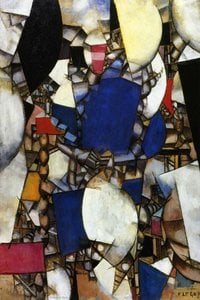
Explore Fernand Léger’s ‘Discs’ (1918), a dynamic Cubist abstraction featuring geometric shapes & pixelated texture. A captivating early 20th-century artwork – discover its unique style!

Discover Fernand Léger (1881-1955): Pioneer of Cubism & 'Tubism'! Explore bold paintings celebrating modern life, machinery, and the human form – a key forerunner to Pop Art.

Purchase a high-resolution, enhanced digital image, far superior to the online preview.

Each file is meticulously prepared by our in-house specialists using advanced tools and expert manual retouching. We ensure every image has exceptional clarity, precise color accuracy, and fine detail.

The final file is delivered via email within 72 hours, optimized for immediate use in professional, editorial, and print environments. This is the same quality trusted by top-tier design studios, publishers, and galleries.

Digital Image

Download a high-resolution file for personal display, printing, and creative projects. ( Switch to Print Buy Hand Made Painting)

Total Price

$ 24.90

Included in Every Digital Image Order

Expert Digital Delivery, Guaranteed

When you choose WahooArt.com, you're not just getting an image - you're receiving a professionally enhanced digital artwork, crafted with precision and backed by a satisfaction guarantee. Here's everything that comes with your order, automatically:

Fast Email Delivery

Your high-resolution digital image file will be emailed to you within 72 hours of ordering - ready for immediate use.

AI-Enhanced Digital File

Your artwork is professionally optimized using advanced AI tools and manual editing, ensuring maximum detail, clarity, and color accuracy.

Free Lifetime Re-Delivery

Accidentally deleted or lost your file? No worries - we'll resend it to you anytime, free of charge.

No Import Fees - Ever

Enjoy your artwork instantly with zero customs, duties, or delivery fees - digital downloads are always tax-free.

Color Accuracy Guarantee

We ensure your digital image reflects the original colors as closely as possible using professional tools and color management.

100-Day Satisfaction Guarantee

If you're not satisfied with your digital image, we'll revise it or refund 100% within 100 days - no questions asked.

100% Money-Back Guarantee

Not satisfied? Get a full refund within 100 days of receiving your digital file - no questions asked.

Bulk Order Discounts

Buy 3 images, save 10% - Buy 5, save 15% - Buy 10+, save 20%. Great for creative projects, galleries, and agencies.

Quick Facts

  • movement: Cubism
  • style: Geometric abstraction, fragmented forms
  • influences: Early 20th-century Cubist principles
  • subject: Abstracted figure or structure (possibly a building or human form)

Art Quiz

There is only one correct answer for each question.

Question 1:
To which artistic movement does Fernand Léger's 'Discs' (1918) most closely belong?
Question 2:
What is a defining characteristic of the forms used in 'Discs'?
Question 3:
The image description notes a 'pixelated effect' in 'Discs'. What does this suggest about the artwork’s creation?
Question 4:
Fernand Léger's style, characterized by cylindrical forms, was sometimes referred to as what?

A Symphony of Geometric Forms

In the realm of early twentieth-century modernism, few works capture the rhythmic pulse of the machine age as effectively as Fernand Léger’s Discs. Created in 1918, this captivating masterpiece serves as a visual manifesto of what is often termed “Tubism,” a distinctive branch of Cubism that moves away from monochromatic fragmentation toward a more vibrant, structural clarity. The composition is a mesmerizing dance of geometric shapes, where circles, rectangles, and sharp angular forms interact across the canvas in a dynamic display of overlapping planes. While the work avoids explicit representation, there is an undeniable sense of movement, as if the viewer is witnessing the very gears of progress in motion. The interplay of these shapes creates a complex, layered depth that invites the eye to wander through a landscape of intersecting lines and rhythmic patterns.

The technique employed in Discs reflects Léger’s profound fascination with the aesthetics of modern technology. Rather than relying on traditional painterly textures, the artwork presents a flattened picture plane characterized by bold, simplified forms that evoke a certain mechanical precision. There is a deliberate machine aesthetic at play here, where the shapes feel as though they could be components of an industrial engine or architectural blueprint. The use of color and form suggests a world of standardization and power, mirroring the efficiency of the era. For the discerning collector or interior designer, this piece offers a striking visual anchor, providing a sophisticated sense of structure and energy that can transform a contemporary space with its clean, geometric elegance.

Historical Resonance and Symbolic Depth

To understand Discs is to understand the spirit of 1918—a period defined by intense societal upheaval and the rapid acceleration of the industrial revolution. Having served as a soldier during World War I, Léger emerged with a vision that sought to integrate the new realities of the modern age into the language of fine art. The recurring motif of the disc is deeply symbolic, often interpreted as an allusion to wheels, gears, or the essential components of a deconstructed world. These circular forms represent more than mere shapes; they embody the concepts of movement, progress, and the relentless momentum of a new century. Through this work, Léger captures the tension between the anxieties of a post-war world and the soaring aspirations of an age defined by speed and technological triumph.

The emotional impact of Discs lies in its ability to evoke both stability and dynamism simultaneously. The heavy, grounded nature of the geometric forms provides a sense of architectural permanence, yet the way they overlap and intersect creates a feeling of perpetual motion. It is an artwork that celebrates the beauty found in fragmentation and the grace inherent in mechanical precision. For those seeking to adorn a collection or a curated interior, this reproduction offers more than just decoration; it provides a profound connection to a pivotal moment in art history, bringing the bold, muscular energy of the machine age into the modern home.

Questions & Answers

How can "Discs" by Fernand Léger be used in home decor?

"Discs" is suggested for statement, and the recommended space is a living room.

Where in the home does a reproduction of "Discs" fit well?

"Discs" by Fernand Léger is recommended for a living room. This suggestion is based on the work's subject, colors and mood.

Is "Discs" by Fernand Léger a bright or a dark artwork?

The perceived brightness of "Discs" by Fernand Léger is brilliant. It can be matched to the light of the intended space.

Where in Fernand Léger's career does "Discs" fall, given its date?

"Discs", created in 1918, belongs to the Early 20th Century of Fernand Léger's career.

Who created "Discs"?

The artist behind "Discs" is Fernand Léger. The work is catalogued under Fernand Léger's name.

Is "Discs" available as a fine art print?

To get a print of "Discs" by Fernand Léger, simply order it on this page: a fine art print on cotton canvas or archival canvas paper.

Is "Discs" by Fernand Léger recommended as a gift, and for whom?

The gift recommendation for "Discs" by Fernand Léger combines corporate gift with statement.

Does "Discs" by Fernand Léger use strong contrasts or soft harmonies?

The color composition of "Discs" by Fernand Léger combines a statement contrast with a softly mixed palette harmony.


Artist Biography

A Life Forged in Form: The World of Fernand Léger

Fernand Léger, born Joseph Fernand Henri Léger in 1881 amidst the rural landscapes of Argentan, Normandy, stands as a pivotal figure in the evolution of modern art. His journey from the farmlands of his youth to the forefront of Parisian avant-garde circles is a testament to an unwavering artistic vision and a relentless pursuit of capturing the spirit of the machine age. Unlike many of his contemporaries who embraced abstraction as a retreat from representation, Léger sought to *integrate* modernity – its dynamism, its mechanical forms, its very essence – into a new visual language that was both powerfully abstract and deeply rooted in the observable world. His early life, steeped in the physicality of agricultural labor, provided a grounding contrast to the industrialized future he would so passionately depict. Initially destined for architecture, Léger’s path shifted towards painting after arriving in Paris around 1900, supporting himself through drafting work while honing his artistic skills. This period was marked by traditional academic training, but it wasn't until encountering the groundbreaking work of Paul Cézanne that a true transformation began to unfold.

The Birth of ‘Tubism’ and the Section d’Or

Cézanne’s retrospective in 1907 acted as a catalyst, liberating Léger from conventional representation and propelling him towards a more geometric and structural approach. He began dismantling forms, analyzing their underlying structures, and rebuilding them on canvas with a newfound emphasis on solidity and volume. This exploration quickly led him into the orbit of Cubism, but Léger wasn’t content to simply replicate the styles of Picasso or Braque. Instead, he developed his own distinct idiom – a personal form of Cubism that critics playfully dubbed “Tubism.” Characterized by cylindrical forms, flattened planes, and bold color contrasts, Tubism celebrated the machine aesthetic long before it became a widespread artistic preoccupation. It was an art born from observing the burgeoning industrial world, recognizing beauty in its functional shapes and mechanical rhythms. This period saw Léger actively participating in the avant-garde scene, joining forces with artists like Jean Metzinger, Henri Le Fauconnier, Francis Picabia, and Marcel Duchamp within the Puteaux Group, also known as the Section d’Or (The Golden Section). The group explored mathematical principles of harmony and proportion, seeking to infuse their art with a sense of order and rationality. Their collective investigations pushed the boundaries of artistic expression, laying the groundwork for future developments in abstract art.

War, Mechanization, and a New Aesthetic

The outbreak of World War I profoundly impacted Léger’s life and work. Serving at the front from 1914 to 1916 exposed him to the brutal realities of modern warfare – artillery barrages, aerial combat, and the dehumanizing effects of mechanized conflict. This experience didn't lead to disillusionment or a rejection of modernity; rather, it solidified his fascination with machines and their power. Sketches made during his service documented the stark beauty of military technology, transforming instruments of destruction into subjects of artistic contemplation. Upon returning to civilian life, Léger’s aesthetic underwent a further evolution. His paintings began to reflect a more streamlined, mechanistic sensibility, celebrating the dynamism and efficiency of the industrial world. *Soldier with a Pipe* (1916) exemplifies this shift, showcasing simplified forms and bold colors that evoke the feeling of mechanical precision. This wasn't merely an aesthetic choice; it was a philosophical statement – an affirmation of modernity’s potential for progress and renewal, even in the wake of devastating conflict.

Legacy and Lasting Influence

In his post-war years, Léger continued to explore the intersection of art and industry, creating works that celebrated modern life with a unique blend of abstraction and figuration. His *Paysages animés* (Animated Landscapes) series from 1921 showcased figures and animals seamlessly integrated into streamlined compositions, blurring the boundaries between organic and inorganic forms. He also experimented with sculpture and filmmaking, expanding his artistic practice beyond the confines of traditional painting. Léger’s influence on subsequent generations of artists is undeniable. His bold simplification of form, his embrace of industrial imagery, and his celebration of popular culture anticipated the emergence of Pop Art decades later. Artists like Roy Lichtenstein and Andy Warhol owe a clear debt to Léger's pioneering work. He bridged the gap between abstract art and figurative representation, demonstrating that it was possible to create works that were both intellectually rigorous and visually engaging. Today, Fernand Léger’s paintings are held in major museums worldwide, including the Musée d'Art et d'Histoire in France and the Musée National Fernand Léger, dedicated solely to his work. He remains a towering figure of 20th-century art – a visionary who dared to find beauty in the machine age and to translate its energy onto canvas with unparalleled boldness and originality. His legacy is not merely as a painter, but as a prophet of modernity. A true pioneer whose work continues to resonate with audiences today.
Fernand Léger

Fernand Léger

1881 - 1955 , France

Quick Facts

  • Full Name: Fernand Léger
  • Nationality: French
  • Date Of Birth: 1881
  • Date Of Death: 1955
  • Place Of Birth: Argentan, France
  • Notable Artworks:
    • The Sitted Woman
    • Machine Element
    • The Great Parade
    • The City
  • Artistic Movement Or Style: Cubism, Tubism
  • Artists Who Influenced This Artist: ['Paul Cézanne']
  • Artists Or Movements Influenced By This Artist: ['Pop Art']