Get a print-ready file that goes far beyond the web preview. Every digital image we sell comes from a high-resolution master in our stock database — usually 5,000 to 15,000 pixels wide — so you can print large, crop tightly, or reproduce fine detail with confidence.
No file leaves our studio untouched. A digital expert checks the colors against the original painting and corrects them if needed, then improves clarity and detail with professional retouching tools — always staying faithful to the artist's brushwork and style. The result is an image that looks like the painting, not like a filtered scan.
You approve before you're done: our expert sends the image by e-mail within 72 hours for your review. Not satisfied? Ask for improvements or corrections, or request a refund if the quality falls short.
This is the quality relied on by publishers, design studios, galleries and print shops.
Download a high-resolution file for personal display, printing, and creative projects. ( Switch to Print Buy Hand Made Painting)
When you choose WahooArt.com, you're not just getting an image - you're receiving a professionally enhanced digital artwork, crafted with precision and backed by a satisfaction guarantee. Here's everything that comes with your order, automatically:
Your high-resolution digital image file will be emailed to you within 72 hours of ordering - ready for immediate use.
Your artwork is professionally optimized using advanced AI tools and manual editing, ensuring maximum detail, clarity, and color accuracy.
Accidentally deleted or lost your file? No worries - we'll resend it to you anytime, free of charge.
Enjoy your artwork instantly with zero customs, duties, or delivery fees - digital downloads are always tax-free.
We ensure your digital image reflects the original colors as closely as possible using professional tools and color management.
If you're not satisfied with your digital image, we'll revise it or refund 100% within 100 days - no questions asked.
Not satisfied? Get a full refund within 100 days of receiving your digital file - no questions asked.
Buy 3 images, save 10% - Buy 5, save 15% - Buy 10+, save 20%. Great for creative projects, galleries, and agencies.
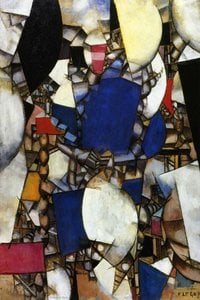
Fernand Léger's "Acrobats in the Circus," painted in 1918, isn’t merely a depiction of a circus performance; it’s a vibrant explosion of energy and a bold declaration of modernity. Emerging from the fertile artistic landscape of early 20th-century Paris, Léger sought to capture the dynamism of the machine age – its geometric forms, its rhythmic movement, and its inherent spectacle – within a distinctly personal visual language. This painting, created during a period of intense experimentation and marked by his development of “Tubism,” offers a captivating glimpse into this artistic vision.
The scene unfolds with an almost frenetic intensity. Léger abandons traditional representational techniques in favor of fractured forms and simplified shapes. The acrobats themselves are rendered as cylinders, cones, and angular blocks, their bodies dissolving into geometric patterns. This deliberate abstraction isn’t a retreat from reality but rather a way to distill the essence of movement and form – to capture the *feeling* of the circus, not just its appearance. Notice how the figures seem to vibrate with an internal energy, suggesting the thrilling rush of performance and the precarious balance inherent in their acts.
Léger’s work during this period is inextricably linked to the burgeoning field of Cubism, though he developed a unique approach. Unlike Picasso and Braque, who often employed collage techniques, Léger focused on pure geometric abstraction, drawing inspiration from the industrial world around him. The rhythmic repetition of shapes – the circular forms of the acrobats’ bodies, the angularity of the stage props, even the suggestion of machinery in the background – echoes the patterns found in factories and urban landscapes. This fascination with mechanics is evident not just in the visual style but also in Léger's broader artistic philosophy; he believed that art should reflect the realities of modern life.
The painting’s color palette further enhances this sense of dynamism. Bold primary colors – reds, yellows, and blues – dominate the composition, creating a visually arresting effect. Metallic tones are strategically employed to mimic the sheen of polished metal, reinforcing the mechanical aesthetic. The use of contrasting colors also contributes to the overall feeling of movement and excitement.
Beyond its formal innovations, “Acrobats in the Circus” is rich in symbolic meaning. The circus itself represents a world of illusion, spectacle, and escape – a realm where the ordinary becomes extraordinary. The acrobats, with their daring feats and precarious balance, embody themes of risk, skill, and human resilience. Léger’s choice to depict them in such an abstracted manner suggests that they are not simply performers but rather embodiments of modern energy and dynamism.
The inclusion of everyday objects – a clock, bowls, and vases – scattered throughout the scene adds another layer of complexity. These seemingly mundane items become integrated into the larger composition, blurring the boundaries between reality and abstraction. They serve as reminders of the world outside the circus tent, grounding the fantastical imagery in a recognizable context. The painting’s overall effect is one of joyful chaos—a celebration of life, movement, and the spirit of innovation.
WahooArt offers meticulously hand-painted reproductions of Fernand Léger's “Acrobats in the Circus,” capturing the artist’s unique style and vibrant energy with exceptional detail. Whether you are an art enthusiast, a collector seeking to expand your collection, or simply someone looking for a striking piece of décor, our reproductions provide a beautiful and authentic way to experience this iconic work of modern art. Choose from a range of sizes and canvas materials to perfectly complement your interior design.
"Acrobats in the circus" was created by Fernand Léger in 1918.
The image of "Acrobats in the circus" by Fernand Léger can be downloaded from the artwork's Download page: a high-resolution digital image download.
The subjects of "Acrobats in the circus" are acrobats, circus, figures, geometric, modernity, dynamism, form.

1881 - 1955 , France
 Preview
 Send
Send Share
Share
 Details
 Guide
Guide

 Download
 Similars
 X-Ray
X-Ray Diaporama
 Q&A
Q&A
 Stats
Stats

 Read More