The Life of Fernand Léger
The story of Fernand Léger begins in the village of Argentan, located in the Orne region of Lower Normandy. He arrived into this world on February 4, 1881, as an only son. His early years were shaped by the quietude of the French countryside and the presence of his mother, Marie-Adèle Daunou. His father, a man who made his living as a cattle dealer, passed away when Fernand was still a young boy, leaving the child to be raised by his mother in a household marked by her piety and a certain self-effacing nature.
This upbringing in the rural landscapes of Normandy provided a grounding contrast to the life he would eventually lead in the bustling centers of French culture. While his roots were tied to the earth and the physicality of agricultural life, his spirit was drawn toward the complexities of the modern age. He would eventually expand his reach far beyond the borders of Argentan, becoming a man of many disciplines. He did not limit himself to the canvas, but instead sought to express his vision through sculpture and the moving images of film.
His life was a constant movement between the organic textures of his youth and the structured, mechanical rhythms of the cities. This duality defined his very existence, as he navigated the shifts of a changing century. His path was never a simple one, marked by the tension between the traditional world of his childhood and the rapid, industrial pulse of the future he would eventually help to define through his art.
Early Life, Family and Training
The roots of his vision were planted in the rural landscapes of Argentan, in the Orne region of Lower Normandy, France. Born into a world of cattle farming, his early years were shaped by the physicality of the land and the steady rhythms of agricultural life. This grounding in the tangible, working world would remain a quiet presence beneath the surface of his later, more complex explorations. He was an only son, raised by a mother who was both pious and self-effacing, and his path was initially steered toward the structured discipline of architecture. From 1897 to 1899, he dedicated himself to this technical craft, learning the logic of space and the necessity of precise drafting.
By 1900, the pull of the city became too strong to ignore, and he moved to Paris. He supported himself by working as an architectural draftsman, a role that required a keen eye for line and proportion. While his formal training in architecture provided a foundation of structural understanding, his heart began to drift toward the canvas. He sought entry into the prestigious École des Beaux-Arts, but the institution did not grant him the official status of an enrolled student. Undeterred, he attended the school as a non-enrolled student, absorbing the lessons of the masters while navigating the fringes of the academic establishment. This period of study, though sometimes described as a time of searching, was essential in refining the technical skill he would eventually use to dismantle and rebuild the world in his own image.
The Influence of Cézanne and Cubism
A profound shift occurred in 1907 when the artist encountered the retrospective of Cézanne at the Salon d'Automne. This encounter acted as a catalyst, pulling him away from the soft impressions of his youth and toward a more structural way of seeing. He began to look past the surface of things, seeking instead the underlying geometry that defines the world. By 1909, his presence in the creative circles of Paris grew as he met figures such as Alexander Archipenko, Jacques Lipchitz, Marc Chagall, and Robert Delaunay. These encounters were not merely social; they were collisions of new ideas that helped shape the direction of his developing vision.
As the years progressed, he found himself moving within the orbit of the Puteaux Group, a circle of artists also known as the Section d'Or. Alongside Jean Metzinger and Henri Le Fauconnier, he explored the mathematical and structural possibilities of this new language. He was not content to simply follow the paths laid by others, but instead sought to find his own way through the fractured planes and overlapping forms that defined the era. This period of intense experimentation led to his first major exhibition at the Salon des indépendants in 1911, where he presented Nudes in the Forest.
War and the Mechanical Period
The chaos of the Great War pulled the artist away from the studios of Paris and into the harsh realities of the front. From 1914 to 1917, he served in the French Army, spending two grueling years in the Argonne. The conflict was not merely a backdrop to his life but a transformative force that altered his very perception of form. In 1916, a mustard gas attack nearly claimed his life, leaving him to recover while the world around him was being reshaped by the sheer power of industrial destruction. Even during a brief furlough in that same year, he found himself compelled to paint, producing Soldier with a Pipe. This work captured a sense of the new reality, where the human figure began to take on the qualities of the machines that dominated the battlefield.
By 1917, a distinct shift had taken hold in his creative spirit, marking the beginning of what would be called his mechanical period. He found a strange, rhythmic beauty in the tools and technology of modern warfare and industry. The sleek, tubular shapes and the precision of mechanical parts became his new visual language. He did not see these objects as cold or impersonal; instead, he embraced their strength and their ability to organize the chaos of modern existence. The war had stripped away the soft edges of his earlier work, replacing them with a hard-edged, structural clarity that mirrored the steel and pistons of a changing age.
Technique and Style
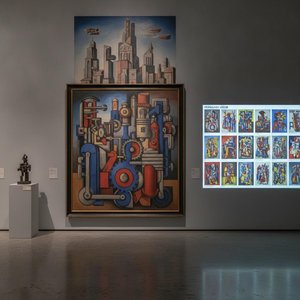
His brush moved with a rhythmic, almost industrial precision, seeking to capture the pulse of a changing era. He moved away from the soft, blended shadows of the past, choosing instead to build his compositions through a language of robust, geometric strength. This led to the development of a personal form of Cubism that critics identified as "Tubism." In this style, the world was reimagined through tubular, conical, and cubed forms, creating a sense of volume that felt both solid and dynamic. He did not merely paint objects; he sought to find their essential, structural logic.
The colors he chose were as assertive as the shapes they filled. He favored a palette dominated by primary colors, often punctuated by stark black and white, which helped to define the sharp boundaries of his subjects. Rather than relying on traditional illusionism, he applied paint in bold, flattened planes of color. He often used a thick impasto, a technique that emphasized the physical presence of the medium on the canvas. This textural approach ensured that his work felt grounded and material, mirroring the very machines and urban structures he so admired. His figures often took on sleek, mechanical-looking shapes, blurring the line between the organic human form and the engineered precision of the modern age.
Later Years and Death
The shifting tides of global conflict eventually pulled the artist away from his Parisian circles and across the Atlantic. Between 1940 and 1945, he lived in the United States, a period that offered a different perspective on the modern world he had so long sought to translate onto canvas. This time abroad provided a pause in his long evolution, a moment of transition before his eventual return to the soil of France.
Upon returning to his homeland, his personal life saw a significant change. In February 1952, he married Nadia Khodasevich. This union marked a final chapter in his life, one lived amidst the continued production of his diverse works, from large-scale murals to delicate stained-glass windows. Even as he aged, his recognition remained steady on the international stage. In 1955, he won the Grand Prize at the São Paulo Bienal, a high honor that arrived in the same year as his passing. He died on August 17, 1955, in Gif-sur-Yvette, France.
Legacy and Influence
Léger left a mark that reached far beyond the avant-garde circles of his own time. By bridging the gap between abstract art and figurative representation, he offered a way for artists to engage with the modern world without abandoning the human subject entirely. His approach allowed for a dialogue between the structural logic of geometry and the recognizable presence of people and objects. This ability to find a middle ground between the purely conceptual and the tangible helped shape the direction of much of the art that followed.
His bold simplification of form and his fascination with the aesthetics of mass production acted as a forerunner to the pop art movement. He saw a certain beauty in the repetitive, functional nature of the machine age, a perspective that would later resonate with a new generation of creators. Artists such as Roy Lichtenstein and Andy Warhol drew a clear line from his experiments with bold outlines and mechanical imagery to their own explorations of popular culture. He helped prepare the visual language for an era that would eventually celebrate the very industrial and commercial elements he had once sought to translate onto canvas.
Where to See the Works Today
To encounter the physical presence of his vision, one might travel to the south of France, specifically to Biot in the Alpes-Maritimes. Here, the Musée national Fernand Léger resides, a place dedicated entirely to the study and preservation of his creative output. The museum occupies the Mas Saint-André, a villa that once belonged to the artist himself. Within these walls and the surrounding gardens, his polychrome ceramic sculptures find their intended setting, allowing the viewer to see how his forms interact with the light and space of the Mediterranean landscape.
Beyond this specialized sanctuary, his canvases and sculptures are held within various significant institutions. The Musée d'Art et d'Histoire in France maintains a collection of his works, ensuring his presence in the broader narrative of French art. These holdings allow for a continued study of how he translated the energy of the machine age into static, yet pulsing, visual forms. Travelers seeking his specific aesthetic can find his traces in several major collections, including:
His influence also lingers in the works of others, but the primary way to witness his direct hand is through these established repositories. Whether observing the bold, cylindrical shapes in a museum setting or seeing his sculptures in the quiet of a garden, the viewer is met with the same structural clarity that defined his life's work. His legacy remains anchored in these specific locations, where the heavy, mechanical rhythms of his paintings are preserved for those who seek the truth of his geometry.


 Preview

 Send
 Share
 Details
 Guide


 Download
 Similars
 X-Ray
 Diaporama
 Q&A

 Stats


 Read More
 Switch to Print






































 Glass option is only available in size under 110 CM