
x


 Acrylic On PaperSymbolism
 1897
1897 24.0 x 29.0 cm
 National Gallery of Bosnia and Herzegovina
Museum-quality giclée or canvas print with fast production and flexible finish options. ( Buy Hand Made Painting Buy Image)





























Pick from our preset sizes that match the artwork's original proportions.

You may enter your own dimensions to fit a specific frame or space. If your selected size does not match the original image's proportions, we will either crop the artwork or extend the image with a mirrored or solid-fill edge. A digital mockup will be sent for your approval before production begins.
Please note that the on-screen preview does not reflect the actual cropping or extension. Only the mockup will accurately show the final composition.
While custom sizes are available, we recommend selecting a dimension from the predefined list to preserve the original proportions.
Worldwide Delivery () in 2 weeks instead of standard 4/5 weeks. (28 August)


Study of two figures
Reproduction Size
Ferdinand Hodler’s “Study of Two Figures” is not a grand, dramatic statement; rather, it's an invitation to linger in the quiet intimacy of a shared moment. Painted in 1897, this graphite drawing on paper captures two women seated together, their postures suggesting a profound sense of contemplation and perhaps even melancholy. Hodler, a pivotal figure within Swiss Symbolism, wasn’t interested in literal representation but rather in conveying emotional atmosphere and psychological depth – a characteristic powerfully evident here. The work feels less like a finished composition and more like a preparatory sketch, a glimpse into the artist's process, revealing his loose, gestural lines and intuitive approach to form.
The scene is remarkably simple: two women, their faces partially obscured, seated on the ground. Their hands rest in their laps, hinting at an activity – perhaps weaving or crafting – yet leaving the specifics deliberately vague. The composition is carefully balanced, with the figures positioned slightly off-center, creating a sense of visual equilibrium. The muted color palette—primarily shades of grey and black against a light beige background—further enhances this feeling of understated elegance and quiet introspection. Subtle tonal variations suggest volume and form without resorting to dramatic contrasts.
What immediately draws the eye, and contributes significantly to the work’s enigmatic quality, are the small red dots adorning the backs of the women. Their precise placement is intriguing; they aren't merely decorative but seem to carry a symbolic weight. While Hodler himself never explicitly explained their meaning, art historians often interpret them as representing wounds, vulnerabilities, or perhaps even the lingering presence of past sorrows – a direct reflection of Hodler’s own childhood marked by loss and grief. This element adds a layer of complexity, transforming a seemingly simple portrait into a meditation on human experience.
The artist's stylistic choices further reinforce this symbolic reading. The loose, sketch-like quality of the drawing—the visible line work, the lack of precise detail—suggests an emphasis on feeling and intuition over technical perfection. Hodler’s approach aligns closely with the tenets of Symbolism, where the goal is to evoke emotions and ideas rather than depict reality in a straightforward manner. The flattened perspective and minimal use of spatial recession contribute to this sense of dreamlike ambiguity.
“Study of Two Figures” offers a fascinating insight into Hodler’s working method. Executed in graphite on paper, the drawing showcases his characteristic technique—a combination of loose sketching and careful shading to define forms and create tonal variations. The artist employs quick, gestural marks, capturing the essence of the subjects with remarkable economy of line. The choice of paper itself – a slightly textured surface – adds another layer of tactile interest to the work.
Painted in 1897, this piece is firmly rooted within Hodler’s artistic evolution. It reflects his growing interest in Symbolism and his exploration of themes related to mortality, memory, and the human psyche. Further research reveals that Hodler was deeply influenced by Dürer's theories on proportion and perspective, yet he ultimately rejected rigid academic conventions in favor of a more expressive and intuitive approach. The work’s connection to Hodler’s biography—his personal struggles with loss and his fascination with the ephemeral nature of existence—adds another layer of resonance.
Resources like WikiArt.org and Google Arts & Culture provide valuable supplementary information, including detailed analyses of Hodler's oeuvre and reproductions of related works. The availability of high-quality hand-painted reproductions offers a wonderful opportunity to experience the beauty and emotional depth of “Study of Two Figures” in your own home.


1853 - 1918 , Switzerland

Explore the profound beauty of the sketch. Discover how masters use charcoal and graphite to capture raw emotion, anatomical precision, and fluid movement, bridging the gap between ephemeral marks and eternal oil masterpieces.
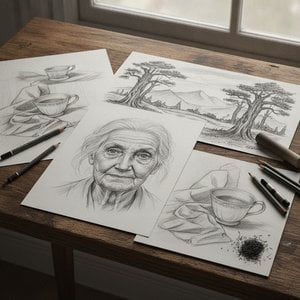
Explore the profound elegance of pencil and charcoal sketching. Discover how masters use line, shadow, and chiaroscuro to capture light and texture, bridging the gap between preparatory studies and timeless fine art masterpieces.


Stay updated with the latest art news, exclusive offers, and decoration ideas.
Tell us about your project and our art experts will provide you with 3 personalized art suggestions.
Let Us Curate 3 Options Just for You - Free!

 Preview
 Send
Send Share
Share
 Details

 Download
 Similars
 X-Ray
X-Ray Diaporama
 Read More







 Glass option is only available in size under 110 CM


