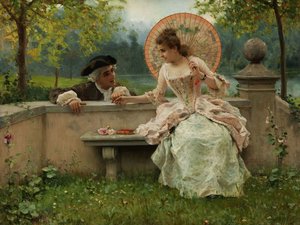
The Elegance of a Lost Era: The Life and Art of Federigo Andreotti
In the shifting tides of the late nineteenth century, as the world began to embrace the rapid industrialization and naturalistic grit of the modern age, there emerged an artist who chose instead to look backward, finding profound beauty in the gilded memories of the past. Federigo Andreotti, born in the cradle of the Renaissance, Florence, in 1847, became a master of the Rococo Revival. His work did not merely seek to replicate history; it sought to resurrect the very atmosphere of an era defined by grace, theatricality, and aristocratic splendor. Through his brush, the eighteenth century was breathed back into life, draped in silks and powdered with the soft light of a bygone elegance.
Andreotti’s artistic foundation was built upon the rigorous traditions of the Florentine Academy of Fine Arts. His early years were shaped by the disciplined guidance of masters such as Angiolo Tricca and Stefano Ussi, whose teachings instilled in him a profound command of classical anatomy and the delicate art of disegno. This formal training provided the structural integrity required to execute his more flamboyant visions. His talent was recognized early through prestigious competitions, earning him a stipend that paved the way for a distinguished career that would eventually see him appointed as a professor at the very Academy where he had once been a student. This dual role as both creator and educator allowed him to influence a generation of painters, ensuring that the meticulous craftsmanship of the Italian tradition remained vibrant.
A Symphony of Texture and Light
To gaze upon an Andreotti canvas is to enter a world of sensory richness. While many of his contemporaries were drawn to the fleeting, impressionistic captures of light, Andreotti leaned into a more deliberate, illusionistic technique. He possessed an almost supernatural ability to render the tactile qualities of luxury; one can almost feel the cool smoothness of satin, the heavy weight of velvet, and the shimmering luster of fine silk as they cascade across his figures. His palette was often vivid and spirited, utilizing color harmony to create scenes that felt both opulent and deeply inviting.
His subject matter frequently revolved around the charmingly staged dramas of aristocratic life—scenes of flirtation, music, and quiet intimacy. Whether depicting a lively dance in a lush garden or a whispered conversation in a grand interior, Andreotti infused his figures with a sense of wit and spontaneous joy. There is a certain spontaneity in his brushwork that prevents his highly detailed scenes from feeling static or museum-like. Instead, his characters possess an infectious vitality, often characterized by:
- Theatricality: A masterful use of dramatic lighting and composition to stage emotional moments.
- Narrative Wit: A subtle sense of humor and charm, reminiscent of the satirical elegance found in the works of Jehan Georges Vibert.
- Atmospheric Depth: An expert command over both indoor and outdoor light, creating immersive environments that transport the viewer through time.
Legacy of a Rococo Revivalist
As his career progressed through the bustling art centers of Rome and Florence, Andreotti’s significance grew beyond that of a mere painter of genre scenes. He became a vital link in the preservation of aesthetic beauty during a period of intense social change. While some critics might have viewed his focus on historical costume as retardataire—a nostalgic retreat from the present—his work offered a necessary sanctuary of refinement and grace. His ability to handle the spectrum of human experience, from the delicate features of youth to the weathered dignity of old age, demonstrated a versatility that transcended simple period piece painting.
Ultimately, the historical significance of Federigo Andreotti lies in his ability to marry the precision of classical realism with the whimsical spirit of the Rococo. He did not just paint clothes; he painted the soul of an era. His legacy remains etched in the vibrant textures and emotive landscapes of his oeuvre, standing as a testament to the enduring power of beauty, elegance, and the timeless allure of the past.



 Preview
 Buy Print
 Send
Send Share
Share
 Details

 Download
 Similars
 X-Ray
X-Ray Diaporama
 Read More






































 Glass option is only available in size under 110 CM