Artist Biography
A Pioneer of Art Nouveau: The Life and Legacy of Eugène Samuel Grasset
Eugène Samuel Grasset, born in Lausanne, Switzerland on May 25th, 1845 (though some sources cite 1841), emerged as a pivotal figure bridging the gap between traditional craftsmanship and the burgeoning aesthetic of Art Nouveau. His journey began within an artistic household; his father, a skilled cabinet designer and sculptor, instilled in young Eugène both a practical understanding of materials and a deep appreciation for creative expression. This early exposure fostered a sensitivity to form and detail that would become hallmarks of Grasset’s distinctive style. Initial studies under François-Louis David Bocion honed his drawing skills, but it was a subsequent foray into architectural studies in Zurich that broadened his artistic horizons, though ultimately proved insufficient to contain his burgeoning creativity. A transformative experience followed – a voyage to Egypt after completing his formal education. This journey ignited a lifelong fascination with exoticism and ancient design principles, profoundly influencing the decorative motifs that would later define his work. Equally significant was his growing admiration for Japanese art, particularly its emphasis on flowing lines, flattened perspectives, and harmonious compositions—elements he masterfully integrated into his own unique visual language.
From Diverse Crafts to Defining a Style
By 1869-1870, Grasset had established himself as both a painter and sculptor in Lausanne, but the allure of Paris proved irresistible. In 1871, he relocated to France, embarking on an extraordinarily diverse career that encompassed furniture design, fabric creation, tapestry weaving, ceramic artistry, and jewelry making. These weren’t merely exercises in applied arts; Grasset elevated them to high art, employing luxurious materials like ivory and gold with a meticulous attention to detail and innovative combinations of textures and forms. His creations quickly became foundational elements of the Art Nouveau movement, embodying its organic aesthetic and rejection of rigid academic conventions. Grasset's style is instantly recognizable for its graceful, flowing lines, inspired by natural forms—particularly floral motifs—and a remarkable synthesis of historical influences. He didn’t simply imitate these sources; rather, he skillfully blended Gothic art’s intricate detailing with the elegant simplicity of Japanese aesthetics, forging a distinctive visual vocabulary that resonated with the spirit of the age. This ability to harmonize disparate elements was central to his success and cemented his position as a leading innovator in decorative design.
The Rise of a Graphic Master
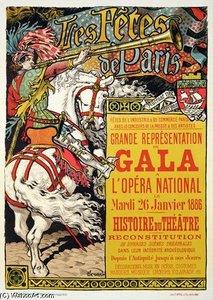
In 1877, Grasset turned his attention towards graphic design, initially focusing on postcards before expanding into the realm of postage stamps for both France and Switzerland. It was, however, in the field of poster art that he truly excelled. He rapidly gained recognition as a master of the medium, producing lithographs that were not only visually stunning but also remarkably effective in communicating their message. His *Jeanne d'Arc Sarah Bernhardt* poster became one of his most celebrated works, earning inclusion in the prestigious *Maîtres de l'Affiche* series—a testament to its artistic merit and widespread acclaim. Yet, perhaps his most enduring legacy is the “Semeuse,” a captivating figure scattering dandelion seeds, created in 1890 for the dictionary publishers Éditions Larousse. This iconic design, symbolizing the dissemination of knowledge, remains in use today, a powerful demonstration of Grasset’s lasting impact on visual culture. His talent extended beyond France; during the 1880s and 1890s, he received commissions from American companies, further solidifying his international reputation. He designed the Christmas cover for *Harper's Magazine* in 1892 and contributed illustrations—*The Wooly Horse* and *The Sun of Austerlitz*—to *Century Magazine* in 1894, accompanying a serialized story about Napoleon Bonaparte. Notably, *The Wooly Horse* proved so popular that it was recreated in stained glass by Louis Comfort Tiffany, highlighting the cross-pollination of artistic ideas during this period.
Educator and Enduring Influence
Beyond his prolific creative output, Grasset dedicated himself to education, believing strongly in nurturing the next generation of artists and designers. He taught at several prominent Parisian institutions—École Guérin (1890–1903), École d’art graphique (1903–1904), Académie de la Grande Chaumière (1904–1913), and École Estienne—imparting his knowledge and inspiring countless students. Among his notable pupils were Paul Berthon, Georges Bourgeot, Augusto Giacometti, and Arsène Herbinier, all of whom went on to achieve significant success in their own right. In 1898, the G. Peignot et fils typefoundry introduced the “Grasset” typeface, an italic design created by the artist specifically for use in his posters—a further indication of his holistic approach to design and his commitment to every aspect of visual communication. Eugène Samuel Grasset passed away on October 23rd, 1917, in Sceaux, France, leaving behind a rich artistic legacy. He is rightfully remembered as a pivotal figure in the Art Nouveau movement, a visionary who seamlessly blended tradition with innovation and whose work continues to inspire artists and designers today. His innovative use of floral motifs, Japanese influences, and historical references remains remarkably relevant, demonstrating the enduring power of his aesthetic vision.
A Lasting Impression
Grasset’s influence extends far beyond the realm of decorative arts and graphic design. He helped to redefine the relationship between art and commerce, demonstrating that beautiful objects could also be functional and accessible. His emphasis on organic forms and natural motifs anticipated many of the key themes of 20th-century modernism, while his meticulous attention to detail and craftsmanship served as a counterpoint to the increasing mechanization of industrial production. His work embodies a harmonious balance between form and function, tradition and innovation, making him a truly exceptional artist whose legacy continues to resonate with audiences today. Grasset’s ability to synthesize diverse influences into a cohesive and original style remains a source of inspiration for designers seeking to create visually compelling and emotionally resonant works. He wasn't merely decorating; he was crafting a new visual language, one that celebrated beauty, nature, and the power of artistic expression.



 Preview
 Buy Hand Made Painting
 Send
Send Share
Share
 Details

 Download
 Similars
 X-Ray
X-Ray Diaporama
 Read More






































 Glass option is only available in size under 110 CM