


Get a print-ready file that goes far beyond the web preview. Every digital image we sell comes from a high-resolution master in our stock database — usually 5,000 to 15,000 pixels wide — so you can print large, crop tightly, or reproduce fine detail with confidence.
No file leaves our studio untouched. A digital expert checks the colors against the original painting and corrects them if needed, then improves clarity and detail with professional retouching tools — always staying faithful to the artist's brushwork and style. The result is an image that looks like the painting, not like a filtered scan.
You approve before you're done: our expert sends the image by e-mail within 72 hours for your review. Not satisfied? Ask for improvements or corrections, or request a refund if the quality falls short.
This is the quality relied on by publishers, design studios, galleries and print shops.
Download a high-resolution file for personal display, printing, and creative projects. ( Switch to Print Buy Hand Made Painting)
When you choose WahooArt.com, you're not just getting an image - you're receiving a professionally enhanced digital artwork, crafted with precision and backed by a satisfaction guarantee. Here's everything that comes with your order, automatically:
Your high-resolution digital image file will be emailed to you within 72 hours of ordering - ready for immediate use.
Your artwork is professionally optimized using advanced AI tools and manual editing, ensuring maximum detail, clarity, and color accuracy.
Accidentally deleted or lost your file? No worries - we'll resend it to you anytime, free of charge.
Enjoy your artwork instantly with zero customs, duties, or delivery fees - digital downloads are always tax-free.
We ensure your digital image reflects the original colors as closely as possible using professional tools and color management.
If you're not satisfied with your digital image, we'll revise it or refund 100% within 100 days - no questions asked.
Not satisfied? Get a full refund within 100 days of receiving your digital file - no questions asked.
Buy 3 images, save 10% - Buy 5, save 15% - Buy 10+, save 20%. Great for creative projects, galleries, and agencies.

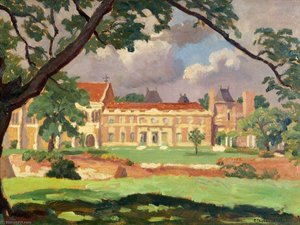
Ethelbert White, born in the Middlesex town of Isleworth in 1891, remains a profound yet understated figure in the tapestry of early twentieth-century British art. His journey was one of remarkable versatility, moving between the delicate precision of wood engraving and the expansive, atmospheric realms of oil and watercolour. Trained at the St John’s Wood Art School under the guidance of Leonard Walker, White developed a technical foundation that allowed him to navigate various mediums with an effortless grace. While many of his contemporaries sought the loud provocations of pure abstraction, White found his true calling in the quietude of the natural world, capturing the subtle shifts of light and the serene essence of the English landscape.
His early career was marked by a daring engagement with the avant-garde. In 1913, alongside luminaries such as Mark Gertler and C R W Nevinson, White embraced the energetic spirit of the Futurist movement. This period of experimentation, which included a bold collaborative depiction of Hampstead Heath for the AAA exhibition, showcased a willingness to challenge traditional boundaries and explore new visual languages. Yet, even amidst these modernistic explorations, the seeds of his later, more contemplative style were already being sown. His work began to reflect the structural influences of Cézanne, blending a modernist sense of composition with an enduring reverence for the organic forms of nature.
Beyond his canvases, White carved a significant niche in the history of British printmaking. In 1920, he transitioned into the intricate world of wood engraving, a move that would redefine much of his artistic output. As a founding member of the English Wood Engraving Society in 1925, he became a central figure in a movement that championed the modern style advocated by Noel Rooke. His engravings were noted for their unusual scale and their ability to translate complex textures into stark, beautiful contrasts. One of his most celebrated achievements in this medium was his illustration for Richard Jefferies' The Story of My Heart in 1923, a work that critics often cite as a landmark in the publication of modern wood-engraved books in Britain.
As his career progressed, White’s focus drifted back toward the expansive beauty of landscapes, though he never lost the precision learned from his printmaking years. His paintings—ranging from the lush, verdant Early Spring to the tranquil Woods—are characterized by a masterful command of tonal gradations and a restrained colour palette. He possessed a rare ability to convey deep emotion through subtle atmospheric effects, a quality that drew comparisons to the celebrated Paul Nash. Whether capturing the rugged coastlines of Cornwall or the soft light of an English garden, his work remains an invitation to pause and observe the quiet majesty of the earth.
Throughout his life, White’s presence in the British art establishment was both steady and respected. His memberships in prestigious organizations such as the following reflect his standing among the era's most significant creators:
By the time of his passing in 1972, Ethelbert White had left behind a body of work that serves as a bridge between the experimental fervor of the early twentieth century and a timeless, classical appreciation for the natural landscape. His ability to find the extraordinary within the ordinary continues to resonate, offering a sense of peace and a profound connection to the enduring beauty of the world around us.
1891 - 1972
 Preview
 Send
Send Share
Share
 Details
 Guide
Guide

 Download
 Similars
 X-Ray
X-Ray Diaporama
 Q&A
Q&A
 Stats
Stats Read More


