

The artwork displayed on this page is protected by copyright law, which means we cannot legally create or sell an identical reproduction. This protection is enforced under international agreements such as the Berne Convention and by national laws, including those outlined by the U.S. Copyright Law - Title 17.
This method fully complies with copyright regulations because it does not involve copying or duplicating the protected artwork. Instead, it is a creative reinterpretation - a new painting that is influenced by the original but not identical to it.
Museum-quality giclée or canvas print with fast production and flexible finish options. ( Buy Hand Made Painting Switch to Digital Image)





























Pick from our preset sizes that match the artwork's original proportions.

Type the width and the height you need, to fit your frame or your wall. A print can only be cut, never made bigger than the picture, so a size with a different shape loses a part of the image. We send you a digital mockup to approve before we print anything. The picture shown on this page does not show the real cut — only the mockup does.
Worldwide Delivery () in 2 weeks instead of standard 4/5 weeks. (22 October)
Evening ensemble
Reproduction Size
Elsa Schiaparelli wasn't merely a fashion designer; she was a provocateur, a visual poet, and a key figure in the burgeoning world of surrealism. Her 1937 creation, "Evening Ensemble," embodies this spirit with audacious elegance and a deliberate rejection of conventional beauty standards. This isn’t simply a gown and jacket; it's a carefully constructed dialogue between art, fashion, and the subconscious – a testament to Schiaparelli’s radical vision that continues to resonate today.
The piece immediately commands attention with its dramatic contrast. A sumptuous, deep purple velvet dress, exquisitely draped and skimming the figure, provides a foundation of luxurious formality. Yet, this richness is dramatically offset by the jacket – a flamboyant explosion of pink foil embroidery, padded and oversized, creating an almost cartoonish effect. The embroidery itself isn’t merely decorative; it's a deliberate distortion of traditional motifs, featuring stylized flowers, geometric shapes, and even a playful nod to the human form with exaggerated sleeves. The choice of pink foil is particularly striking – a vibrant, artificial hue that feels both celebratory and slightly unsettling, perfectly aligning with Schiaparelli’s surrealist aesthetic.
The execution of “Evening Ensemble” speaks volumes about Schiaparelli's meticulous approach to design. The velvet itself is a testament to the finest craftsmanship, its deep purple hue achieved through careful dyeing techniques – a rarity in the 1930s. Beyond the velvet, the jacket showcases an extraordinary level of detail. The foil embroidery isn’t simply applied; it’s painstakingly stitched by hand, creating a tactile and visually arresting surface. Notice the subtle variations in texture—the raised relief of the padded elements, the delicate sheen of the foil, and the precise placement of each individual stitch. The buttons, crafted from polished metal and shaped like stylized black swans, are another example of Schiaparelli’s attention to detail – a small but significant element that elevates the entire garment.
To fully appreciate “Evening Ensemble,” it’s crucial to understand the context in which it was created. The 1930s were a period of significant social and artistic upheaval, marked by the rise of surrealism – a movement that sought to liberate art from the constraints of reason and logic. Schiaparelli embraced this spirit wholeheartedly, collaborating with artists like Salvador Dalí and Jean Cocteau on projects that blurred the boundaries between fashion, art, and design. “Evening Ensemble” is a direct product of this collaboration, reflecting the influence of surrealist principles such as juxtaposition, irony, and the exploration of the subconscious.
The piece can be seen as a deliberate challenge to traditional notions of femininity and elegance. The oversized jacket, the unconventional color palette, and the playful distortions of form all contribute to a sense of irreverence and rebellion. It’s a statement that prioritizes artistic expression over conventional beauty standards – a radical concept for the time.
Beyond its aesthetic qualities, “Evening Ensemble” is rich in symbolism. The pink foil embroidery can be interpreted as a celebration of joy and extravagance, while the oversized form suggests a desire to break free from societal constraints. The black swan buttons, with their elegant yet slightly unsettling appearance, represent both beauty and danger – a potent symbol of Schiaparelli’s complex and multifaceted personality.
Ultimately, “Evening Ensemble” evokes a sense of wonder and intrigue. It's a garment that invites the viewer to engage in a dialogue—to question assumptions, explore hidden meanings, and embrace the power of imagination. It remains a powerful reminder of Elsa Schiaparelli’s legacy as one of the most innovative and influential designers of the 20th century – a true visionary who dared to challenge convention and redefine the boundaries of fashion.
"Evening ensemble" by Elsa Schiaparelli combines the acrylic on canvas technique with the Surrealism style. Technique and movement describe the making and the style of the work.
"Evening ensemble" dates from 1937. The date places the work within Elsa Schiaparelli's career and its era.
The suggested use for "Evening ensemble" by Elsa Schiaparelli is statement. It can serve other purposes as well.


1890 - 1973 , Italy
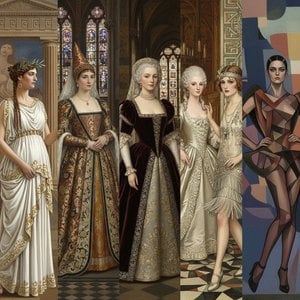
Explore the breathtaking intersection of fine art and high fashion. Discover how iconic masterpieces from Art Deco to Impressionism have shaped the world of luxury couture and timeless design in this curated visual journey.
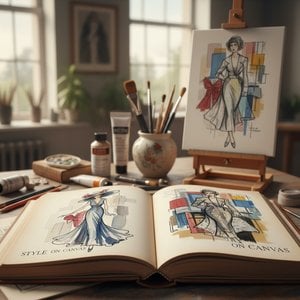
Discover the exquisite world of fashion illustration art. From Art Deco elegance to bespoke oil reproductions, explore how timeless sartorial beauty transforms luxury interiors through masterfully crafted canvas works and curated historical masterpieces.

Discover the unparalleled elegance of Art Deco through the lens of Erté. Explore a masterclass in linear precision, theatrical costume design, and high-fashion illustration that continues to define modern luxury and sophisticated interior aesthetics.

Embark on a visual journey through the evolution of fashion photography. Discover how masters like Gianfranco Ferré blended geometry, surrealism, and texture to redefine high-fashion art for collectors and connoisseurs of luxury imagery.

 Preview
 Send
Send Share
Share
 Details
 Guide
Guide

 Download
 Similars
 X-Ray
X-Ray Diaporama
 Stats
Stats


 Read More









 Glass option is only available in size under 110 CM


