

The artwork displayed on this page is protected by copyright law, which means we cannot legally create or sell an identical reproduction. This protection is enforced under international agreements such as the Berne Convention and by national laws, including those outlined by the U.S. Copyright Law - Title 17.
This method fully complies with copyright regulations because it does not involve copying or duplicating the protected artwork. Instead, it is a creative reinterpretation - a new painting that is influenced by the original but not identical to it.
Museum-quality giclée or canvas print with fast production and flexible finish options. ( Buy Hand Made Painting Switch to Digital Image)





























Pick from our preset sizes that match the artwork's original proportions.

Type the width and the height you need, to fit your frame or your wall. A print can only be cut, never made bigger than the picture, so a size with a different shape loses a part of the image. We send you a digital mockup to approve before we print anything. The picture shown on this page does not show the real cut — only the mockup does.
Worldwide Delivery () in 2 weeks instead of standard 4/5 weeks. (24 October)
Dress
Reproduction Size
Elsa Schiaparelli, a name synonymous with audacious style and surrealist innovation, irrevocably altered the landscape of 20th-century fashion. Born into an aristocratic Roman family in 1890, her life was anything but conventional. Unlike many of her contemporaries who embraced established societal norms, Schiaparelli possessed a fiercely independent spirit, fueled by intellectual curiosity and a penchant for challenging expectations. Her father, Celestino Schiaparelli, a renowned scholar of Islamic studies and Sanskrit, cultivated an environment rich in learning, while her uncle, the astronomer Giovanni Schiaparelli – famed for his observations of Martian “canals” – sparked within her a lifelong fascination with the cosmos and the unconventional.
This unique upbringing instilled a love for art, mythology, and esoteric thought that would profoundly shape her aesthetic vision. Early rebellious tendencies manifested in her refusal to conform to traditional roles, prioritizing artistic expression over societal pressures. Schiaparelli’s groundbreaking designs weren't merely garments; they were statements—bold declarations of individuality against the backdrop of a conservative era.
“Dress,” created in 1940, exemplifies Schiaparelli’s signature style – a masterful blend of geometric precision and playful surrealism. The photograph captures a studio shot of a mannequin draped in a black silk gown adorned with repeating patterns of squares and diamonds interspersed with stylized floral motifs. These elements are rendered in shades of white, gray, and red against a creamy off-white background, minimizing harsh shadows and maximizing the fabric’s textural richness.
The composition is centered and symmetrical, reflecting Schiaparelli's meticulous attention to detail. The mannequin’s pose conveys formality while subtly hinting at the garment’s unconventional design. The geometric patterns—a deliberate nod to Mondrian and Cubism—represent a rejection of decorative excess, prioritizing form over ornamentation. Simultaneously, the floral motifs introduce an element of organic beauty, juxtaposed against the rigid geometry.
Photographic technique skillfully captures the nuances of fabric texture and color, highlighting Schiaparelli’s commitment to realism within her surrealist framework. The dress itself is crafted from silk—a luxurious material chosen for its drape and sheen—further enhancing its visual impact. Delicate embroidery adds textural complexity and reinforces the garment's artistic merit.
The meticulous craftsmanship speaks volumes about Schiaparelli’s dedication to elevating fashion beyond mere practicality. It underscores her belief that clothing could serve as a vehicle for conveying ideas and emotions, mirroring the broader ethos of Surrealism—a movement that sought to liberate imagination and challenge rational thought.
Beyond its aesthetic qualities, “Dress” carries symbolic weight. The geometric patterns symbolize order and intellect, countering the perceived chaos of the subconscious mind – a core preoccupation of Surrealist artists like Dalí. Yet, the floral elements offer respite from this intellectual rigor, representing fertility and natural beauty—themes frequently explored in Schiaparelli’s oeuvre.
Ultimately, “Dress” embodies Schiaparelli's unwavering conviction that fashion could be both intellectually stimulating and emotionally resonant. It remains a testament to her pioneering spirit and her enduring legacy as one of the most influential designers of the 20th century—a timeless masterpiece that continues to inspire awe and admiration.
The color harmony of "Dress" is recorded as softly mixed palette.
The medium of "Dress" by Elsa Schiaparelli is acrylic on canvas, and the work is dated 1940.
A reproduction of "Dress" by Elsa Schiaparelli is recommended for accent. This suggestion follows from the work's subject, mood and colors.


1890 - 1973 , Italy

Embark on a visual journey through the evolution of fashion photography. Discover how masters like Gianfranco Ferré blended geometry, surrealism, and texture to redefine high-fashion art for collectors and connoisseurs of luxury imagery.

Discover the unparalleled elegance of Art Deco through the lens of Erté. Explore a masterclass in linear precision, theatrical costume design, and high-fashion illustration that continues to define modern luxury and sophisticated interior aesthetics.
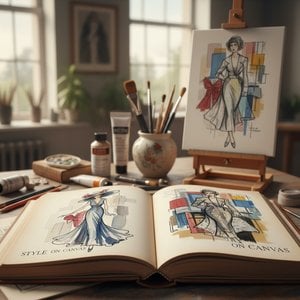
Discover the exquisite world of fashion illustration art. From Art Deco elegance to bespoke oil reproductions, explore how timeless sartorial beauty transforms luxury interiors through masterfully crafted canvas works and curated historical masterpieces.
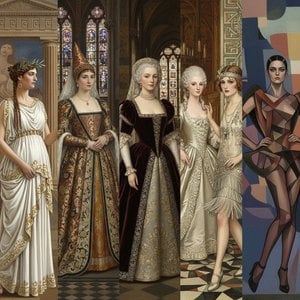
Explore the breathtaking intersection of fine art and high fashion. Discover how iconic masterpieces from Art Deco to Impressionism have shaped the world of luxury couture and timeless design in this curated visual journey.

 Preview
 Send
Send Share
Share
 Details
 Guide
Guide

 Download
 Similars
 X-Ray
X-Ray Diaporama
 Stats
Stats


 Read More









 Glass option is only available in size under 110 CM


