Museum-quality giclée or canvas print with fast production and flexible finish options. ( Buy Hand Made Painting Switch to Digital Image)





























Pick from our preset sizes that match the artwork's original proportions.

Type the width and the height you need, to fit your frame or your wall. A print can only be cut, never made bigger than the picture, so a size with a different shape loses a part of the image. We send you a digital mockup to approve before we print anything. The picture shown on this page does not show the real cut — only the mockup does.
Worldwide Delivery () in 2 weeks instead of standard 4/5 weeks. (7 November)
Self-Portrait
Reproduction Size
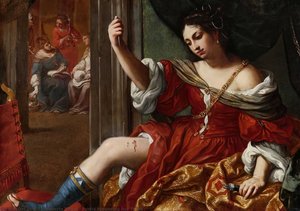
The charcoal whispers from Elisabetta Sirani's 1664 “Self-Portrait” are more than mere lines on paper; they’re a poignant invitation into the heart and mind of a remarkably talented, yet tragically short-lived, artist. This intimate study, housed within an ornate gilded frame, transcends its humble dimensions – measuring just 21 x 17 centimeters – to reveal a profound depth of emotion and technical mastery that speaks volumes about the burgeoning artistic landscape of 17th-century Bologna. It’s a work not simply *of* a woman, but *by* a woman, boldly asserting her presence within a world largely dominated by male figures.
Sirani's story is inextricably linked to the vibrant and fiercely competitive art scene of her time. Born into an artistic family – her father, Giovanni Andrea Sirani, was himself a respected painter and teacher – she inherited not only technical skill but also a pioneering spirit. Bologna, then a hub for artistic innovation, offered a relative openness to female artists, a circumstance that allowed Sirani to establish herself as one of the era’s most celebrated figures. The portrait itself feels like a deliberate act of self-definition, a conscious assertion of her identity and talent in an environment where women were often relegated to secondary roles.
The immediate impression is one of meticulous detail, achieved through a masterful deployment of hatching and cross-hatching – techniques borrowed from the Renaissance masters but imbued with Sirani’s unique sensibility. The artist doesn't simply *draw* her face; she builds it up layer by layer, creating a remarkable sense of volume and texture. Notice how the subtle variations in tone suggest the play of light on skin, the delicate curve of a cheekbone, or the shadowed recesses beneath an eye. This isn’t merely a likeness; it's a carefully constructed illusion of reality.
The choice of red chalk – a favored medium for portraiture at the time – contributes to the work’s subdued palette and velvety texture. The muted browns and beiges create a sense of intimacy, drawing the viewer into the subject’s gaze. Sirani's use of light is particularly noteworthy; it’s not dramatic or theatrical but rather soft and diffused, illuminating the face with a gentle warmth that emphasizes her features and invites contemplation. The composition itself – centered within the frame, with the head occupying most of the vertical space – reinforces this sense of intimacy and directness.
Beyond its technical brilliance, “Self-Portrait” is rich in symbolic meaning. The direct gaze of the subject—a deliberate choice—conveys a remarkable confidence and perhaps even a touch of introspection. She isn’t passively presenting herself; she's engaging with the viewer, inviting them to share in her thoughts and feelings. The slightly off-center placement of her eyes adds to this sense of immediacy and connection.
The frame itself – an ornate gilded border – serves as a powerful reminder of the formality and status associated with portraiture during the Renaissance. It elevates the subject, transforming her into a figure worthy of admiration and respect. However, within this formal setting, Sirani subtly challenges conventions by presenting herself not as a demure model but as an active participant in the act of creation – a painter at work, surrounded by her tools and materials.
Elisabetta Sirani’s life was tragically cut short at the age of 27, adding a poignant layer to this already compelling portrait. The circumstances surrounding her death – rumored poisoning—have fueled speculation and intrigue for centuries. Regardless of the truth behind her demise, her legacy as one of the most accomplished female artists of the Baroque period endures. Her story is not just about artistic talent; it’s about resilience, determination, and a pioneering spirit that paved the way for future generations of women in the arts.
Today, “Self-Portrait” stands as a testament to Sirani's genius – a captivating glimpse into the mind and soul of an extraordinary artist. Its intimate scale belies its profound emotional depth, offering viewers a rare opportunity to connect with a remarkable woman who defied societal expectations and left an indelible mark on the history of art.
"Self-Portrait" by Elisabetta Sirani combines the acrylic on paper technique with the Baroque style. Technique and movement describe the making and the style of the work.
The suggested use for "Self-Portrait" by Elisabetta Sirani is statement. It can serve other purposes as well.
"Self-Portrait" by Elisabetta Sirani is a portrait composition measuring 21 x 17 cm in the original.


1638 - 1665 , Italy

Explore the breathtaking drama of 17th-century Baroque art. Our expert guide decodes the use of chiaroscuro, emotional intensity, and historical grandeur to help you appreciate and curate timeless masterpieces for your collection.

Journey through the drama & grandeur of Baroque art! Explore 10 masterpieces by Caravaggio, Rembrandt, Rubens & more. Discover stunning oil paintings, rich colors & timeless stories. Find museum-quality reproductions at .

Explore the dramatic world of Baroque art! Discover iconic artists like Caravaggio & Rubens, defining techniques, and its lasting impact on art history. Expert insights for collectors & enthusiasts at WahooArt.
Explore the profound elegance of Baroque Classicism. Discover how 17th-century masters synthesized dramatic emotion with classical order through the lens of the Counter-Reformation and the works of legends like Carlo Maratta and Andrea Sacchi.

Explore the captivating world of Baroque Classicism! Discover its history, key artists like Caravaggio & Rubens, and defining characteristics. Expert insights & high-quality reproductions at WahooArt.
 Preview
 Send
Send Share
Share
 Details
 Guide
Guide

 Download
 Similars
 X-Ray
X-Ray Diaporama
 Q&A
Q&A
 Stats
Stats


 Read More









 Glass option is only available in size under 110 CM