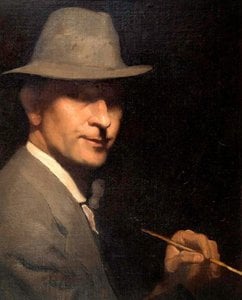
Early Life and Artistic Beginnings
Elioth Lauritz Leganyer Gruner, born on December 16, 1882, in the small coastal town of Gisborne, New Zealand, emerged from a family background that would subtly shape his artistic trajectory. His father, Elliott Grüner, a Norwegian-born bailiff, and his Irish mother, Mary Ann Brennan, instilled in him a sense of resilience and connection to the land – qualities that would later permeate his evocative landscapes. The family’s relocation to Sydney before Elioth reached his first birthday proved pivotal, immersing him in an environment where artistic expression was beginning to flourish. Even as a young boy, Gruner displayed a natural inclination towards drawing, a passion nurtured by his mother who wisely arranged for lessons with the esteemed Julian Ashton around the age of twelve. However, life took a difficult turn when both his father and older brother passed away, forcing Gruner to shoulder significant responsibilities at just fourteen years old. He entered the workforce, dedicating long hours to support his family, yet remarkably, he continued to paint during his weekends, submitting works to exhibitions organized by the Society of Artists in Sydney around 1901 – a testament to his unwavering dedication.
Developing an Impressionistic Vision
Gruner’s artistic style is most readily identified as Impressionistic, though it evolved over time and absorbed influences from various sources. He possessed a remarkable ability to capture the fleeting effects of light and atmosphere in the Australian landscape, imbuing his paintings with a sense of serenity and poetic beauty. The encouragement he received from fellow artist Norman Lindsay was instrumental in shaping his artistic direction, bolstering his confidence and refining his vision. A transformative period arrived between 1923 and 1925 when Gruner embarked on an extended sojourn to Europe. This experience proved profoundly impactful, prompting him to simplify his compositions and pay closer attention to pattern and brushwork. Constructive criticism from Sir William Orpen during this time was particularly influential, challenging Gruner to refine his technique and approach. Upon his return to Australia, he revisited his fascination with light studies, skillfully blending it with a heightened appreciation for color and form. This synthesis resulted in paintings that were both technically masterful and emotionally resonant, capturing the essence of the Australian bush with unparalleled sensitivity.
Recognition and Major Achievements
Elioth Gruner’s talent did not go unnoticed, and his consistent success at the prestigious Wynne Prize cemented his place as a leading figure in Australian art. He achieved the remarkable feat of winning the prize seven times – an unprecedented accomplishment that speaks volumes about the quality and impact of his work. His victorious paintings included “Morning Light” (1916), a luminous depiction of rural New South Wales; “Spring Frost” (1919), celebrated for its masterful rendering of light and atmosphere; and “The Valley of the Tweed” (1921). The Art Gallery of New South Wales also commissioned him to paint "The Valley of the Tweed," a large-scale work, though it is not considered among his most highly regarded pieces. In 1927, Gruner held a successful one-man show, further demonstrating the growing recognition and demand for his art. These accolades were not merely acknowledgements of technical skill; they represented a broader appreciation for his ability to capture the spirit of the Australian landscape and evoke a sense of national identity.
Later Life, Legacy, and Enduring Appeal
Despite his artistic triumphs, Gruner’s later life was marked by health challenges. He suffered from chronic nephritis, which ultimately led to his death at his home in Waverley on October 17, 1939. He was cremated with Anglican rites, leaving behind a legacy of breathtaking landscapes that continue to captivate audiences today. Elioth Gruner is remembered as a significant Australian landscape painter who possessed an extraordinary ability to capture the beauty and tranquility of rural New South Wales with both sensitivity and skill. His consistent success at the Wynne Prize firmly established his position in Australian art history, and recent recognition – such as the acquisition of his painting "Untitled (The Dry Road)" by the Canberra Museum and Gallery in 2014 – highlights the enduring appeal of his work.
Gruner’s paintings are not simply representations of places; they are evocative expressions of light, atmosphere, and emotion that resonate deeply with viewers. He stands as a testament to the power of observation, dedication, and artistic vision in capturing the essence of a nation's landscape.
Key Works & Artistic Characteristics
- Impressionistic Technique: Gruner’s hallmark was his masterful use of Impressionistic techniques, particularly his ability to capture fleeting moments of light and atmosphere.
- Landscape Focus: He primarily focused on Australian landscapes, especially the rural areas of New South Wales, portraying scenes of farms, fields, and bushland.
- Light & Color Harmony: His paintings are characterized by a harmonious blend of colors and a delicate rendering of light, creating a sense of tranquility and serenity.
- Notable Paintings: Some of his most celebrated works include “Morning Light,” “Spring Frost,” “The Valley of the Tweed,” and "Untitled (The Dry Road)."
- Influence & Legacy: Gruner’s work continues to inspire artists and art lovers alike, solidifying his position as a significant figure in Australian art history.



 Preview
 Buy Print
 Send
Send Share
Share
 Details

 Download
 Similars
 X-Ray
X-Ray Diaporama
 Read More