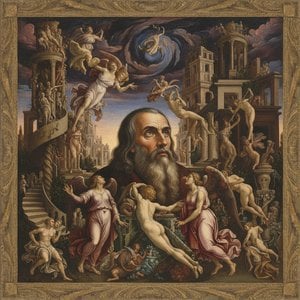
St John the Evangelist by El Greco, hand-painted oil painting reproduction by a master artist
Preview AR preview Switch to Print Switch to Digital Image Send
Details Guide Add to favorites Download Similars X-Ray Diaporama Q&A Presentation Stats

St John the Evangelist Hand-painted oil painting reproduction

Explore El Greco’s "St John the Evangelist." A Baroque masterpiece featuring dramatic chiaroscuro, elongated figures & contemplative symbolism. Discover this iconic work!

El Greco's Mannerist style shines in The Burial of the Count of Orgaz. Discover his spiritual and dramatic masterpieces today.

Hand Made Oil Reproduction

Hand-painted oil on canvas in your size and frame, made to order by our artists. ( Switch to Print Switch to Digital Image)

Corner sample of the P118B picture frame: moulded polystyrene, 5 cm wide and 3 cm thick
P118B $10
Corner sample of the P118H picture frame: moulded polystyrene, 5 cm wide and 3 cm thick
P118H $10
Corner sample of the P118W picture frame: moulded polystyrene, 5 cm wide and 3 cm thick
P118W $10
Corner sample of the P438Z picture frame: moulded polystyrene, 5.5 cm wide and 3.5 cm thick
P438Z $10
Corner sample of the P508JH picture frame: moulded polystyrene, 7 cm wide and 3.5 cm thick
P508JH $12
Corner sample of the P508YH picture frame: moulded polystyrene, 7 cm wide and 3.5 cm thick
P508YH $12
Corner sample of the P805H picture frame: moulded polystyrene, 5 cm wide and 3.5 cm thick
P805H $10
Corner sample of the P805Z picture frame: moulded polystyrene, 5 cm wide and 3.5 cm thick
P805Z $10
Corner sample of the P919BZ picture frame: moulded polystyrene, 7 cm wide and 3.5 cm thick
P919BZ $10
Corner sample of the P919G picture frame: moulded polystyrene, 7 cm wide and 3.5 cm thick
P919G $10
Corner sample of the P919XJ picture frame: moulded polystyrene, 7 cm wide and 3.5 cm thick
P919XJ $10
Corner sample of the P959ZH picture frame: moulded polystyrene, 5 cm wide and 3 cm thick
P959ZH $10
Corner sample of the P968JZ picture frame: moulded polystyrene, 6 cm wide and 4 cm thick
P968JZ $12
Corner sample of the W106C picture frame: solid wood, 5 cm wide and 3 cm thick
W106C $8
Corner sample of the W218G picture frame: solid wood, 5 cm wide and 3 cm thick
W218G $10
Corner sample of the W218JH picture frame: solid wood, 5 cm wide and 3 cm thick
W218JH $8
Corner sample of the W218Y picture frame: solid wood, 5 cm wide and 3 cm thick
W218Y $10
Corner sample of the W307PJ picture frame: solid wood, 6 cm wide and 3 cm thick
W307PJ $10
Corner sample of the W316G picture frame: solid wood, 6 cm wide and 3 cm thick
W316G $10
Corner sample of the W316PJ picture frame: solid wood, 6 cm wide and 3 cm thick
W316PJ $8
Corner sample of the W316Y picture frame: solid wood, 6 cm wide and 3 cm thick
W316Y $10
Corner sample of the W398PJ picture frame: solid wood, 5 cm wide and 3 cm thick
W398PJ $8
Corner sample of the W4111J picture frame: solid wood, 6.5 cm wide and 3.5 cm thick
W4111J $10
Corner sample of the W500HY picture frame: solid wood, 7 cm wide and 5 cm thick
W500HY $15
Corner sample of the W500JH picture frame: solid wood, 7 cm wide and 5 cm thick
W500JH $15
Corner sample of the W692G picture frame: solid wood, 8 cm wide and 4 cm thick
W692G $12
Corner sample of the W849H picture frame: solid wood, 5 cm wide and 3 cm thick
W849H $8
Corner sample of the W940BG picture frame: solid wood, 7.5 cm wide and 4.5 cm thick
W940BG $15
Corner sample of the W953PJ picture frame: solid wood, 6 cm wide and 3.5 cm thick
W953PJ $8

Standard
custom
CM
INCH

Pick from our preset sizes that match the artwork's original proportions.

width
height

Type the width and the height you need, to fit your frame or your wall. This is hand-painted, so for a size with a different shape the artist can paint a bit more around the picture, or cut a bit — you choose. We send you a digital mockup to approve before the painting starts. The picture shown on this page does not show the real result — only the mockup does.

Examples of what can be changed: Replace face with customer photo; Add pet (e.g., replace cat with dog); Include hidden message in background; Change background landscape or elements.
After order, WahooArt.com team will email client for instructions and provide a mockup preview

Worldwide Delivery () in 3/4 weeks instead of standard 5 weeks. (9 November). No compromise on quality.

Free Worldwide Express Shipping
High-Quality Linen Canvas
Full Shipping Insurance
Customs Tax Refund Guarantee
True Color Matching Guarantee
100-Day Return Policy (Defects Only)
100% Money-Back Guarantee
Bulk Discount Offer

Total Price

$ 272

St John the Evangelist

Reproduction Medium

Reproduction Size

-

Total Price

$ 272

Quick Facts

  • style: Dramatic, expressive, elongated figures
  • notable elements: Chiaroscuro, dramatic lighting, swirling background, contemplative pose
  • influences: Tintoretto, Titian, Byzantine art
  • title: St John the Evangelist

Art Quiz

There is only one correct answer for each question.

Question 1:
El Greco, the artist of 'St John the Evangelist', was originally from which country?
Question 2:
The dramatic use of light and shadow in 'St John the Evangelist' is known as:
Question 3:
Which artistic movement is El Greco most closely associated with?
Question 4:
What is Saint John the Evangelist depicted doing in this painting?
Question 5:
El Greco's style often features figures that are:

A Vision of Contemplation: Exploring El Greco’s *St John the Evangelist*

This captivating painting by Doménikos Theotokópoulos, known as El Greco, presents a powerful image of Saint John the Evangelist immersed in thought and spiritual reflection. A masterwork of the late Renaissance/early Baroque period, this piece exemplifies El Greco’s unique style – a synthesis of Byzantine tradition, Venetian colorism, and Mannerist exaggeration.

Subject & Symbolism

The painting depicts Saint John, traditionally believed to be the author of the Gospel of John, the three Johannine epistles, and the Book of Revelation. He is portrayed not as a martyred figure, but as an *intellectual* – deeply engaged with scripture, holding an open book in his hand. This emphasizes John’s role as a theologian and visionary. The swirling, dark sky behind him isn't merely atmospheric; it suggests a realm beyond the earthly, hinting at divine inspiration and the mysteries of faith. The very act of reading becomes symbolic, representing wisdom, introspection, and the pursuit of spiritual understanding.

Style & Technique: A Mannerist Master

El Greco’s style is instantly recognizable. He departs from strict realism, favoring elongated figures, dramatic lighting, and vibrant, often unnaturalistic colors. This painting showcases his masterful use of chiaroscuro – the stark contrast between light and dark – which sculpts the figure, drawing our eye to Saint John’s face and hands, and heightening the emotional intensity. The flowing red robe provides a striking visual counterpoint to the cooler blues beneath, further emphasizing the dynamism of the composition. His brushwork is visible, creating a textured surface that adds depth and energy to the scene. While rooted in Renaissance techniques like layering paint for form and glazing for luminosity, El Greco pushes these boundaries, anticipating the emotional intensity of the Baroque era.

Historical Context & Artistic Influences

Born in Crete, El Greco’s artistic journey took him through Venice and Rome before he settled in Toledo, Spain. In Italy, he absorbed influences from masters like Titian and Tintoretto – evident in his use of color and dramatic composition. However, he ultimately forged a style entirely his own. His work was initially met with mixed reactions; his unconventional approach didn’t always align with the tastes of his contemporaries. Yet, by the 20th century, El Greco's unique vision gained widespread recognition, influencing movements like Expressionism and Cubism.

Emotional Impact & Interior Design

*St John the Evangelist* is more than just a religious painting; it’s an exploration of the human condition – our capacity for thought, faith, and spiritual longing. The intensity of Saint John's gaze invites contemplation, creating a powerful connection with the viewer. The painting’s dramatic composition and rich color palette make it a striking focal point for any interior. It would be particularly well-suited to libraries, studies, or contemplative spaces, adding a touch of historical gravitas and spiritual depth. A high-quality reproduction captures the essence of El Greco's vision, bringing this masterpiece into your home or office.

Key Characteristics

  • Artist: El Greco (Doménikos Theotokópoulos)
  • Style: Mannerism / Early Baroque
  • Medium: Oil on Canvas
  • Dominant Colors: Red, Blue, Dark Tones
  • Key Features: Chiaroscuro, Elongated Figures, Dramatic Composition

Questions & Answers

Can I see "St John the Evangelist" by El Greco on my own wall before buying?

"St John the Evangelist" by El Greco can be previewed on your own wall with the artwork's AR Preview page, using augmented reality on a compatible device.

What technique and style characterize "St John the Evangelist" by El Greco?

In "St John the Evangelist", the oil on canvas technique meets the Baroque movement.

Why is the copyright status of "St John the Evangelist" what it is?

The copyright status of "St John the Evangelist" - in the public domain - its copyright has expired - follows from the artist's death in 1614.


Artist Biography

The Cretan Foundation

Doménikos Theotokópoulos, known to history as El Greco, began his life in 1541 on the island of Crete. At that time, the island was a Venetian possession, a fact that would later allow him to bridge the gap between Eastern and Western traditions. He was trained as an icon painter within the Byzantine tradition, a discipline that demanded a meticulous attention to detail and a focus on the spiritual essence of a subject rather than mere physical likeness. This early immersion in the Cretan school provided him with a sense of symbolic precision that would remain a constant, even as his style underwent radical transformations.

By the age of twenty-six, he moved to Venice, seeking to expand his understanding of the natural world. In the Venetian Republic, he encountered the works of Titian and Tintoretto, absorbing their mastery of color and the use of light to define form. He learned to move away from the rigid lines of his youth, embracing a more fluid brushwork and a sense of dynamism. This period was not a rejection of his roots but an expansion of them, as he began to blend the disciplined iconography of his Greek heritage with the atmospheric sensuality of the Italian Renaissance.

The Toledo Transformation

After a period in Rome, where he encountered the elongated forms and sophisticated compositions of Mannerism, El Greco settled in Toledo, Spain, in 1577. This move proved decisive. Toledo was a center of intense religious fervor during the Counter-Reformation, providing a landscape perfectly suited to his increasingly mystical vision. It was here that his style reached its most distinctive phase, characterized by figures that appeared stretched and contorted, as if pulled by an unseen spiritual force. He used color not to mimic reality, but to heighten emotional impact, often employing unnatural hues to depict the divine.

His work in Spain was marked by a tension between the earthly and the ethereal. In The Burial of the Count of Orgaz (1586-1588), he juxtaposed the realistic portrayal of contemporary figures with elongated, celestial forms, creating a visual bridge between the mortal and the divine. His ability to manipulate light and shadow allowed him to create a sense of drama that felt both theatrical and deeply personal. He did not merely paint scenes; he attempted to render the emotional and spiritual realities that exist beyond the surface of the physical world.

A Legacy of Form and Light

The later years of his life saw a move toward even greater abstraction and mysticism. His compositions became more complex, and his figures more distorted, reflecting a growing detachment from conventional artistic norms. While he achieved success and received significant commissions from churches and monasteries in Toledo, his influence was not immediately felt by the broader art world after his death in 1614. For a long period, he was viewed as an eccentric, his work largely overlooked by the mainstream of art history.

It was not until the 20th century that his importance was fully recognized. Modernists found in his work a precursor to the expressive and fragmented styles of the future. His ability to distort proportion and use bold, emotive color resonated with those seeking to convey internal psychological states. Today, his paintings are viewed as windows into the human spirit, celebrated for their unique ability to capture the intensity of faith and the struggle for transcendence.

Notable works include:

El Greco

El Greco

1541 - 1614 , Greece

Explore artworks organized by themes, styles, and characteristics.