Museum-quality giclée or canvas print with fast production and flexible finish options. ( Buy Hand Made Painting Switch to Digital Image)





























Pick from our preset sizes that match the artwork's original proportions.

Type the width and the height you need, to fit your frame or your wall. A print can only be cut, never made bigger than the picture, so a size with a different shape loses a part of the image. We send you a digital mockup to approve before we print anything. The picture shown on this page does not show the real cut — only the mockup does.
Worldwide Delivery () in 2 weeks instead of standard 4/5 weeks. (10 November)
untitled (3813)
Reproduction Size
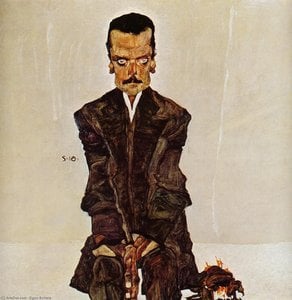
Egon Schiele's "Untitled (3813)" is not merely a depiction of a man in repose; it’s a raw, visceral exploration of vulnerability, isolation, and the ever-present specter of mortality. Painted in 1917, during a period of immense personal turmoil for the artist – marked by illness, loss, and the looming shadow of World War I – this work embodies Schiele's signature style: an intensely psychological portrait rendered with unsettling honesty and a masterful command of line. The painting immediately draws the viewer in with its stark simplicity; a solitary figure seated against an indeterminate background, his posture suggesting both weariness and a profound sadness. The deliberate ambiguity surrounding his identity – the partially concealed nudity beneath the dark jacket – invites speculation about his inner state, fueling a sense of unease and empathy.
Schiele’s technique is characterized by its forceful, almost frantic energy. The lines are not smooth or polished; they vibrate with an urgent intensity, reflecting the emotional turmoil he sought to convey. Notice how the jacket seems to cling tightly to his form, a protective yet suffocating layer that simultaneously conceals and reveals. The use of dark, muted tones – predominantly browns and blacks – contributes to the painting’s somber mood, while subtle shifts in value create a dynamic interplay of light and shadow that emphasizes the figure's contours and adds to the overall sense of drama. The background is deliberately vague, further isolating the subject and directing our attention entirely onto his face—a study in melancholic contemplation.
Schiele’s biography is inextricably linked to the themes explored within his art. His childhood was marked by profound loss – the early deaths of his sister Elvira and, crucially, his father, Adolf Schiele, who succumbed to syphilis. This familial tragedy cast a long shadow over Egon's life, instilling in him a deep preoccupation with illness, death, and the fragility of human existence. The painting’s subject, often interpreted as a self-portrait or a representation of someone close to the artist, carries this weight of sorrow within his gaze. The downward tilt of his head and the subtle downturn of his mouth speak volumes about his emotional state – a quiet despair that resonates deeply with viewers.
Adding to the complexity is the presence of two secondary figures in the composition. One man on the left, partially obscured, and another further back on the right, create a sense of an unseen audience or perhaps even a reflection of Schiele’s own internal struggles. These figures are not fully defined; they exist as fragments within the scene, contributing to the overall atmosphere of isolation and uncertainty. They could represent memories, anxieties, or simply the silent witnesses to his suffering.
“Untitled (3813)” is firmly rooted in the Expressionist movement, a European artistic current that prioritized emotional intensity over objective representation. Schiele’s work shares many characteristics with other Expressionists: distorted forms, exaggerated lines, and a focus on subjective experience. The painting's unsettling quality stems from its ability to tap into primal emotions—fear, grief, loneliness—without resorting to overt symbolism or narrative. The figure’s nakedness can be interpreted as a symbol of vulnerability and exposure, while the jacket represents a fragile shield against the harsh realities of life.
Interestingly, Schiele's fascination with trains, evident in earlier works, subtly reappears here through the implied journey—a journey inward, into the depths of his own psyche. The chair, partially visible at the bottom of the image, might represent a place of contemplation or perhaps even a site of mourning. The painting’s power lies not in its literal depiction but in its evocative suggestion – it invites us to project our own emotions and experiences onto the scene.
Egon Schiele's "Untitled (3813)" is more than just a painting; it’s a poignant meditation on the human condition. WahooArt offers meticulously crafted, hand-painted reproductions that capture the essence of this iconic work. Our artists replicate Schiele’s distinctive style and emotional intensity with remarkable precision, ensuring that you receive a faithful representation of this powerful artwork. Whether for your personal collection or to enhance an interior space, a WahooArt reproduction allows you to experience the haunting beauty and profound psychological depth of “Untitled (3813)” in stunning detail. Explore our selection today and bring a piece of Schiele’s legacy into your home.
View the Original Artwork | Learn More About Egon Schiele
"untitled (3813)" by Egon Schiele combines an earthy palette with a melancholic tone.
In terms of perceived brightness, "untitled (3813)" by Egon Schiele is brilliant.
The recorded values for "untitled (3813)" by Egon Schiele are: brilliant brightness, bright balance luminance.

Tulln, Lower Austria, provides the setting for the beginning of Egon Schiele’s life. Born on 12 June 1890, he enters a world defined by the rigid structures of the Austro-Hungarian Empire. His father, Adolf Schiele, manages the local station as the station master for the Austrian Federal Railways. His mother, Marie, is known by her maiden name, Soukup. Within the family, Egon grows alongside his three sisters: Elvira, Melanie, and Gertrude.
The stability of this domestic life fractures early. The shadow of illness moves through the household, leaving a permanent mark on the young artist's psyche. These personal disruptions do not merely pass; they settle into the marrow of his future work. He moves through the world with a sensitivity to mortality that will eventually define his place in Austrian Expressionism. His existence becomes a struggle to translate internal tension onto the surface of the canvas.
His path leads him toward the center of a shifting European landscape. He navigates the tension between traditional academic expectations and a burgeoning need for raw, psychological truth. The life of Egon Schiele is a series of intense, often uncomfortable confrontations with the human condition. He does not seek to depict the world as it appears to the eye, but as it vibrates within the nervous system.
The stability of Schiele's youth fractures in 1904. His father, Adolf Schiele, a station master, succumbs to syphilis. This illness, contracted during a honeymoon in Trieste, leaves the family impoverished and the young artist's psyche marked by the shadow of his father's mental confusion and rage. Egon grows up alongside his three sisters, Elvira, Melanie, and Gertrude, under the guardianship of his uncle-in-law, Leopold Czihaczek. Even in these turbulent years, a fascination with trains persists, a motif that would later surface in his work.
Formal training begins under the guidance of tutor Ludwig Karl Strauch. By 1906, Schiele moves to Vienna to study at the Academy of Fine Arts (Akademie der bildenden Künste). The atmosphere is rigid. He finds himself increasingly at odds with the ultra-conservative teaching of Professor Christian Griepenkerl. The friction becomes unsustainable. After three years of navigating these strict academic traditions, Schiele abandons the Academy altogether to forge an independent path.
A shift occurs when he encounters Gustav Klimt. The established artist becomes a mentor, providing the young painter with models and introducing him to the circles of the Vienna Secession. This connection marks the transition from a student struggling against tradition to a central figure in the burgeoning avant-garde.
Vienna becomes the center of Schiele's creative friction. He moves through the city's artistic circles, eventually meeting Gustav Klimt. This encounter marks a significant shift in his trajectory. While he absorbs the influence of his mentor, Schiele does not simply replicate the decorative patterns of the Secession. Instead, he begins to strip away the ornamentation. He seeks a more visceral truth. By 1909, he is actively challenging the established order, co-founding the Neues Wiener Kunstgruppe and the Neukunstgruppe. These movements signal his break from tradition.
His presence in the city is marked by a restless movement between urban centers and quieter outskirts. He works across Vienna, Krems, Klosterneuburg, Neulengbach, and Prague. This geographic spread mirrors a psychological expansion. His art moves from the formal constraints of his early training toward a raw, unshielded exploration of the human condition. The tension of the era is visible in his evolving sketches and compositions.
The line is the primary engine of Schiele’s vision. It does not merely outline a form; it vibrates with a nervous, restless energy. He employs expressive lines to map out psychological tension, often resulting in contorted poses and twisted body shapes. Figures appear elongated, their limbs stretched beyond natural proportions to convey a sense of unease. This is not a pursuit of anatomical perfection but an attempt to expose the internal state of the subject. Skin tones often appear emaciated or sickly-coloured, emphasizing a sense of fragility and physical vulnerability.
His technical approach varies by medium, yet the intensity remains constant. In his watercolors, he utilizes loose washes of color to create depth and mood, often leaving much of the paper bare to heighten the sense of isolation. When working in oil on canvas, the brushwork carries the same jagged urgency found in his drawings. Beyond the two-dimensional plane, he also explored form through sculpture, working in clay and plaster to capture the weight of the human presence.
The canvas becomes a site of psychological excavation. Schiele confronts the heavy presence of death, sexuality, anxiety, and isolation through a lens of unflinching honesty. In 1915, he produces Death and the Maiden, a work where the presence of mortality intersects with eros. The figures exist in a state of tension, reflecting the internal struggles that define his vision. He often returns to the human form to map these invisible states, using the body as a vessel for the complexities of existence.
Self-portraiture acts as a recurring method of introspection. He does not seek to present a polished image but rather a vulnerable one, often appearing in contorted or emaciated states. In Self-Portrait with Physalis, he utilizes the Physalis plant as a recurring motif. The plant, with its delicate and papery husk, symbolizes transience and the fragility of life. This botanical element anchors his preoccupation with decay and the fleeting nature of the human condition.
His intimate connections also find their way into his compositions. In 1915, he paints Portrait of Edith Schiele, capturing his wife in a way that reflects his specific expressive language. His subjects are rarely static; they pulse with a nervous energy that mirrors the shifting social and psychological landscapes of the era. The following works represent significant points in his exploration of these themes:
The landscape of Schiele's life shifts as the First World War approaches. He marries Edith Harms, a union that marks a significant personal transition. However, the stability of marriage is quickly interrupted by the demands of the conflict. He is drafted into military service, a period that places him within the chaos of the war's reach.
The end arrives with sudden, biological ferocity. In 1918, the Spanish flu pandemic sweeps through Vienna. The virus claims Schiele at the age of 28. He dies on 31 October 1918. His passing occurs shortly after the death of his wife, Edith, who succumbed to the same disease. The artist's life ends abruptly, leaving behind a body of work that captures the tension of a world in collapse.
Schiele emerges from the early 20th century as a leading figure in Austrian Expressionism. His departure from the decorative gold of the Secession movement toward a more visceral, psychological exploration of the human form changed the trajectory of figurative painting. He stripped away the surface to map the nervous system, using jagged, restless lines to capture the tremors of anxiety and desire. This focus on the internal landscape rather than idealized beauty established him as a major figurative painter of the era.
The impact of his work extends far beyond the borders of Vienna. Subsequent generations of artists find a precedent in his radical honesty, particularly those drawn to the darker, more complex layers of the human psyche. His ability to translate personal trauma and existential tension into a universal visual language ensures his presence in the discourse of modern art. Today, his paintings are held in major museum collections worldwide, preserved as essential records of the psychological shifts of his time.
The weight of Schiele’s output is felt most heavily in Vienna. The Leopold Museum holds a vast concentration of his works, preserving the raw energy of his sketches and paintings. Nearby, the Österreichische Galerie Belvedere houses significant canvases, including Death and the Maiden (1915). The city’s institutional landscape continues to guard his legacy through the Kunsthistorisches Museum and the Albertina, both of which contain essential pieces of his oeuvre.
Beyond the Austrian capital, the Egon Schiele Art Centrum in Český Krumlov, Czech Republic, offers a dedicated space for his work. This museum traces his evolution through a permanent collection that includes watercolors and ink drawings. Visitors can encounter the specific intensity of his linework in this setting, which focuses on the development of his expressive style.

1890 - 1918 , Croatia

Explore the profound world of Figurative Expressionism. Discover how masters like Munch and Schiele use the human form to convey raw emotion, and learn how to curate these evocative, museum-quality masterpieces for your private collection.
 Preview
 Send
Send Share
Share
 Details
 Guide
Guide

 Download
 Similars
 X-Ray
X-Ray Diaporama
 Q&A
Q&A
 Stats
Stats

 Read More









 Glass option is only available in size under 110 CM