Artist Biography
A Pioneer of Progressive Design: The Life and Work of Edward William Godwin
Edward William Godwin, born in Bristol in 1833 and passing away in 1886, was a remarkably forward-thinking English architect and designer whose career spanned a period of intense stylistic transition. He wasn’t merely a participant in the Victorian aesthetic landscape; he actively shaped it, moving from the heavily ornamented “Ruskinian Gothic” favored in mid-Victorian Britain to embrace the burgeoning “Anglo-Japanese taste” that characterized the Aesthetic Movement. Godwin's influence resonates even today, subtly woven into the fabric of the Arts and Crafts movement which followed closely on his heels. His early successes included significant public commissions like the Guildhall in Northampton – a testament to his initial mastery of Ruskinian principles – and the Town Hall in Congleton, alongside restorative work at Dromore Castle in Limerick and Castle Ashby. These projects demonstrated a skill for reviving historical forms, but they were merely stepping stones towards a more radical vision. Godwin’s architectural training was largely self-directed, beginning with an apprenticeship to an engineer in Bristol before relocating to London around 1862 where he encountered the influential Gothic Revival designer William Burges. This encounter sparked a lifelong fascination with medieval costume, furniture and architecture, fueling his antiquarian interests.
Personal Life and Artistic Entanglements
Godwin’s personal life was as dynamic and unconventional as his artistic pursuits. Widowed in 1865, he embarked on a significant relationship with the celebrated actress Ellen Terry between 1868 and 1874. This period saw Terry retire from the stage to live with Godwin in Hertfordshire, where they had two children: Edith Craig (1869-1947) and Edward Gordon Craig (1872–1966), the latter becoming a pivotal figure in early 20th-century European theatre as an actor, designer, director, and theorist. The connection with Terry profoundly impacted Godwin’s work, inspiring him to dedicate considerable time to designing theatrical costumes and scenery – a natural extension of his interest in historical dress and dramatic presentation. Following the end of his affair with Terry, Godwin married Beatrice Birnie Philip, a talented designer in his office, who bore him another son named Edward. A fascinating postscript to this story is that after Godwin’s death, Beatrice would marry none other than James McNeill Whistler, forging yet another significant artistic connection. Throughout his life, Godwin was a prolific writer, contributing regularly to the *British Architect* and publishing several books on architecture, costume, and theatre, solidifying his position as a leading intellectual voice of his time.
The Embrace of Japan and the Anglo-Japanese Aesthetic
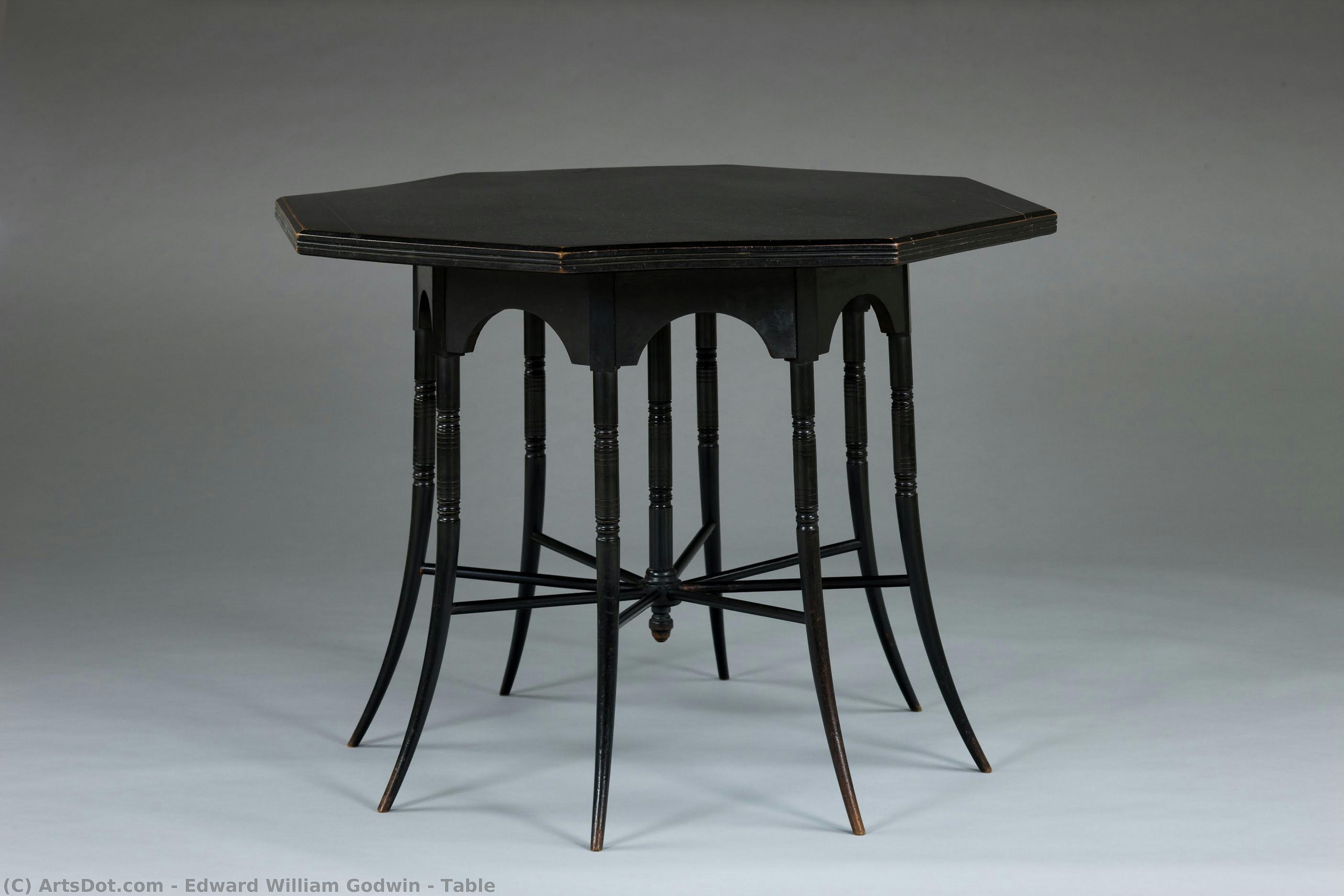
While Godwin’s early work demonstrated proficiency in established styles, it was his pioneering embrace of Japanese art that truly set him apart. In 1853, Japan opened its borders to the Western world, unleashing a wave of influence on European design. Unlike many contemporaries who merely incorporated superficial “Japanese details,” Godwin delved deeper, seeking to understand and embody the *spirit* of Japanese aesthetics – a focus on simplicity, natural materials, and refined craftsmanship. This is vividly apparent in his furniture designs, particularly those executed with an ebonized finish for Dromore Castle and his own home from 1867 onwards. These pieces weren’t simply decorated; they were conceived according to principles of Japanese spatial awareness and proportion. Similar stripped-down “Anglo-Japanese” designs were later produced by firms like William Watt and Collinson & Lock, further disseminating Godwin's vision. A particularly striking example is a black cabinet designed for Collinson & Lock, now housed in the Museum of Modern Art in New York – a testament to his enduring influence on modern design sensibilities.
Aestheticism, Collaboration, and Lasting Legacy
By the 1870s and 80s, Godwin’s designs were highly sought after, finding their way into the showrooms of Liberty & Co. His wallpapers, printed textiles, tiles, “art furniture,” and metalwork defined the aesthetic of progressive homes, attracting a clientele that valued artistic innovation. He counted Oscar Wilde among his admirers, who hailed him as "one of the most artistic spirits of this century," and even received commissions from Princess Louise for a studio at Kensington Palace. Godwin’s involvement with the new garden suburb of Bedford Park in 1876, however, proved less successful; his house designs were criticized for their steep staircases, unconventional bathroom layouts, small rooms, and narrow corridors – ultimately leading to only a few being built. A significant collaboration with James McNeill Whistler began in 1877, resulting in the construction of Whistler’s iconic “White House” on Tite Street, Chelsea. Despite initial objections from authorities, Godwin completed the house, though it was later sold due to Whistler's bankruptcy and subsequently altered by a new owner – eventually being demolished in the 1960s. The partnership extended beyond architecture, encompassing furniture and interior design projects like “Harmony in Yellow and Gold: The Butterfly Cabinet.” Godwin’s willingness to reimagine exhibition spaces—completely redecorating galleries to complement Whistler's radical Impressionist paintings of Venice—further demonstrates his holistic approach to art and design. His influence continued with designs for the Fine Art Society on Bond Street, including a new entrance completed in 1881, which also hosted early exhibitions of Japanese woodblock prints. Edward William Godwin’s legacy lies not only in the beautiful objects he created but in his visionary spirit—a willingness to challenge conventions and embrace new influences that paved the way for modern design.



 Preview
 Buy Print
 Send
Send Share
Share
 Details

 Download
 Similars
 X-Ray
X-Ray Diaporama
 Read More





