Museum-quality giclée or canvas print with fast production and flexible finish options. ( Buy Hand Made Painting Switch to Digital Image)





























Pick from our preset sizes that match the artwork's original proportions.

You may enter your own dimensions to fit a specific frame or space. If your selected size does not match the original image's proportions, we will either crop the artwork or extend the image with a mirrored or solid-fill edge. A digital mockup will be sent for your approval before production begins.
Please note that the on-screen preview does not reflect the actual cropping or extension. Only the mockup will accurately show the final composition.
While custom sizes are available, we recommend selecting a dimension from the predefined list to preserve the original proportions.
Worldwide Delivery () in 2 weeks instead of standard 4/5 weeks. (22 September)


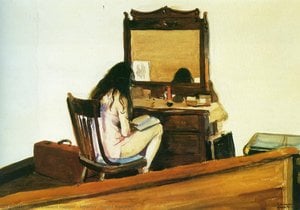
Untitled (Captain Gardner K. Wonson House)
Reproduction Size
Edward Hopper’s “Untitled (Captain Gardner K. Wonson House)” isn't merely a depiction of an American dwelling; it’s a masterful distillation of the pervasive loneliness and contemplative stillness characteristic of mid-century urban life. Completed in 1928, this striking black and white drawing captures a moment frozen in time—a diner bathed in artificial light at dusk, populated by three figures adrift in a sea of muted tones.
The historical context surrounding “Untitled” is crucial to understanding its emotional resonance. Painted during the Jazz Age, a period marked by social upheaval and disillusionment following World War I, Hopper’s work speaks to the anxieties of modernity—the feeling of being disconnected from others and overwhelmed by the impersonal forces of urban existence. It aligns perfectly with the broader artistic movement of American Realism.
Inspired by Hemingway's stories and possibly influenced by “A Clean, Well-Lighted Place,” Hopper meticulously documented every aspect of his artistic process. Jo Hopper’s detailed notes reveal insights into his compositional choices—the deliberate exaggeration of the diner’s size and the careful positioning of light sources—demonstrating a profound commitment to conveying emotion through visual precision.


1931 - 1967 , United States of America

Explore the profound beauty of American Realism. From Winslow Homer’s rural landscapes to the dignity of everyday life, discover how master artists captured the soul of a nation through evocative oil paintings and timeless fine art techniques.

 Preview
 Send
Send Share
Share
 Details
 Guide
Guide

 Download
 Similars
 X-Ray
X-Ray Diaporama
 Stats
Stats


 Read More







 Glass option is only available in size under 110 CM