Museum-quality giclée or canvas print with fast production and flexible finish options. ( Buy Hand Made Painting Switch to Digital Image)





























Pick from our preset sizes that match the artwork's original proportions.

You may enter your own dimensions to fit a specific frame or space. If your selected size does not match the original image's proportions, we will either crop the artwork or extend the image with a mirrored or solid-fill edge. A digital mockup will be sent for your approval before production begins.
Please note that the on-screen preview does not reflect the actual cropping or extension. Only the mockup will accurately show the final composition.
While custom sizes are available, we recommend selecting a dimension from the predefined list to preserve the original proportions.
Worldwide Delivery () in 2 weeks instead of standard 4/5 weeks. (4 October)


untitled
Reproduction Size
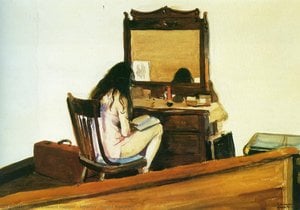
Edward Hopper’s “untitled,” often referenced as “House by the Railroad” (1925), is more than just a depiction of architecture; it's an evocation of a distinctly American mood, a stillness that resonates with both familiarity and a subtle sense of melancholy. The painting presents a large Victorian-era house, rendered not with photographic precision but through the softened lens of Impressionism. Loose brushstrokes define its ornate details – the decorative columns, arched windows, and varied window shapes – creating an impression of solidity tempered by transience. The house isn’t simply *there*; it exists within a specific quality of light and atmosphere, a feeling that Hopper masterfully captures.
Hopper's artistic journey was deeply rooted in his observations of the evolving American landscape, both urban and rural. Born in 1882, he came of age during a period of rapid industrialization and social change. While initially influenced by French Impressionists like Manet and Degas – artists who captured fleeting moments of modern life – Hopper ultimately forged his own path, rejecting European aesthetics in favor of a uniquely American realism. “House by the Railroad” exemplifies this shift. The house itself, with its intricate Victorian detailing, speaks to an earlier era, while the painting’s overall mood hints at a growing sense of isolation and anonymity that characterized modern life. It's not merely a portrait of a building; it’s a commentary on the changing face of America.
The muted color palette employed in “untitled” – dominated by earthy tones in the lower portion, giving way to a lighter blue sky – contributes significantly to its emotional impact. Hopper wasn't interested in vibrant displays of color; instead, he used tone and light to create atmosphere and evoke feeling. The absence of figures within the scene is also crucial. The house stands alone, a silent sentinel against an expansive sky. This emptiness isn’t necessarily bleak, but rather invites contemplation. It allows the viewer to project their own emotions onto the scene, to experience the quietude as a space for introspection. Hopper's skill lies in his ability to suggest narrative without explicitly telling a story; he presents us with fragments of life and leaves it to us to complete the picture.
Though often associated with urban scenes like “Nighthawks,” Hopper’s rural landscapes, such as this one, are equally compelling. They reveal his consistent preoccupation with themes of loneliness, isolation, and the search for meaning in a rapidly changing world. “House by the Railroad” is a testament to Hopper's ability to transform ordinary subjects into powerful statements about the human condition. It’s a painting that lingers in the mind long after viewing, prompting us to consider our own place within the vastness of the American landscape and the complexities of modern life. The work currently resides in the esteemed collection of The Museum of Modern Art in New York, solidifying its position as an iconic representation of 20th-century American art.
To get a print of "untitled" by Edward Hopper, simply order it on this page: a fine art print on cotton canvas or archival canvas paper.
Within Edward Hopper's output, "untitled" sits in the American Realism style, alongside the themes of impressionism, american realism, modernity, urban isolation, social commentary, anonymity, hopper’s signature style”,, solitude.
The artist behind "untitled" is Edward Hopper. The work is catalogued under Edward Hopper's name.
The dominant hue of "untitled" by Edward Hopper is ochre to sepia. The hue is the underlying tone of the palette.
Format (square) and recommended space (living room) are the two placement facts recorded for "untitled" by Edward Hopper.
"untitled" is available as a hand-painted oil reproduction on linen canvas. The order can be placed on this page, with a choice of sizes.
putty (#e5dac5) is the leading color of "untitled" by Edward Hopper.


1931 - 1967 , United States of America

Explore 10 defining American Realism masterpieces – Hopper, Homer & more. Discover the stories behind these iconic paintings and bring timeless art to your home with WahooArt's museum-quality reproductions. Explore the full collection online.

Explore the rich history of landscape art with WahooArt. Discover renowned artists, movements like Impressionism & Romanticism, and expert guidance for collecting timeless pieces. Find your perfect serene escape today!

Explore the rich history of landscape art with WahooArt. Discover renowned artists, movements like Impressionism & tonalism, and expert guidance for collecting timeless pieces. Find your perfect serene escape today!

Explore the serene landscapes of Edward Wilkins Waite (1854-1924), a prolific Victorian painter celebrated for his depictions of Surrey's countryside. Discover his artistic influences, career highlights & collecting guide.

Explore 25 iconic Edward Hopper paintings & their stories. Discover American realism, urban loneliness, and timeless beauty through his masterpieces. Find museum-quality art reproductions & curated decor ideas at WahooArt.com.

 Preview
 Send
Send Share
Share
 Details
 Guide
Guide

 Download
 Similars
 X-Ray
X-Ray Diaporama
 Stats
Stats

 Read More







 Glass option is only available in size under 110 CM