The artwork displayed on this page is protected by copyright law, which means we cannot legally create or sell an identical reproduction. This protection is enforced under international agreements such as the Berne Convention and by national laws, including those outlined by the U.S. Copyright Law - Title 17.
As a respectful and legal alternative, we offer custom, hand-painted artworks inspired by the original. Our skilled and professional artists carefully study the original's style, mood, and artistic essence to create a new, unique piece that evokes the same feeling - while remaining an original creation in its own right.
This method fully complies with copyright regulations because it does not involve copying or duplicating the protected artwork. Instead, it is a creative reinterpretation - a new painting that is influenced by the original but not identical to it.
Hand-painted oil on canvas in your size and frame, made to order by our artists. ( Switch to Print Switch to Digital Image)





























Pick from our preset sizes that match the artwork's original proportions.

Type the width and the height you need, to fit your frame or your wall. This is hand-painted, so for a size with a different shape the artist can paint a bit more around the picture, or cut a bit — you choose. We send you a digital mockup to approve before the painting starts. The picture shown on this page does not show the real result — only the mockup does.
Worldwide Delivery () in 3/4 weeks instead of standard 5 weeks. (26 October). No compromise on quality.
untitled (5560)
Reproduction Size
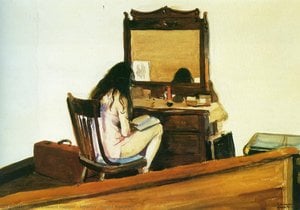
Edward Hopper's untitled (5560) is far more than a mere depiction of a roadside service station; it is a distilled essence of the American experience, a moment frozen in time that speaks volumes about human connection and the profound weight of isolation. Painted during the transformative years between 1942 and 1945, this monochrome masterpiece captures a scene familiar to the mid-century traveler—the late-night glow of artificial light illuminating a sparsely populated landscape. Through his masterful command of light and shadow, Hopper elevates a commonplace setting into something deeply contemplative, creating an atmosphere that lingers in the mind long after the viewer has turned away.
The painting centers around the gas station, a quintessential symbol of American mobility and commerce, yet its true power resides in the subtle tension of its composition. A solitary figure can be seen near the pumps, seemingly detached from the surrounding environment, embodying a sense of quiet introspection. Hopper’s signature style—a seamless blend of geometric precision and expressive realism—is on full display here. The stark, black-and-white palette amplifies the inherent melancholy of the scene, emphasizing the weathered textures of brick walls and the glossy, metallic sheen of the pumps. This meticulous attention to detail draws the eye into a world where every shadow tells a story of solitude.
To truly appreciate the emotional gravity of untitled (5560), one must consider the historical context of its creation. Produced during the height of World War II, a period marked by palpable anxieties regarding national security and sweeping societal shifts, Hopper’s work reflects a broader preoccupation with alienation and disillusionment. The lone occupant of the station, gazing out at an empty streetscape, becomes a vessel for the collective feeling of searching for solace in a world increasingly defined by distance and uncertainty. The painting operates on multiple symbolic levels, where the gas pumps represent the pulse of a nation in motion, yet the stillness of the scene suggests a pause in that very progress.
For collectors and interior designers alike, this piece offers a profound sense of nostalgia and timelessness. It captures a vanished era of simplicity, making it an evocative centerpiece for any curated space. The interplay of light and dark provides a sophisticated visual rhythm that can anchor a room, offering a window into the quiet, reflective moments that define the human condition. Whether viewed as a historical document or a psychological study, Hopper’s work remains an enduring testament to the beauty found within loneliness, making it a captivating acquisition for those who seek art that provokes thought and stirs the soul.
The colors of "untitled (5560)" by Edward Hopper show a softly mixed palette harmony. Harmony describes how the colors relate to each other.
Edward Hopper is also known as Hopper.
"untitled (5560)" shows gas station, diner interior, urban landscape, light & shadow, solitude, nostalgia, americana, and its recorded mood is nostalgic.

1931 - 1967 , United States of America

Explore the profound beauty of American Realism. From the Ashcan School's urban grit to intimate portraits, discover how artists captured the authentic soul of a nation through unvarnished truth and masterful observation.

Explore 25 iconic Edward Hopper paintings & their stories. Discover American realism, urban loneliness, and timeless beauty through his masterpieces. Find museum-quality art reproductions & curated decor ideas at WahooArt.com.

Explore 10 defining American Realism masterpieces – Hopper, Homer & more. Discover the stories behind these iconic paintings and bring timeless art to your home with WahooArt's museum-quality reproductions. Explore the full collection online.

Explore the world of Grant Wood & American Regionalism with WahooArt. Discover the symbolism behind 'American Gothic', recurring themes, and the movement's lasting impact on art history. High-quality reproductions available.

Explore the powerful social commentary & artistic representation of American Realism. Discover key artists like Bellows & Sloan, and understand the movement's lasting impact on 20th-century art history.

 Preview
 Send
Send Share
Share
 Details
 Guide
Guide

 Download
 Similars
 X-Ray
X-Ray Diaporama
 Stats
Stats

 Read More









 Glass option is only available in size under 110 CM