The artwork displayed on this page is protected by copyright law, which means we cannot legally create or sell an identical reproduction. This protection is enforced under international agreements such as the Berne Convention and by national laws, including those outlined by the U.S. Copyright Law - Title 17.
This method fully complies with copyright regulations because it does not involve copying or duplicating the protected artwork. Instead, it is a creative reinterpretation - a new painting that is influenced by the original but not identical to it.
Museum-quality giclée or canvas print with fast production and flexible finish options. ( Buy Hand Made Painting Switch to Digital Image)





























Pick from our preset sizes that match the artwork's original proportions.

Type the width and the height you need, to fit your frame or your wall. A print can only be cut, never made bigger than the picture, so a size with a different shape loses a part of the image. We send you a digital mockup to approve before we print anything. The picture shown on this page does not show the real cut — only the mockup does.
Worldwide Delivery () in 2 weeks instead of standard 4/5 weeks. (25 October)
untitled (512)
Reproduction Size
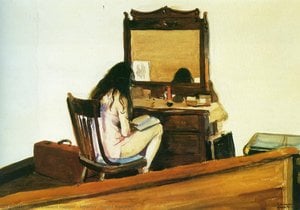
Edward Hopper's untitled (512) is a masterclass in understated emotional power. This painting, representative of his mature style, doesn’t shout for attention; it whispers, inviting prolonged contemplation and offering a poignant glimpse into the inner life of modern America.
The composition centers on a solitary woman seated in what appears to be a private interior – perhaps a bedroom or sitting room. Dressed in a vibrant red dress, she immediately commands the viewer’s attention, yet her downward gaze and crossed legs suggest inward reflection rather than outward engagement. Hopper deliberately limits the surrounding details: a window draped with green curtains, simple furniture, and a stark white wall. This sparseness isn't emptiness; it’s a carefully constructed space designed to amplify the woman’s solitude and psychological state. The arrangement feels less like a narrative scene and more like a captured moment – a fleeting instance of quietude.
Hopper's style is rooted in American Realism, but transcends mere representation. He wasn’t interested in simply *recording* what he saw; he sought to distill reality, emphasizing form and light to evoke specific feelings. His meticulous attention to detail – the texture of fabrics, subtle shifts in shadow, and precise architectural rendering – creates a palpable sense of presence. The dramatic interplay of light and dark isn’t merely aesthetic; it serves to highlight the woman as the focal point while simultaneously emphasizing her isolation within the space. Hopper's brushwork is smooth and controlled, contributing to the painting’s overall mood of stillness and introspection.
Born in 1882, Edward Hopper lived through a period of immense social and industrial transformation in America. While influenced by French Impressionists like Édouard Manet and Edgar Degas – particularly their depictions of modern life – he rejected their emphasis on fleeting impressions. Instead, Hopper sought to create enduring images charged with psychological weight. His work often reflects the alienation and loneliness experienced by individuals within rapidly urbanizing environments. Though the exact date of untitled (512) is unknown, it aligns with his mature period, a time when he was actively exploring themes of isolation and the complexities of modern existence.
untitled (512) isn’t about *what* is happening; it's about how it feels. The painting evokes a profound sense of quiet melancholy and introspection. The woman’s averted gaze invites viewers to project their own thoughts and emotions onto her, fostering a deeply personal connection with the artwork. Is she weary? Reflective? Sad? Hopper deliberately leaves the narrative open-ended, allowing for multiple interpretations. The red dress, a bold splash of color in an otherwise subdued palette, could symbolize passion, vulnerability, or even a sense of being exposed. The window, often interpreted as a symbol of hope or escape, here seems to offer little solace, framing the woman within her internal world.
This painting’s subdued color palette and introspective mood make it exceptionally versatile for various interior settings:
To best showcase untitled (512) consider the following:
untitled (512) is more than just a painting; it’s an invitation to pause, reflect, and connect with the universal human experience of solitude. It's a timeless piece that continues to resonate deeply with audiences today, offering a powerful reminder of the beauty and complexity of the inner life.
The color harmony of "untitled (512)" is recorded as softly mixed palette.
Regarding copyright, "untitled (512)" is still protected by copyright.
"untitled (512)" is suggested for accent, and the recommended space is a hotel room.


1931 - 1967 , United States of America

Explore the profound beauty of American Realism. From Winslow Homer’s rural landscapes to the dignity of everyday life, discover how master artists captured the soul of a nation through evocative oil paintings and timeless fine art techniques.

 Preview
 Send
Send Share
Share
 Details
 Guide
Guide

 Download
 Similars
 X-Ray
X-Ray Diaporama
 Stats
Stats

 Read More









 Glass option is only available in size under 110 CM