The artwork displayed on this page is protected by copyright law, which means we cannot legally create or sell an identical reproduction. This protection is enforced under international agreements such as the Berne Convention and by national laws, including those outlined by the U.S. Copyright Law - Title 17.
This method fully complies with copyright regulations because it does not involve copying or duplicating the protected artwork. Instead, it is a creative reinterpretation - a new painting that is influenced by the original but not identical to it.
Museum-quality giclée or canvas print with fast production and flexible finish options. ( Buy Hand Made Painting Switch to Digital Image)





























Pick from our preset sizes that match the artwork's original proportions.

Type the width and the height you need, to fit your frame or your wall. A print can only be cut, never made bigger than the picture, so a size with a different shape loses a part of the image. We send you a digital mockup to approve before we print anything. The picture shown on this page does not show the real cut — only the mockup does.
Worldwide Delivery () in 2 weeks instead of standard 4/5 weeks. (9 November)
untitled (3371)
Reproduction Size
Edward Hopper (1882-1967), born in Nyack, New York, stands as one of the most recognizable figures in American art history. His artistic journey began with a grounding in commercial illustration—a pragmatic path suggested by his parents—yet Hopper swiftly gravitated toward fine art, enrolling at the New York School of Art under William Merritt Chase and Robert Henri.
These formative influences profoundly shaped Hopper’s artistic vision. Chase instilled technical proficiency, while Henri championed expressive realism—a commitment to portraying the world with unflinching honesty. This dedication to capturing the essence of human experience is evident throughout his extensive body of work, cementing his reputation as a chronicler of modern life.
Hopper's distinctive style—characterized by stark contrasts of light and dark, simplified forms, and an almost photographic precision—became synonymous with the mood of the era. He eschewed grand narratives or overtly dramatic gestures, instead focusing on capturing fleeting moments of everyday existence—a deliberate choice that underscores his belief in the power of observation.
Hopper's technique was meticulously honed through years of practice. He favored a restrained palette, primarily utilizing shades of gray and white—a stylistic decision that heightened the impact of his compositions. The artist skillfully manipulated light to sculpt forms and create depth within the canvas, emphasizing the interplay between illumination and darkness.
Detailed brushstrokes—often subtly textured—were employed to render surfaces with remarkable accuracy, capturing the subtle nuances of material texture. This meticulous attention to detail contributes significantly to the artwork’s overall realism and reinforces Hopper's commitment to portraying the world as he perceived it.
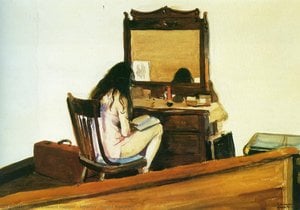
"untitled (3371)" by Edward Hopper is classified as wall art. The category describes the kind of artwork the original is.
"untitled (3371)" shares with Edward Hopper's other works its American Realism style and the recorded themes: realist observation, existential isolation, domestic atmosphere, urban landscape echoes, hopper’s signature style.
Within the American Realism movement, "untitled (3371)" is recorded with a melancholic tone.

1931 - 1967 , United States of America

Elevate your most cherished memories with WahooArt’s bespoke service. We transform your personal photos into breathtaking, hand-painted black & white oil masterpieces. Experience museum-quality craftsmanship and timeless elegance for your private collection. Discover the art of legacy.
 Preview
 Send
Send Share
Share
 Details
 Guide
Guide

 Download
 Similars
 X-Ray
X-Ray Diaporama
 Q&A
Q&A
 Stats
Stats
 Read More









 Glass option is only available in size under 110 CM